Bridge of Apollo

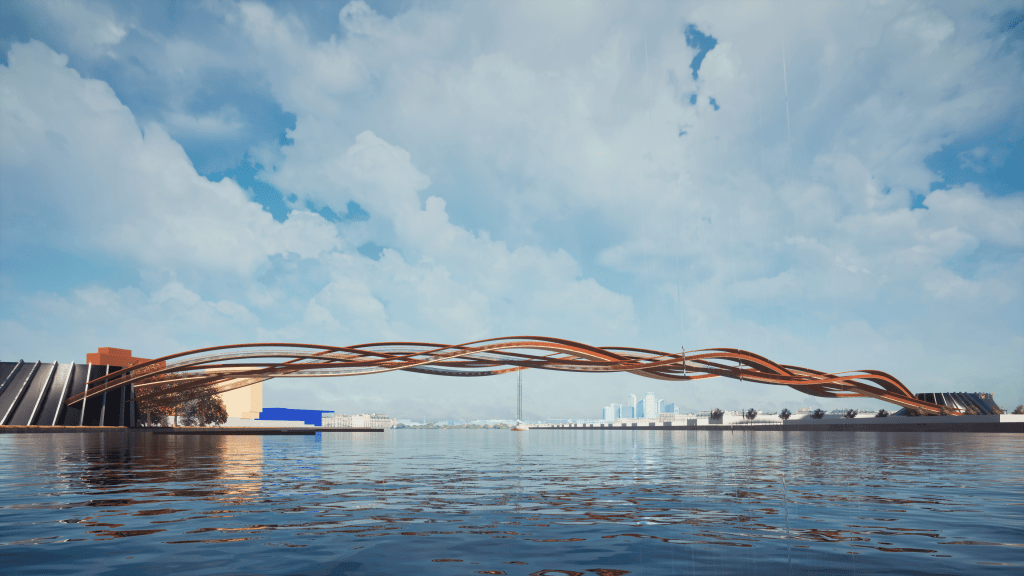
A cycling and pedestrian bridge proposed in Amsterdam, The Netherlands, in 2021 as a competition entry. Conceived as a piece of mobility infrastructure, it examines how collective movement across water can be structured as a calibrated spatial sequence rather than a neutral crossing. The project positions infrastructure as an instrument of orientation, rhythm, and civic presence within the urban fabric.
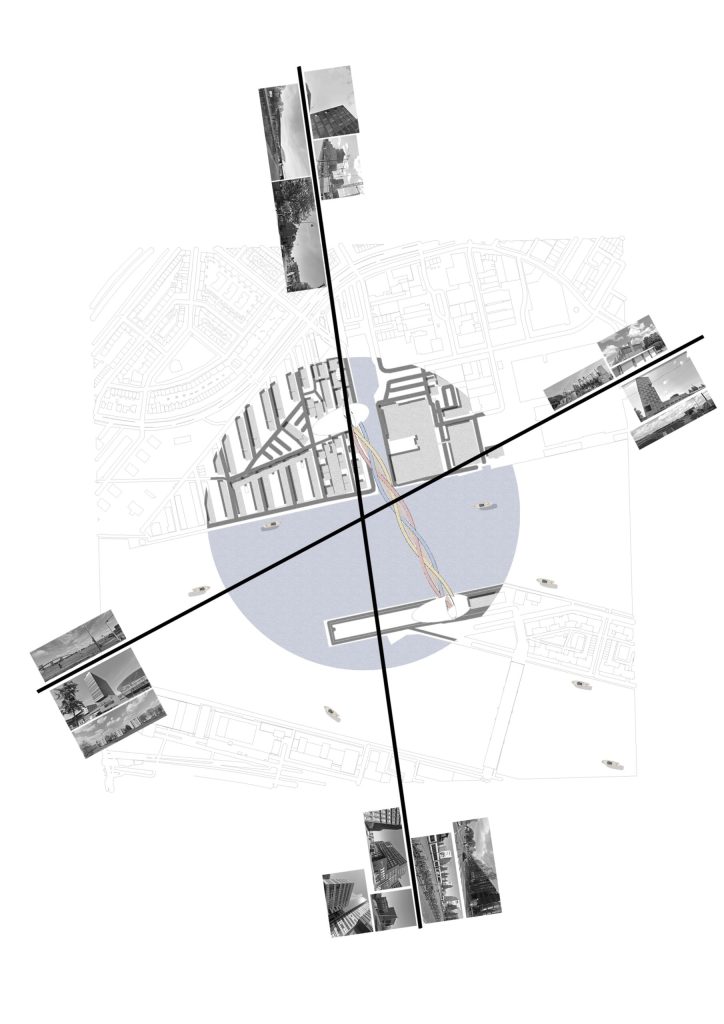
Amsterdam’s urban fabric is defined by water corridors, cycling density, and continuous pedestrian movement. Any new crossing must address high daily traffic while maintaining visual continuity across canals and adjacent streets. The flat topography amplifies horizontal sightlines, making structural interruption immediately visible within the city’s layered historic context.
Location: Amsterdam, The Netherlands
Year: 2021
Area: Not specified
Status: Conceptual / Competition
Category: Mobility Design / Public Infrastructure
Design Style: Experimental, movement-driven formal logic
Client: Competition
Scope: Architectural and conceptual bridge design
Services: Concept development, spatial planning, structural coordination, digital modeling
The site demanded a structure that could handle collective movement without creating congestion at entry points. It also required a clear spatial logic that would orient cyclists and pedestrians intuitively, minimizing conflict between different speeds of movement. The bridge therefore had to operate simultaneously as infrastructure, threshold, and public space.
The concept originates from movement rather than form. Cycling in Amsterdam functions as a collective ritual embedded in daily life. The project translates this behavioral pattern into a continuous spatial loop that frames passage as sequence.
The reference to Apollo is not decorative but conceptual. Apollo represents order, rhythm, and calibrated harmony. These principles informed the geometric logic of the bridge. Curvature was introduced to regulate speed, extend visual perspectives, and create a layered experience of crossing rather than a direct linear transit.

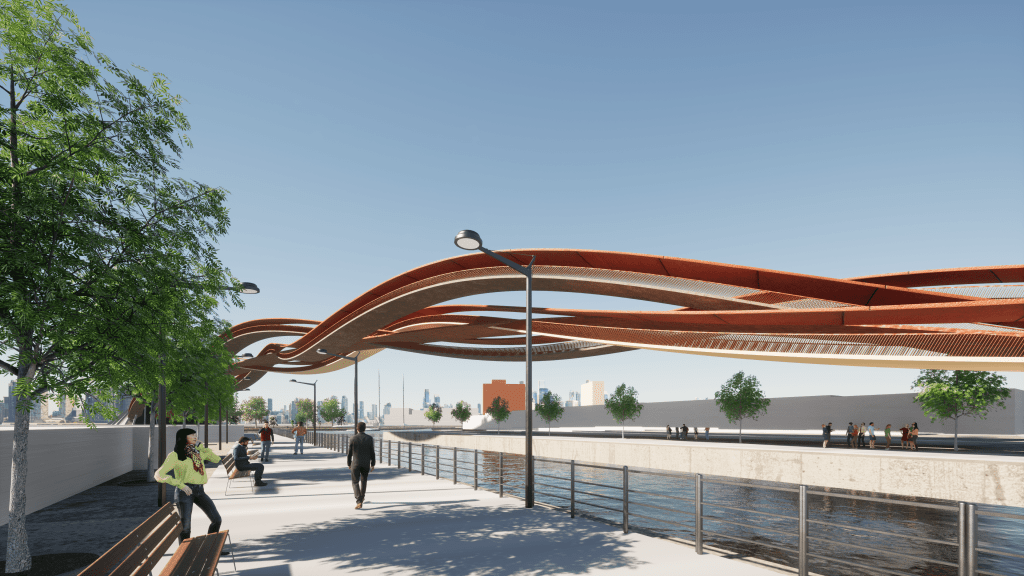
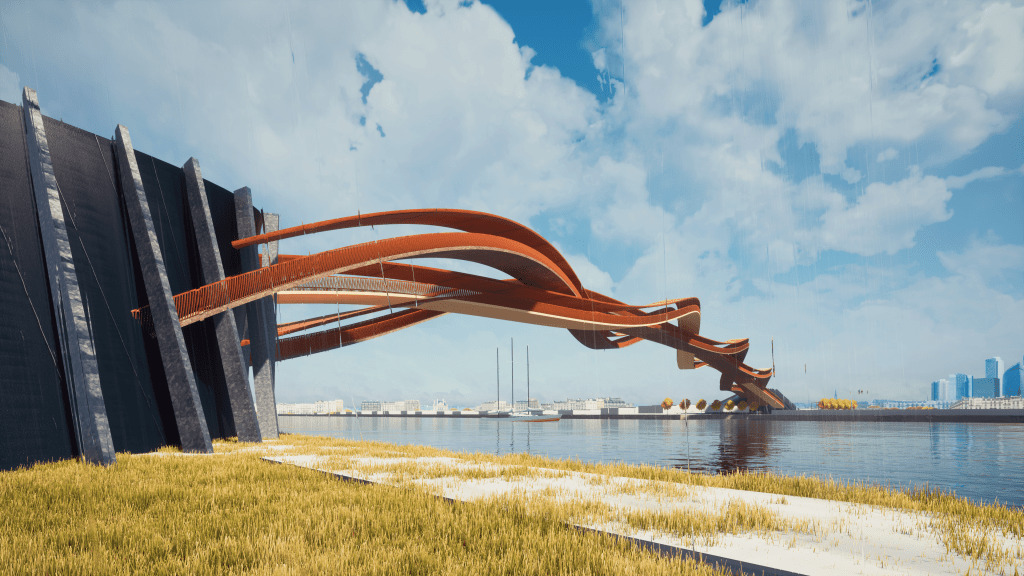
The massing developed as a series of controlled arcs rather than a single straight span. This curvature distributes structural forces while simultaneously elongating the user’s perception of distance, reducing the abruptness of arrival on either side. Each curve resolves both structural efficiency and experiential continuity.
Circulation paths were separated through subtle level differentiation. Cyclists follow a primary flowing trajectory with consistent slope gradients to maintain momentum, while pedestrians occupy widened zones along the outer edge. This separation reduces friction between movement speeds without relying on barriers.
The structural system was conceived as a repetitive rhythmic frame, echoing the idea of harmonic order. The repetition provides clarity and constructability while reinforcing the continuity of motion. Voids between structural members allow filtered light to penetrate the deck, creating shifting patterns that register time and movement.
Material selection was guided by durability and clarity. A restrained palette supports legibility of structure and reduces maintenance demands within a humid canal environment. The bridge reads as a cohesive element within the urban fabric rather than an applied object.
The bridge geometry was calibrated to maintain accessible slope ratios for cyclists and pedestrians, ensuring inclusive use. The curved alignment also mitigates wind acceleration across the deck, a common issue in exposed canal crossings.
Structural depth was minimized to preserve waterway clearance while maintaining load-bearing capacity for peak cycling volumes. Drainage channels were integrated within the deck profile to prevent water accumulation, addressing Amsterdam’s frequent rainfall and protecting surface safety.
As a competition proposal, the project required coordination between architectural intent and structural feasibility at concept stage. Digital modeling tools were used to test curvature, span efficiency, and circulation width under projected user loads.
The complexity lay in balancing expressive geometry with buildable logic. Each formal move was evaluated against structural rationality and maintenance considerations to ensure the concept could transition into a viable construction framework.
The Bridge of Apollo reconsiders the canal crossing as a structured sequence of collective movement. By deriving its form from rhythm, slope calibration, and circulation logic, the project integrates infrastructure into the daily patterns of Amsterdam’s cyclists and pedestrians. It frames mobility as a continuous civic act, reinforcing continuity within the city’s water-defined context.