
Joharji Hotel
High-density pilgrimage accommodation in Al Shisha District, Makkah, Saudi Arabia, completed in 2011. The Joharji Hotel Tower was conceived as an urban infill response to peak Hajj demand, where hospitality must operate under extreme temporal and spatial pressure. Its relevance lies in calibrating collective movement, operational efficiency, and cultural orientation within a constrained urban fabric.
Location: Al Shisha District, Makkah, Saudi Arabia
Year: 2011
Area: 12,346 m²
Status: Completed
Category: Architecture / Hospitality / Urban Infill
Design Style: Contemporary / Sustainable / Pilgrimage-Oriented
Client: Joharji Hotel
Scope: Full architectural design and site supervision
Services: Concept design, architectural development, construction documentation, coordination, project supervision
The project occupies a corner plot with three open elevations along King Fahd Road in Al Shisha, an area defined by dense mid-rise hospitality buildings serving seasonal pilgrimage flows. Notably, Joharji Hotel Tower maximizes program integration within limited land while maintaining clear access for buses, service vehicles, and pedestrian groups.
Makkah’s climate required mitigation of solar exposure and heat gain, particularly on west-facing elevations. At the same time, the urban fabric imposed continuity in scale and alignment to preserve the collective rhythm of surrounding hotels. The building, like the Joharji Hotel Tower, had to respond to two simultaneous pressures: extreme peak occupancy during Hajj and reduced but steady use during the off-season. This dual condition shaped the spatial logic from the outset.
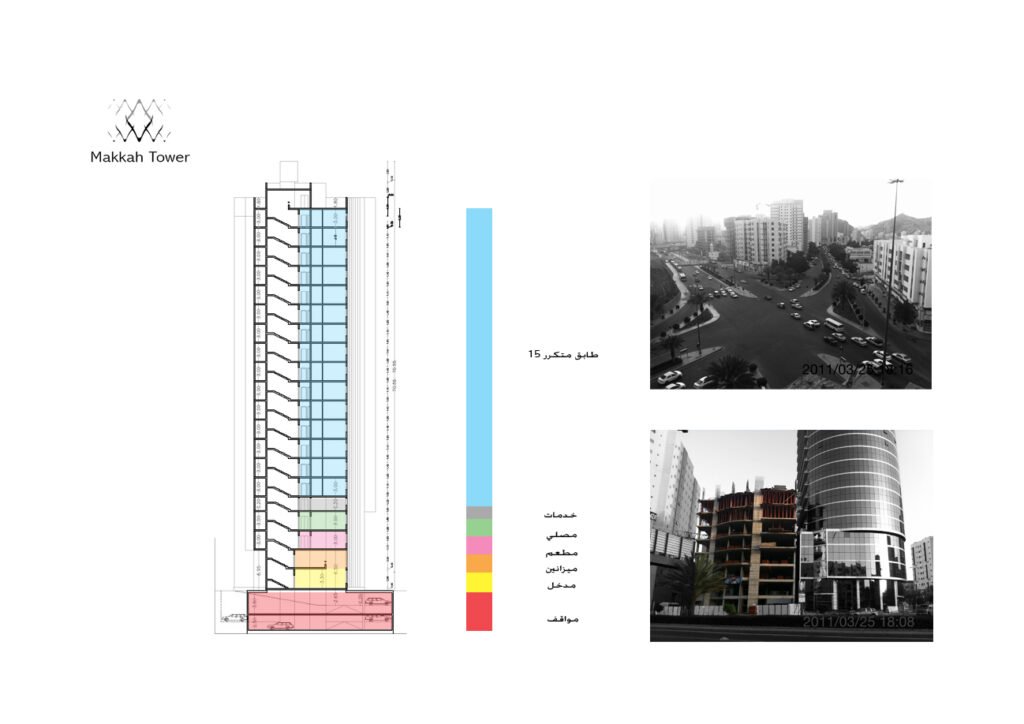
Program distribution and urban context documented during construction phase reflecting operational logic and civic presence © INJ

Vertical lattice facade moderates light while the tower anchors a broad roadway framed by palms and neighboring blocks © INJ
The concept emerged from studying collective movement under time pressure. Pilgrimage hospitality operates as a synchronized system where arrival, vertical transport, room access, and departure occur in concentrated cycles.
The tower was therefore conceived as a vertical circulation framework with rooms organized as efficient modules around it. The primary design driver was not façade expression but movement clarity. Orientation toward the street corner established civic presence, while internal planning prioritized direct, legible thresholds between lobby, elevators, and accommodation levels. In short, every decision in Joharji Hotel Tower aimed to reduce friction in collective flow while maintaining spatial dignity.
The massing rises directly from the plot boundaries to maintain urban continuity, with calibrated setbacks responding to street alignment and light access. The corner condition was emphasized volumetrically to anchor the intersection and clarify entry.

Identity mark combining bilingual typography and geometric ornament expressing institutional clarity and cultural reference © INJ

Vertical lattice facade moderates light while the tower anchors a broad roadway framed by palms and neighboring blocks © INJ
The 220 rooms are distributed across upper levels in repetitive modules ranging from 20 m² studios to 36 m² guest rooms. This modular repetition allowed structural regularity and construction speed while ensuring operational flexibility between peak and standard occupancy. Corridors are organized along a clear central spine, minimizing travel distance and simplifying wayfinding during high-load periods.
Vertical circulation was treated as core infrastructure. Elevator capacity and stair placement were calculated according to peak pilgrim flow, reducing waiting time and preventing congestion at transitional thresholds. The lobby sequence was compressed but legible, allowing group check-ins without disrupting circulation continuity.
The façade logic is based on controlled openings and rhythmic vertical elements. Window proportions were calibrated to balance daylight admission with thermal control. The envelope reads as a disciplined grid because repetition reduces construction complexity and reinforces structural clarity.

Layered textures and controlled lighting create intimate scale within compact hospitality accommodation © INJ

Reception and lounge unfold in a continuous field shaped by light, surface relief, and measured circulation © INJ
Material selection prioritized durability and ease of maintenance due to intensive seasonal use. Interior finishes were chosen for resistance to wear while maintaining a neutral atmosphere suitable for diverse cultural backgrounds.
Thermal performance guided façade orientation and opening size. West-facing exposure was mitigated through controlled glazing ratios and shading strategies to reduce solar gain. Compact massing minimized surface area relative to volume, improving energy efficiency.
Mechanical systems were designed for rapid response to occupancy spikes, ensuring air quality and thermal comfort during peak periods. Fire safety and evacuation routes were modeled to comply with national and international standards, with stairwells positioned for direct and unobstructed access from all corridors.

Repetition of circular tables and suspended fixtures establishes rhythm across a bright communal dining space © INJ
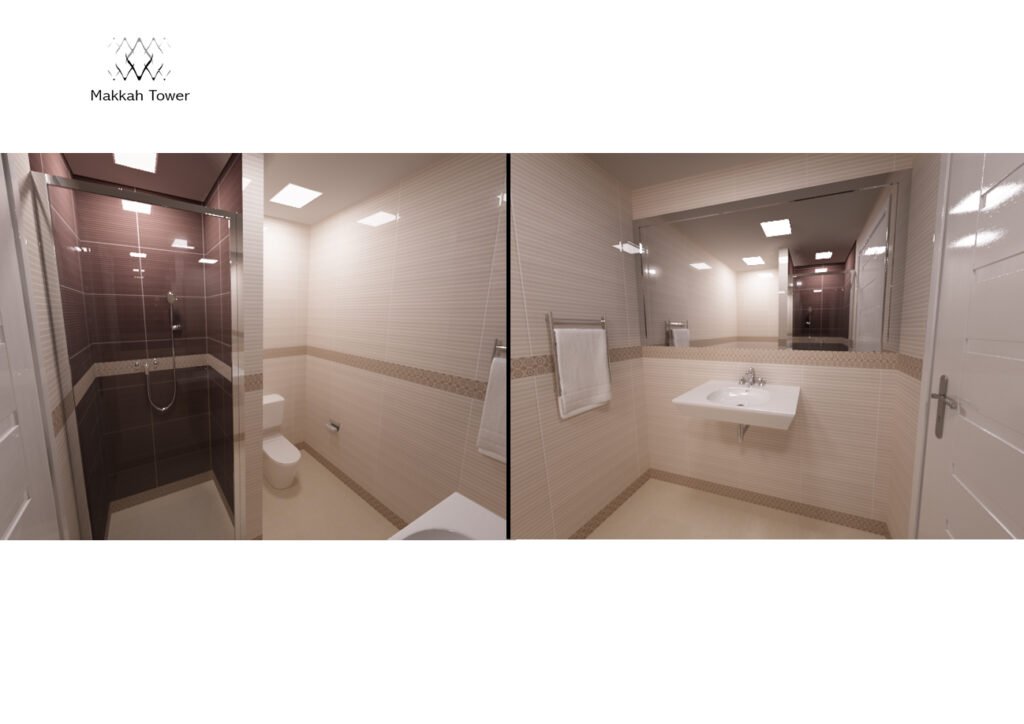
Neutral tiles and transparent partitions define a compact bathing area with practical clarity © INJ
Structural logic relied on a regular grid to accelerate construction and coordinate with repetitive room modules. This integration between structure and program reduced material waste and shortened execution time.
The project was completed within five months, including a four-month design phase and three months of structural execution. This compressed timeline required precise coordination between architectural, structural, and mechanical disciplines.
Construction was phased to allow early operational readiness. The first phase delivered essential infrastructure and primary accommodation levels to receive pilgrims without delay. The second phase focused on refined finishes and final calibrations. Continuous site supervision ensured continuity between concept and built outcome, particularly in circulation efficiency and façade performance.
Joharji Hotel Tower addresses the realities of pilgrimage hospitality through disciplined spatial logic and calibrated urban integration. In a city where collective movement defines architecture, the building functions as an organized system rather than an isolated object. Indeed, Joharji Hotel Tower’s value lies in transforming density, time pressure, and climatic constraint into a coherent framework of clarity, continuity, and operational dignity within Makkah’s evolving urban fabric.