
Sea Home
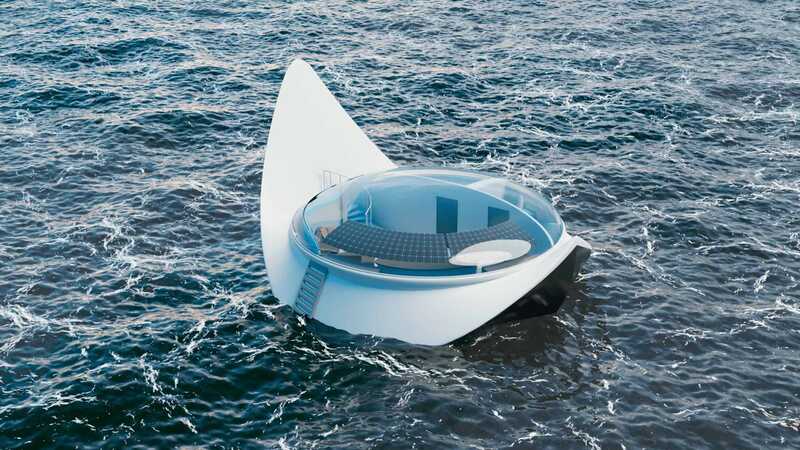
Set along the Red Sea Coast in Saudi Arabia, Sea Home is a conceptual residential proposal that studies how habitation can be reorganized when water becomes the primary site condition. Developed as a research-led housing model, the project addresses isolation, exposure, and environmental response through a floating residential typology calibrated to marine context. Its importance lies in testing a domestic program where orientation, threshold, and continuity are defined by sea, horizon, and movement rather than by conventional land boundaries.
The Red Sea coastline presents a site condition shaped by exposure, salinity, heat, glare, and uninterrupted horizon. In this context, the ground cannot be understood as a stable architectural datum in the conventional sense, since the relationship between dwelling and site is mediated by water, changing light, and marine movement. This demanded a residential response in which structure, orientation, and threshold were all reconsidered as part of an environmental response rather than treated as fixed assumptions.
Location: Red Sea Coast, Saudi Arabia
Year: 2020
Area: 40 m² per unit
Status: Conceptual Design
Category: Residential, Research, Sustainability
Design Style: Modern, Experimental
Client: Not specified
Scope: Concept design for a floating residential unit
Services: Architectural concept design, residential research, spatial development, environmental integration, digital visualization
This architectural question is no longer theoretical in isolation from reality. Demographic and climatic projections indicate that more than 300 million people will be living in coastal zones exposed to annual flooding by 2050, while the population of low-lying coastal areas may exceed one billion by 2060. Approximately 68 percent of the world’s population is expected to live in cities by mid-century, and most major cities are coastal. These figures place architects before an unavoidable question: how is the coast inhabited when water becomes a permanent condition rather than a temporary event?
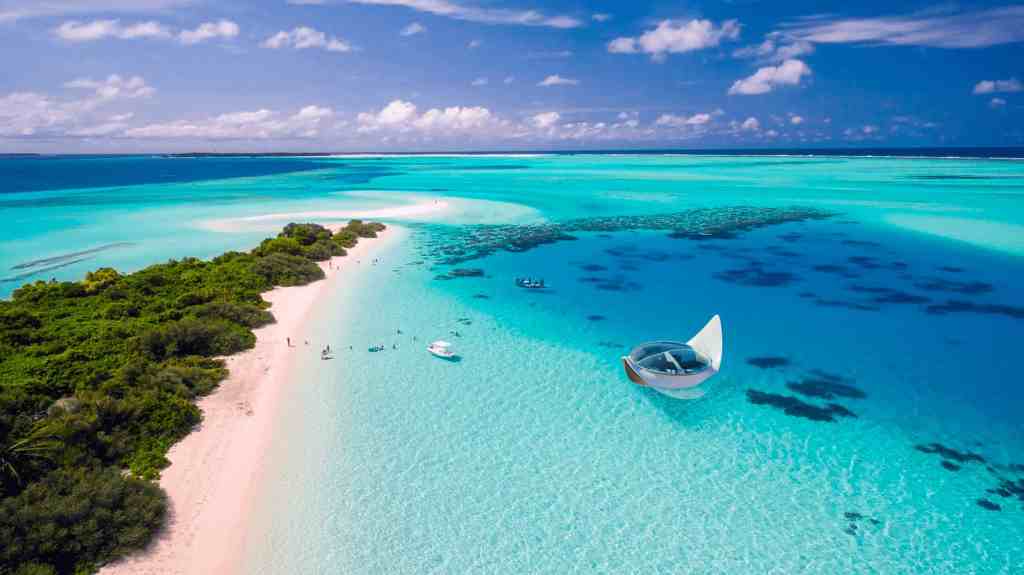
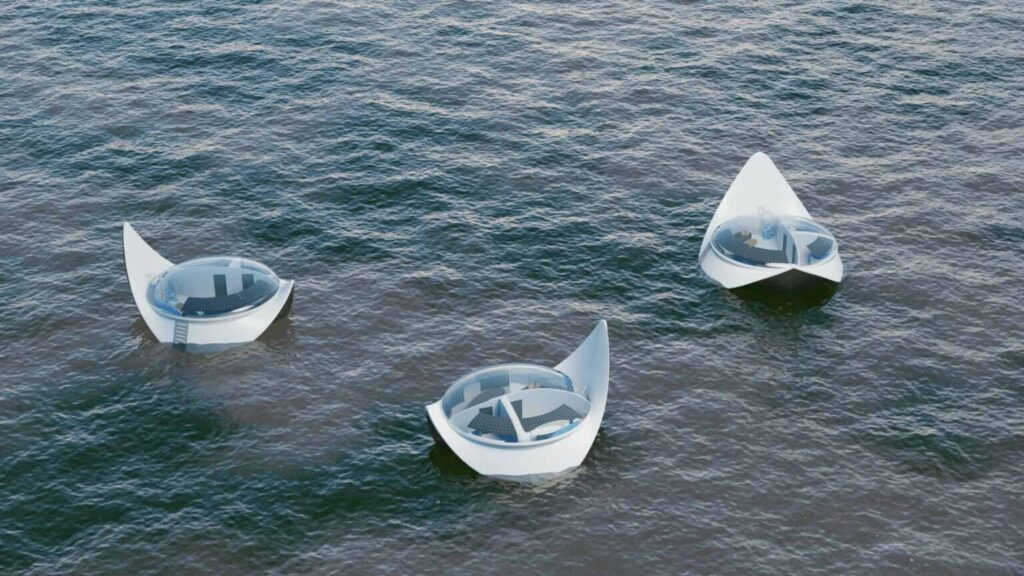
The project also engages a Saudi context where privacy remains a core spatial logic, even within open landscapes. The challenge was therefore not only to secure outward continuity with the sea, but also to calibrate degrees of enclosure, retreat, and controlled visibility within a compact domestic program. The surrounding condition is not urban fabric in the conventional sense, yet the absence of dense context increased the need for internal order, climatic restraint, and clarity of sequence. Isolation here operates both as an opportunity and as a design pressure.
The concept emerged from one primary question: how can a dwelling inhabit the marine horizon without reducing the sea to background scenery. From this, the project was developed as a residential platform in which water acts as an active spatial generator. The concept did not begin with image or silhouette, but with orientation, exposure, and the layered experience of moving from protected interior to open edge.
This idea was translated scenographically through calibrated sequence. Arrival is understood as compression, occupation as gradual release, and outward extension as a controlled dissolution of threshold. The spatial logic is based on layered platforms, panoramic edges, and transitional outdoor surfaces that allow the resident to experience climate, reflection, and distance in stages. Rather than producing a singular object, the concept organizes a continuous dialogue between enclosed program and open marine atmosphere.
The massing was developed as a low, horizontally extended form in order to align the dwelling with the horizon line rather than compete with it. This decision reduced visual interruption, improved orientation toward the sea, and reinforced continuity between built volume and surrounding water. The profile remains controlled because vertical excess would weaken both environmental performance and the intended relationship between inhabitant and landscape.


Spatial sequence was structured through a progression of thresholds. Interior program is anchored in protected zones, while terraces and decks extend habitation outward in measured increments. This layered experience allows movement to unfold gradually, ensuring that openness is earned through sequence rather than given immediately. The result is a domestic arrangement where privacy and exposure remain in balance.
Facade logic was shaped by panoramic orientation and selective enclosure. Openings are positioned to frame long views while maintaining spatial restraint across more vulnerable edges. This calibration supports privacy as a behavioral requirement and reduces unnecessary solar gain. Glazed surfaces are therefore not treated as formal display, but as instruments for light control, visual continuity, and atmospheric integration.
Circulation was organized to strengthen clarity between collective movement and private use. Internal routes remain legible and compact, allowing the residential program to function efficiently within a 250 m² footprint. Outdoor circulation continues this logic by turning decks into inhabitable thresholds rather than residual perimeter space. Movement is used to register environmental change, from sheltered enclosure to open exposure.
The structural expression follows the need for buoyancy, balance, and load clarity. The geometry of the proposal suggests a system in which form is disciplined by support conditions rather than by formal excess. Roof lines and stepped volumes help organize drainage, enclosure, and shading while also clarifying the hierarchy of spaces beneath them.
Material selection, at conceptual level, is guided by durability, reflection control, and restraint. In a marine environment, permanence depends on reducing vulnerability to corrosion, glare, and weathering. The project therefore calls for a restrained material palette capable of supporting long-term environmental response while maintaining clarity of form. This position is consistent with broader global directions in coastal residential design, where saltwater-resistant materials have become a structural prerequisite rather than a finishing consideration.
Climate response is central to the project’s spatial logic. Along the Red Sea, heat gain, strong light, and reflected glare from water create conditions that require calibrated openings, shaded outdoor zones, and controlled depth in the facade. Outdoor decks are not only extensions of use, but also environmental buffers that mediate between direct exposure and enclosed interior space. At a global scale, this approach converges with the principles proposed by nature-based infrastructure strategies, which favor absorbing environmental energy over resisting it. Sea Home translates this principle architecturally through form and spatial sequence rather than through direct natural elements.
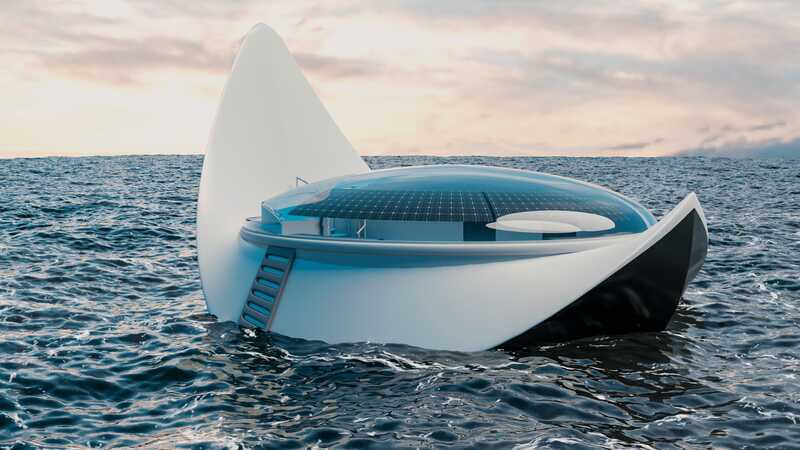
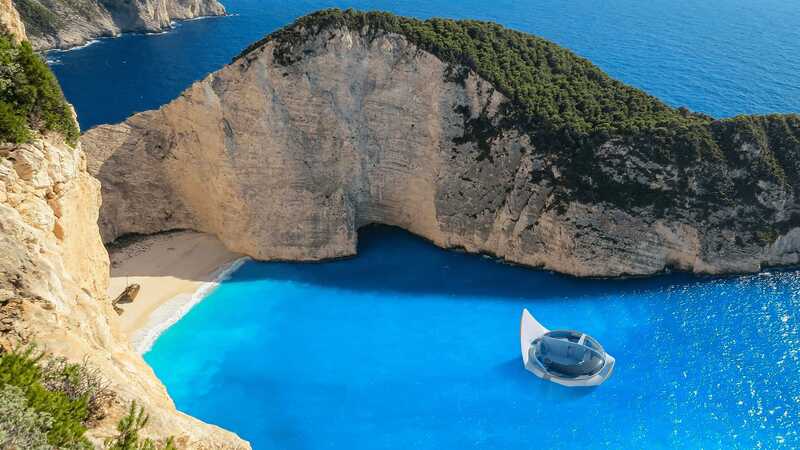
Orientation informed both the arrangement of openings and the placement of inhabited edges. The project privileges views and air movement where possible, while protecting the more sensitive parts of the program from excessive solar exposure. This supports passive thermal performance and improves the atmosphere of interior spaces without relying entirely on mechanical intervention.
As a floating residential concept, the project implies careful consideration of structural stability and marine integration. The distribution of mass, the compactness of the plan, and the continuity of horizontal surfaces all contribute to equilibrium. This structural logic is not unlike that employed by contemporary floating structures, which rely on flexible concrete pontoon systems anchored to the seabed, allowing the building to rise and fall with tidal movement without losing stability. Water here is not simply surrounding scenery but a technical condition that governs how the dwelling is conceived from the outset.
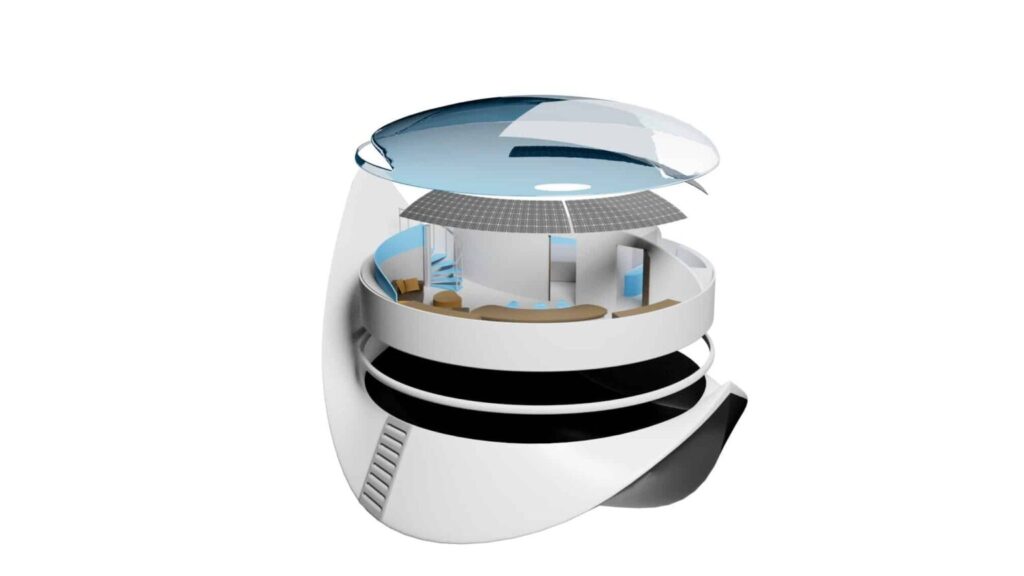
Digital modeling played an important role in examining roof geometry, exterior massing, and the relationship between interior enclosure and external decks. Because the project depends on the layered experience of approach, occupation, and outward extension, scenographic testing through three-dimensional studies was necessary to evaluate rhythm, sequence, and orientation with precision.
Sea Home proposes a residential model in which context is not applied to form after the fact, but used to generate it from the beginning. In light of global data indicating that the coast will cease to be merely a residential option and will become an unavoidable condition for hundreds of millions of people, the project carries significance that extends beyond its conceptual boundaries. By treating water, climate, privacy, and movement as interconnected design drivers, Sea Home builds a clear architectural argument for marine habitation on the Saudi coast, where the dwelling is shaped by environmental response, spatial logic, and a layered experience of living at the threshold between shelter and horizon.