BarJeel Museum

A museum in Sharjah cannot ignore the maritime legacy that defined the emirate’s early economic and cultural prominence. The Barjeel Art Museum proposal rejects static monumentality, drawing its generative logic from the fluid dynamics of the Arabian Gulf and the structural tension of traditional Emirati sailboats. It operates as a contemporary vessel, exporting arts and culture to the urban landscape just as the historic ports did millennia ago.

Location          Sharjah, UAE
Client            Barjeel Art Foundation
Type              Cultural / Museum Architecture
Status            Competition Design
Year              2019
Principal         Ibrahim Nawaf Joharji
Design System     Organic tensile structure, maritime biomimicry
INJ Architects — parametric 3D massing model of a sail-inspired organic canopy in light grey, sweeping upward to a sharp peak and tapering to a low horizontal edge, shown against a white background
Parametric massing study abstracting the Al-Shara sail geometry of a traditional Dhow into a continuous tensile form. © INJ Architects

Translating this heritage into built form requires more than literal representation. The architectural massing abstracts the geometry of the Al-Shara (the primary sail of a traditional Dhow). Positioned along a main urban artery, this sweeping organic volume acts as an active cultural beacon, reintroducing fluid, maritime architecture into Sharjah’s contemporary civic grid. The two-story layout maximizes internal exhibition flow while maintaining a continuous visual connection with the exterior streetscape.
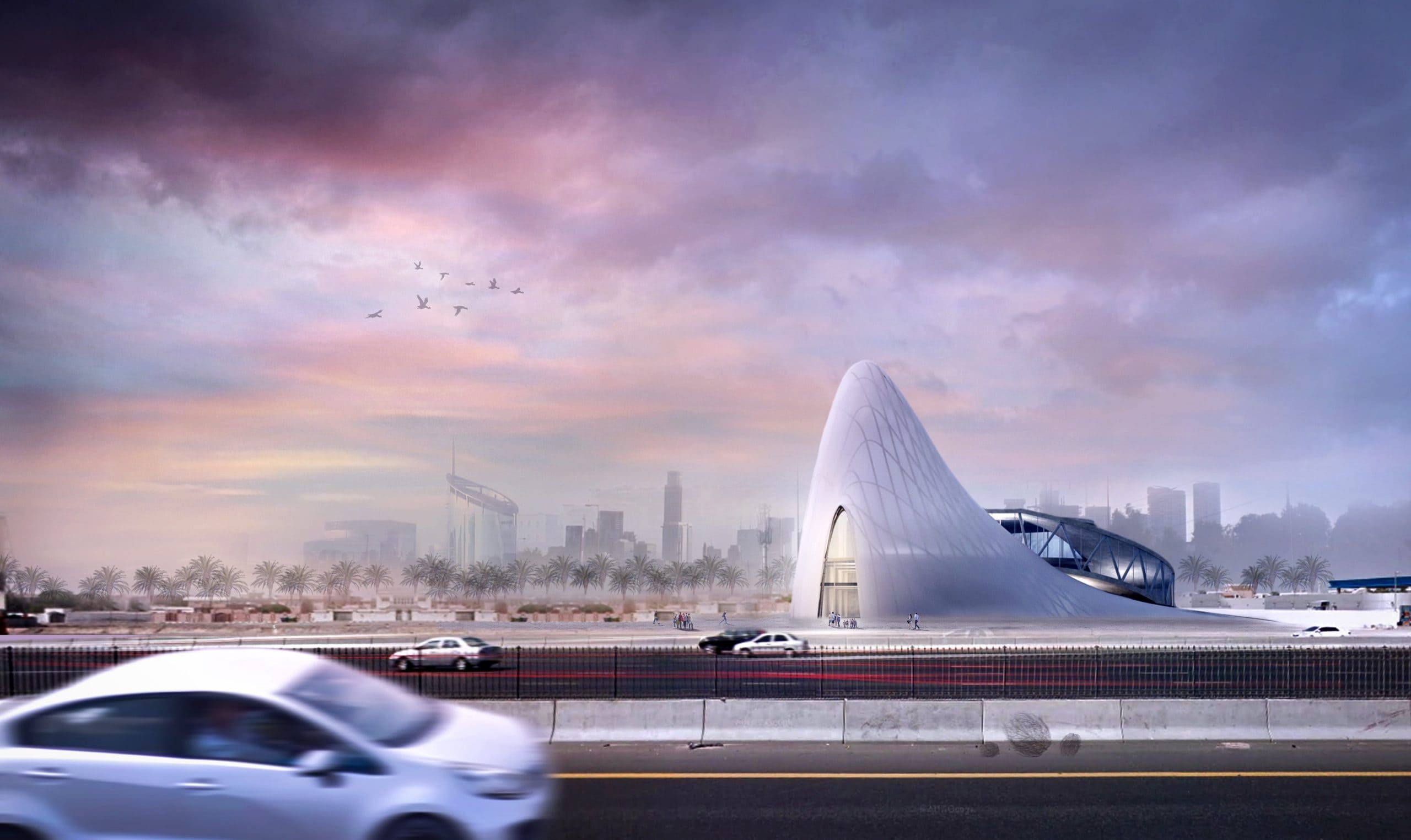
INJ Architects — architectural visualization of Barjeel Art Museum showing a white organic sail-shaped tensile canopy rising above a two-story base, positioned along a major Sharjah highway at dusk with a hazy city skyline and dramatic pink and purple clouds in the background
Exterior visualization of the Barjeel Art Museum viewed from the main urban artery, with the sail-form canopy acting as a civic landmark against the Sharjah skyline. © INJ Architects
INJ Architects — street-level perspective render of Barjeel Art Museum showing a white curved tensile canopy with a golden diagonal lattice exoskeleton, viewed from across a multi-lane highway with motion-blurred red and white vehicles in the foreground and palm trees and urban buildings in the background under a stormy sky
Street-level render revealing the golden diagonal steel exoskeleton beneath the white tensile canopy, framing the museum’s urban presence along the Sharjah highway. © INJ Architects

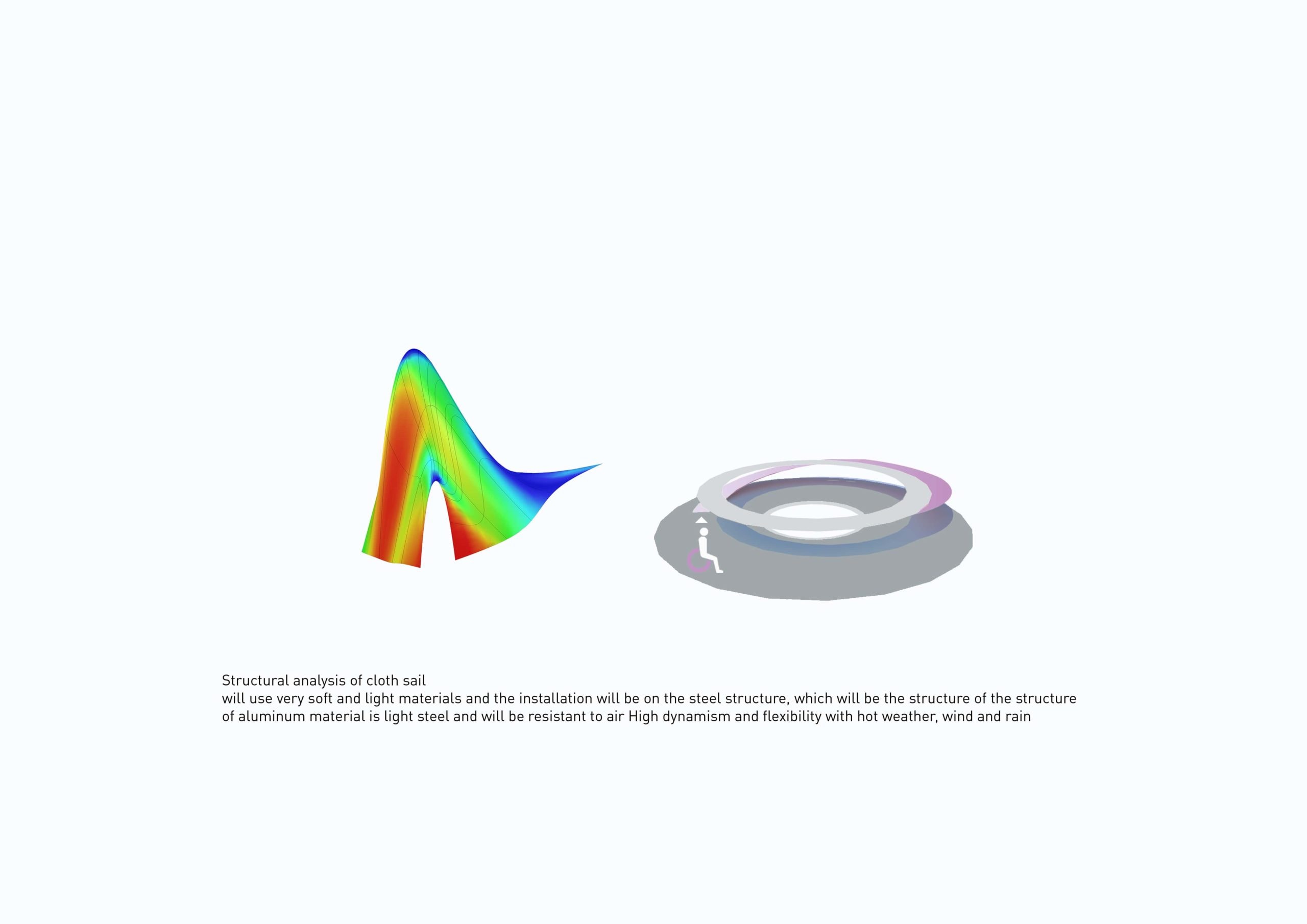
The realization of this organic canopy relies on advanced tensile engineering. The primary envelope is composed of a high-performance, lightweight architectural fabric stretched over a rigid, yet visually weightless, aluminum and light-steel exoskeleton. This material selection is strictly functional: it provides high aerodynamic elasticity to withstand coastal wind shear, manages severe thermal loads, and creates a diffused, naturally illuminated micro-climate ideal for preserving and viewing art.

The Barjeel Art Museum functions as both a protective vessel for regional art and an interactive civic canopy. For a comprehensive breakdown of the structural diagrams and spatial planning, the complete architectural study is available on Behance. This synthesis of cultural history and structural engineering reflects the core methodology outlined in how-we-work. For institutions seeking culturally embedded civic landmarks, the engagement framework is available through bespoke-architecture.

INJ Architects — interior render of Barjeel Art Museum exhibition gallery showing a curved double-height space with a large elliptical skylight above, yellow diagonal structural elements casting light patterns on white walls, a female visitor in the center, and dark sculptural artworks displayed throughout the space
Interior visualization of the main exhibition gallery showing diffused natural light filtering through the elliptical skylight and yellow structural ribs across the curved display space. © INJ Architects
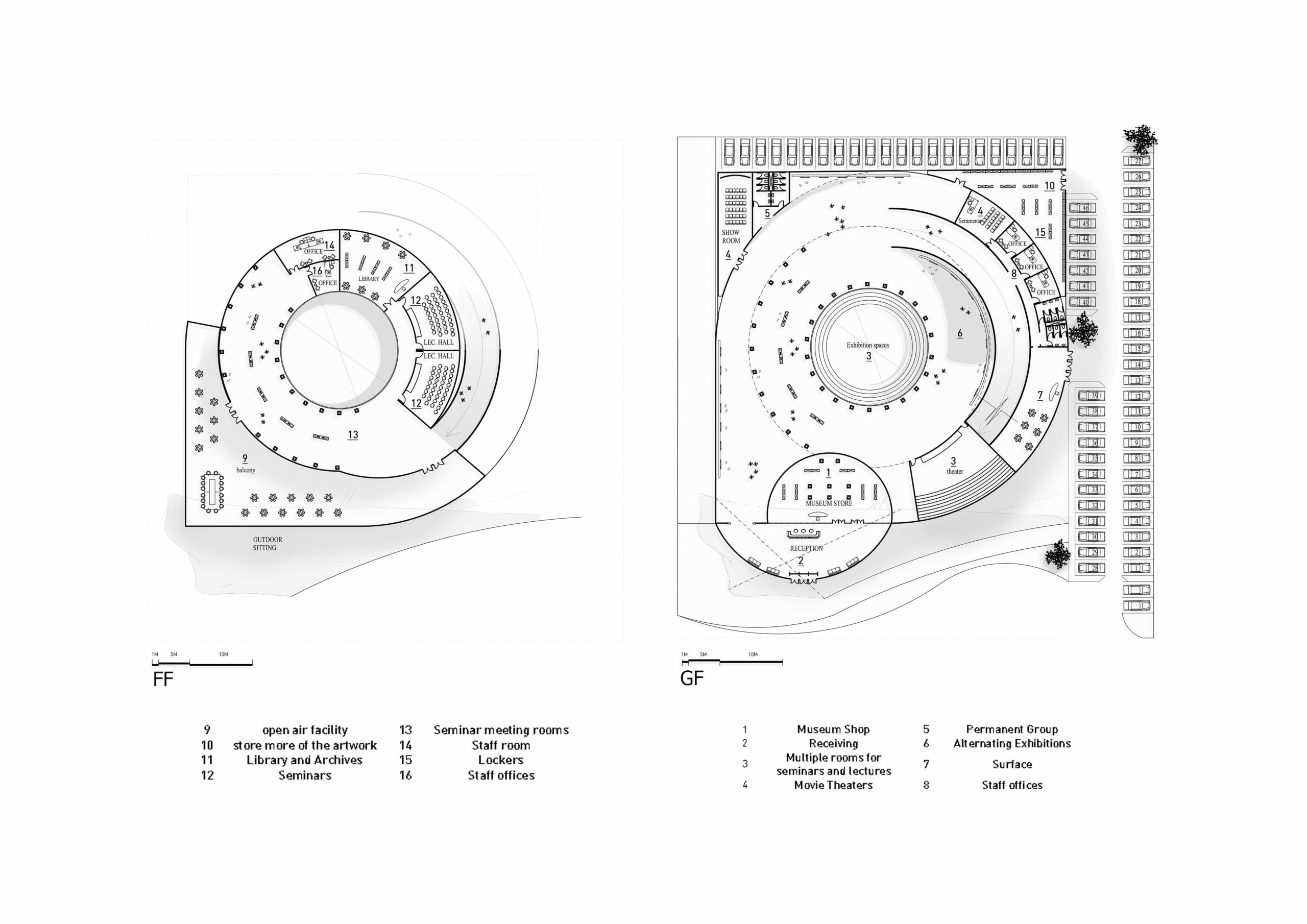
INJ Architects — architectural floor plans of Barjeel Art Museum showing ground floor and first floor layouts with circular exhibition halls, lecture halls, library, seminar rooms, museum shop, reception, theater, and outdoor sitting areas, annotated with numbered legend in black and white
Annotated floor plans of the Barjeel Art Museum showing the radial spatial organization across ground and first floor levels, with clearly defined exhibition, education, and service zones. © INJ Architects
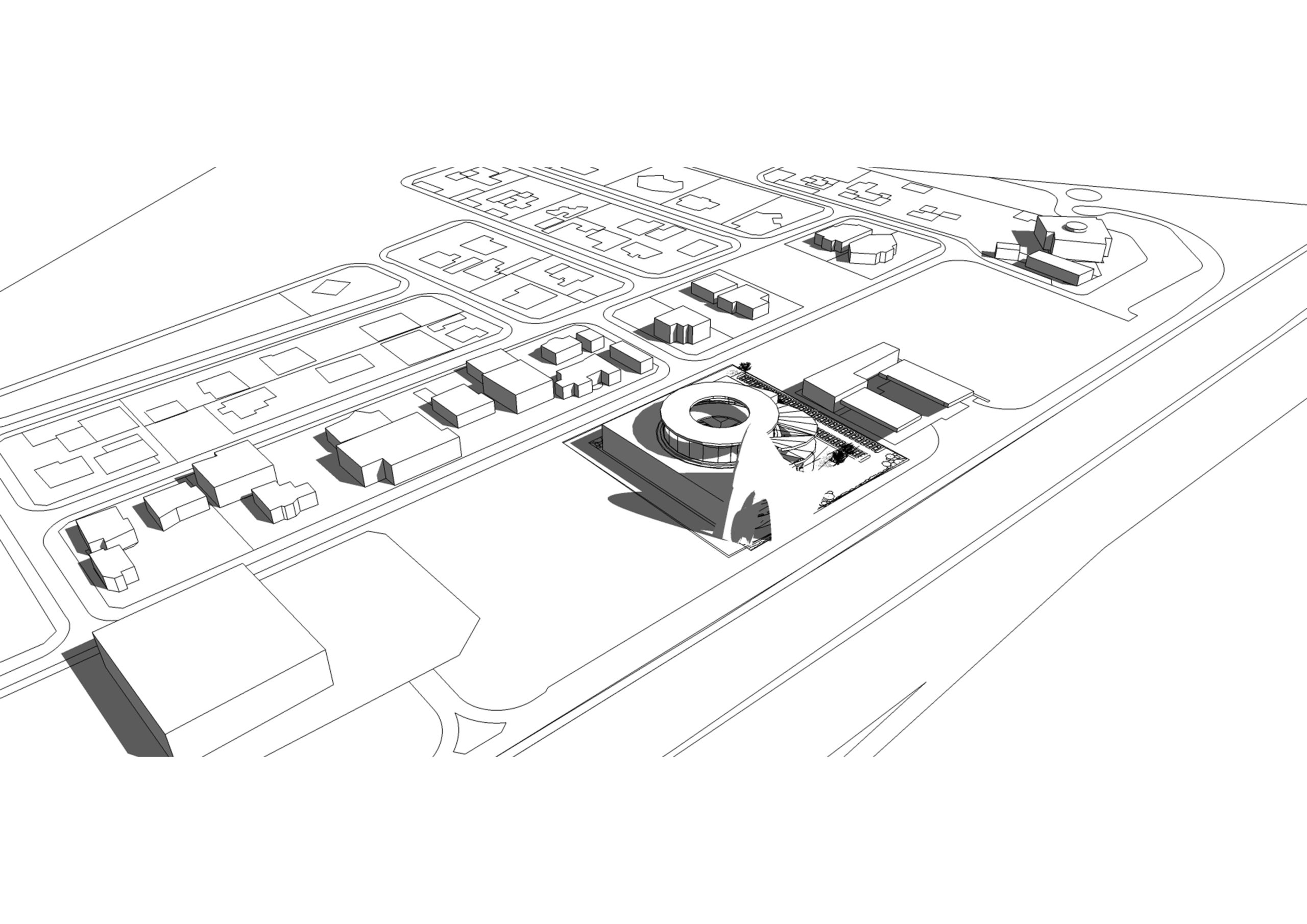
INJ Architects — axonometric site model drawing of Barjeel Art Museum in black and white showing the circular museum building with sail-shaped tensile canopy positioned on a large site plot surrounded by a grid of urban blocks, roads, and surrounding buildings
Axonometric site model illustrating the Barjeel Art Museum’s urban positioning within the Sharjah city grid, with the organic tensile form contrasting the rectilinear surrounding fabric. © INJ Architects
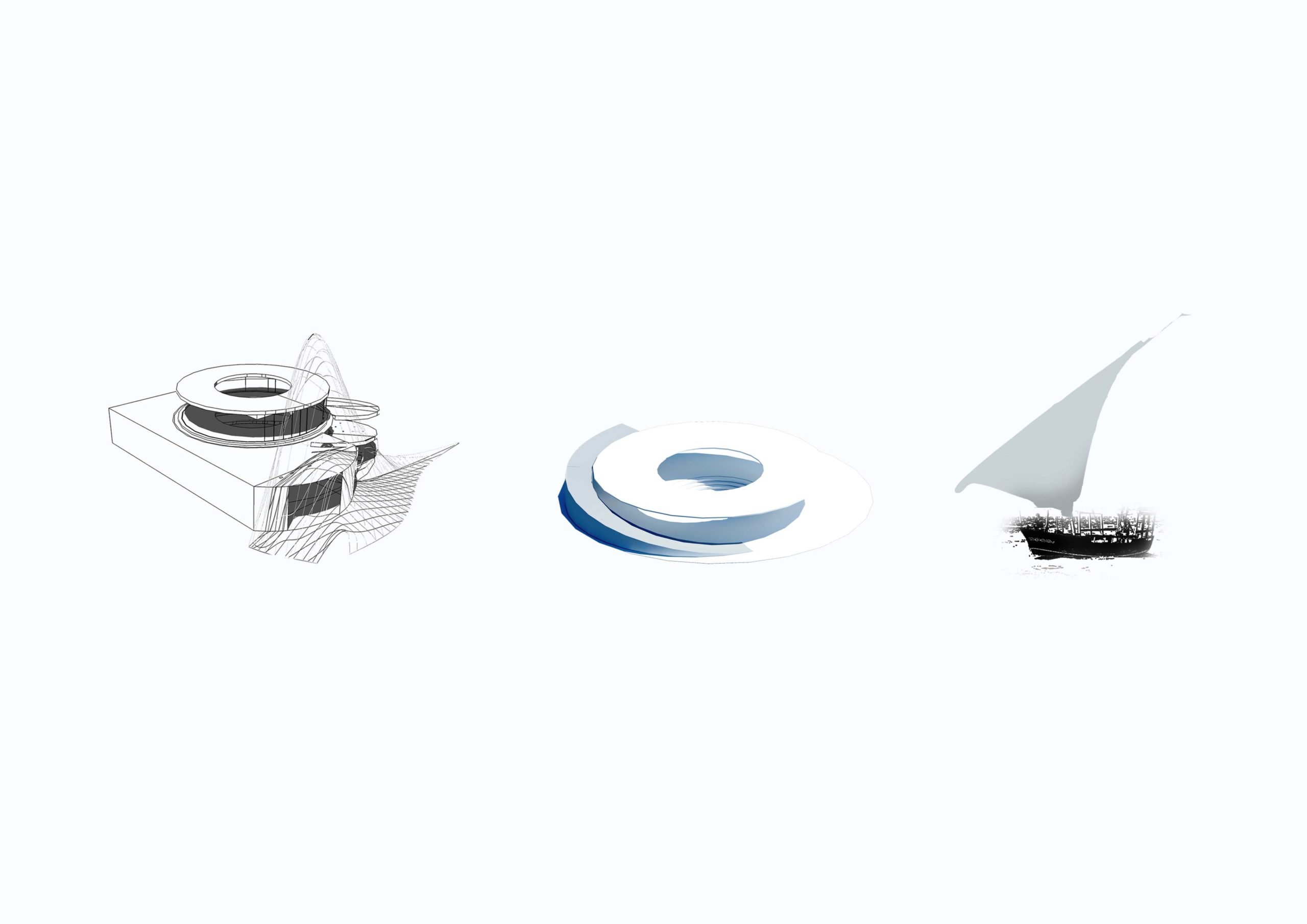
INJ Architects — design concept diagram showing three elements side by side: a wireframe axonometric model of the museum building with tensile canopy lines, a blue and white spiral circular form representing fluid motion, and a silhouette of a traditional Dhow sailboat with a billowing triangular sail
Concept diagram juxtaposing the structural wireframe model, the fluid circular form, and the traditional Dhow sail silhouette to illustrate the three generative layers of the design. © INJ Architects
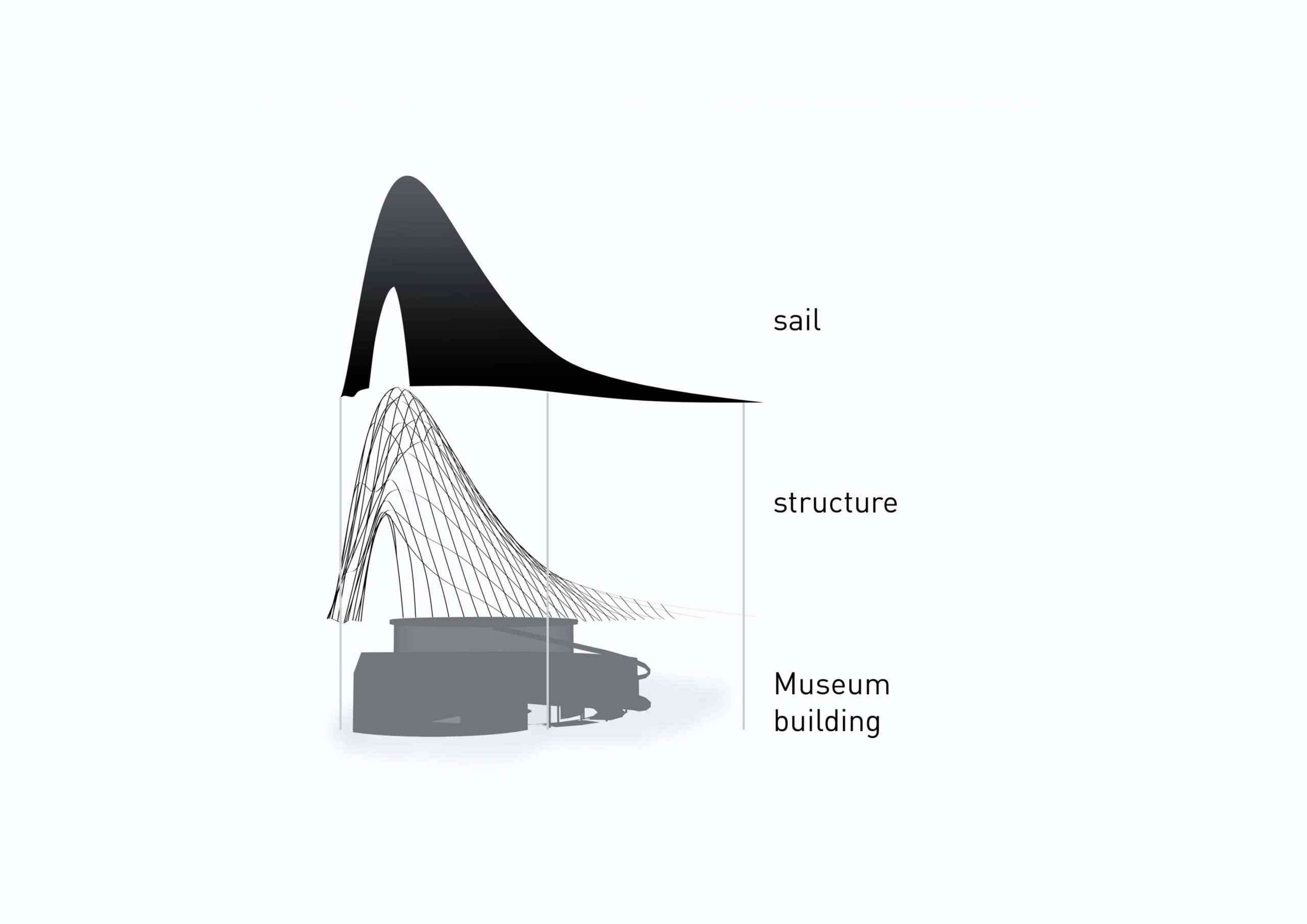
INJ Architects — structural decomposition diagram showing three stacked layers labeled sail, structure, and museum building, with a black silhouette of the Al-Shara sail form at top, a wireframe tensile rib structure in the middle, and a grey cylindrical museum building volume at the bottom
Structural decomposition diagram illustrating the three-layer assembly of the Barjeel Art Museum canopy system, from the sail silhouette through the tensile rib framework to the museum building base. © INJ Architects
INJ Architects — structural analysis diagram showing a heat-map colored parametric sail surface model in red, orange, yellow, and blue tones indicating stress distribution, alongside a grey circular ring base element with a small human figure for scale, with explanatory text below describing lightweight fabric and aluminum steel structural properties
Structural analysis diagram displaying stress distribution across the tensile sail surface using heat-map color coding, alongside the circular base ring element shown at human scale. © INJ Architects