Building departments complex in Yanbu
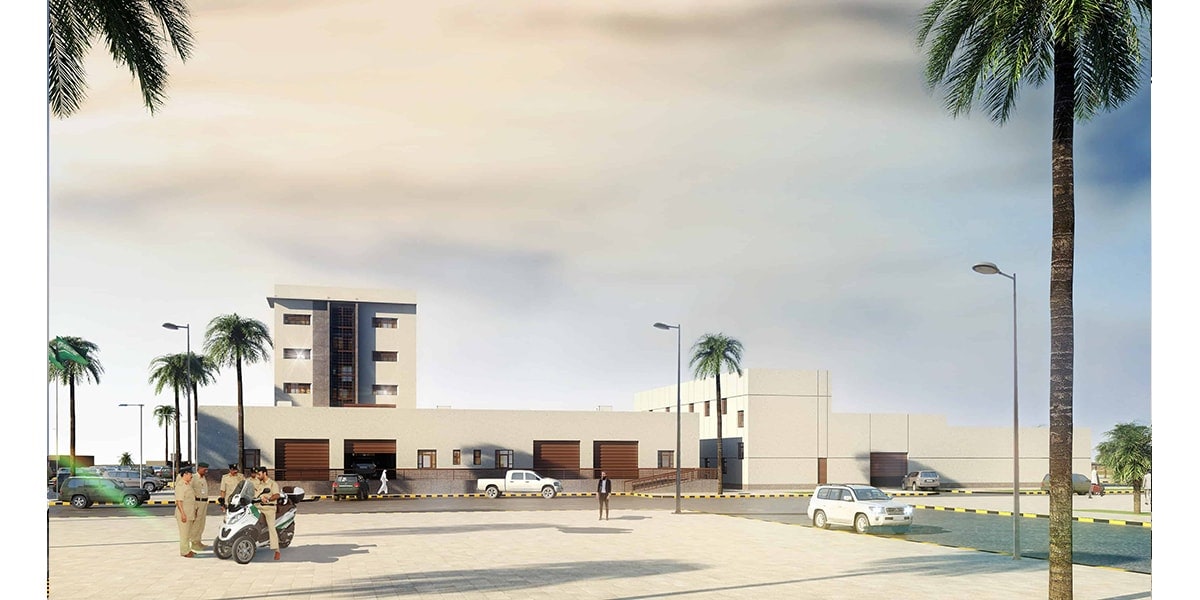
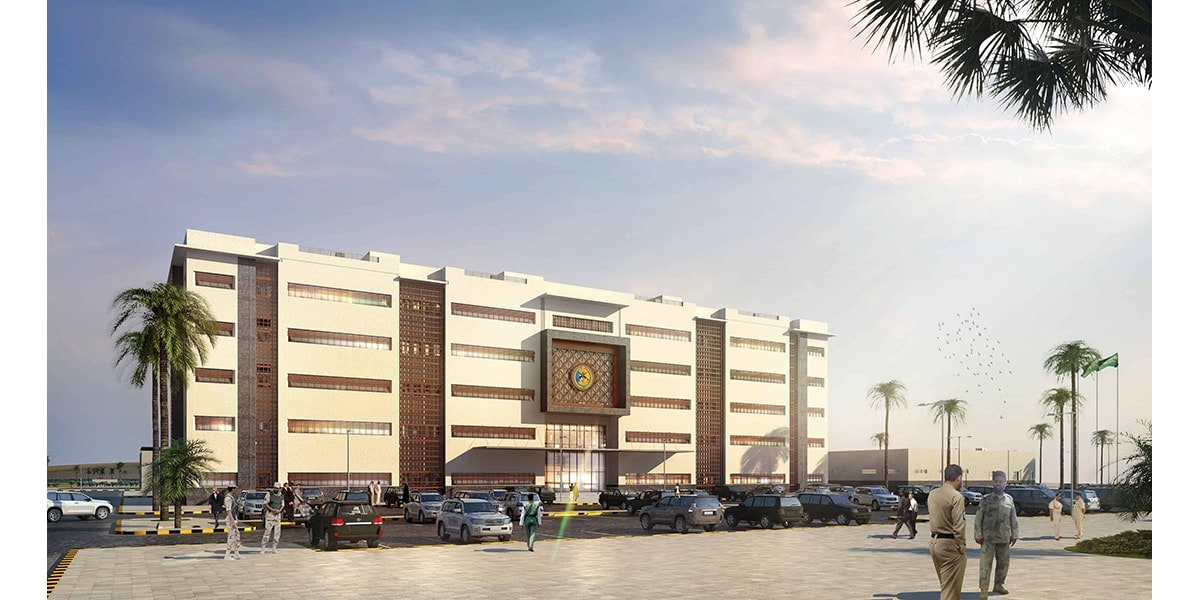
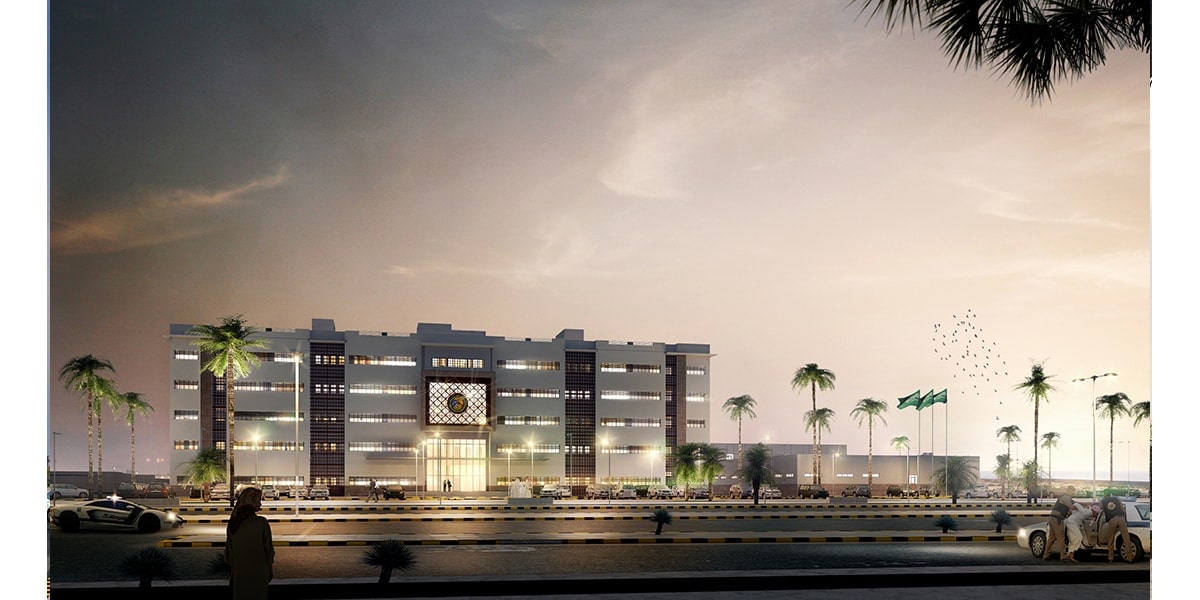
Government architecture at the institutional scale carries a brief unlike any other. It must project stability, organize complex operational programs across multiple building types, and perform its functions without concession to the visual languages that commercial or residential architecture borrows freely. The Yanbu Departments Complex for the Ministry of the Interior operates within this register — a multi-building compound whose architecture serves the daily operational requirements of a major government institution on the Red Sea coast.
The compound forms part of the Ministry of the Interior’s administrative infrastructure in Yanbu, accommodating four major operational departments within a single integrated site: Supply Management, Engineering Management, Transportation, and Maritime Affairs. The scale of the program — 312 employees distributed across a functionally diverse campus — required a planning approach that could hold together substantially different building typologies within a coherent architectural framework. Administrative blocks, operational facilities, warehousing and logistics infrastructure, workshop buildings, and command and control spaces each carry different technical requirements, different circulation logics, and different relationships to the compound’s perimeter and internal movement network. The master plan resolves these differences through a clear hierarchical organization that separates the public-facing administrative register of the compound from its operational interior zones.
Location          Yanbu, Saudi Arabia
Client            Ministry of the Interior
Type              Government Compound — Multi-Building Complex
Capacity          312 employees
Status            Completed - fais 2
Year              2013
Principal         Ibrahim Nawaf Joharji
Scope             Master Planning, Architecture, Interior Design, Local Consultant
The administrative buildings anchor the compound’s primary axis, their facades establishing the institutional character of the complex as a whole. The architectural language draws from the formal vocabulary appropriate to government buildings in the Kingdom — composed, authoritative, and resolved in materials that communicate permanence and institutional weight. The interior design of the administrative floors was developed to support the specific work patterns of each department, with particular attention to the command and control spaces whose operational requirements impose precise spatial and technical conditions on the planning. Reception and public interface zones are separated clearly from the secured interior circulation, the spatial sequence from arrival to access managed through an architectural grammar that communicates authority without requiring signage to do so.
The workshop and warehousing buildings occupy the compound’s service zones, their structural spans and floor loads specified against the equipment and vehicle dimensions that the departments’ operational functions require. These buildings are not architecturally subordinate to the administrative blocks — they are resolved with the same material and spatial discipline, their utilitarian program addressed within a building envelope that maintains the compound’s overall visual coherence. The logistics and transportation infrastructure connecting the compound’s multiple building clusters was planned as part of the architectural brief from the outset, the internal road network and loading areas integrated into the site plan rather than added after the buildings were positioned.
The scale of the site and the diversity of its program place this commission within the practice’s body of work in institutional and government architecture — projects where the architect’s primary obligation is to the operational effectiveness of the institution rather than to the aesthetic preferences of an individual client. The methodology governing this type of large-scale government commission is detailed in how-we-work. For government bodies and public institutions considering architectural consultancy for comparable institutional compounds, the engagement framework is outlined in bespoke-architecture.