Deyar Al Assayla
Five kilometres from the Grand Mosque, Makkah is experienced less as a static city than as a continuous sequence of movement, gathering, devotion, and return. Deyar Al Assayla was conceived within that rhythm. Rather than addressing the temporary population that defines much of the city’s global image, the study focuses on the resident family — households that need affordable housing with dignity, shade, privacy, and a clear relationship to the communal life of the neighbourhood.
Location: Al Aseila District, Makkah Al Mukarramah, Saudi Arabia
Type: Mixed-Use Residential Development
Status: Design Study
Year: 2018
Principal: Ibrahim Nawaf Joharji
Focus: Affordable housing, spatial sequence, courtyard living, religious context
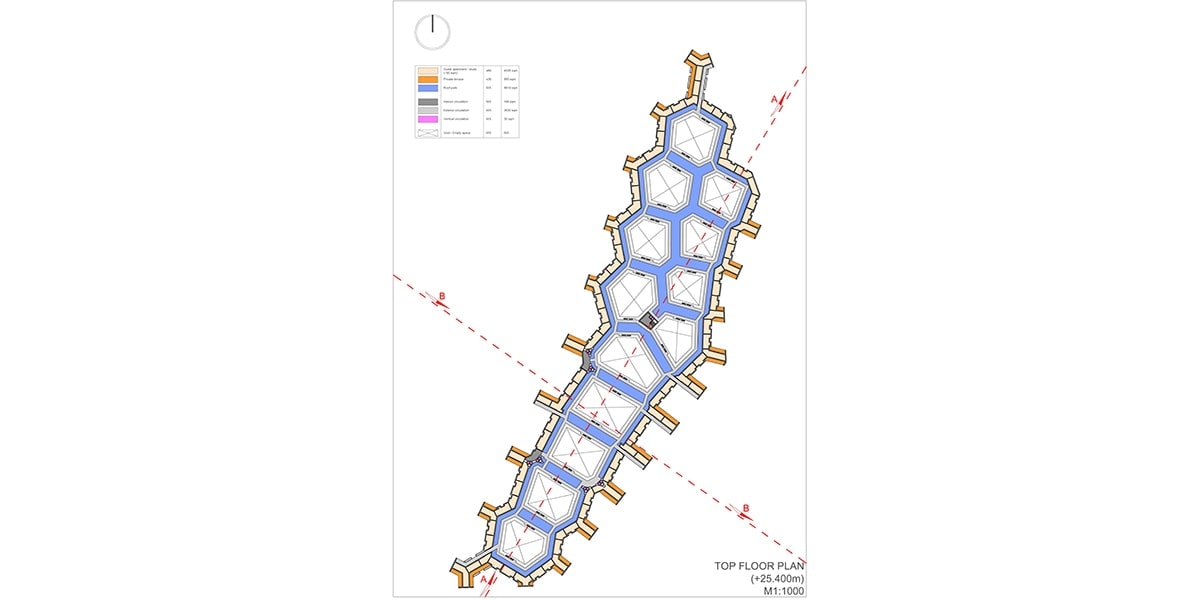
The site lies at the intersection of the 3rd and 4th ring roads along the Hajj Street corridor, where infrastructural scale meets everyday domestic life. This condition suggested a scenographic approach to planning: the project is organized not as isolated blocks on a plot, but as a sequence of spaces that unfold from arrival to threshold, from threshold to courtyard, and from courtyard to mosque. Each zone is legible, layered, and calibrated to the pace of residents rather than traffic.
At the centre of that sequence stands the mosque. It is conceived as the visual and social focal point of the scheme, with residential clusters positioned around it so that daily movement toward prayer becomes natural, short, and sheltered. In this context, the mosque is not an accessory to housing; it is the anchor that gives the development orientation, hierarchy, and meaning.
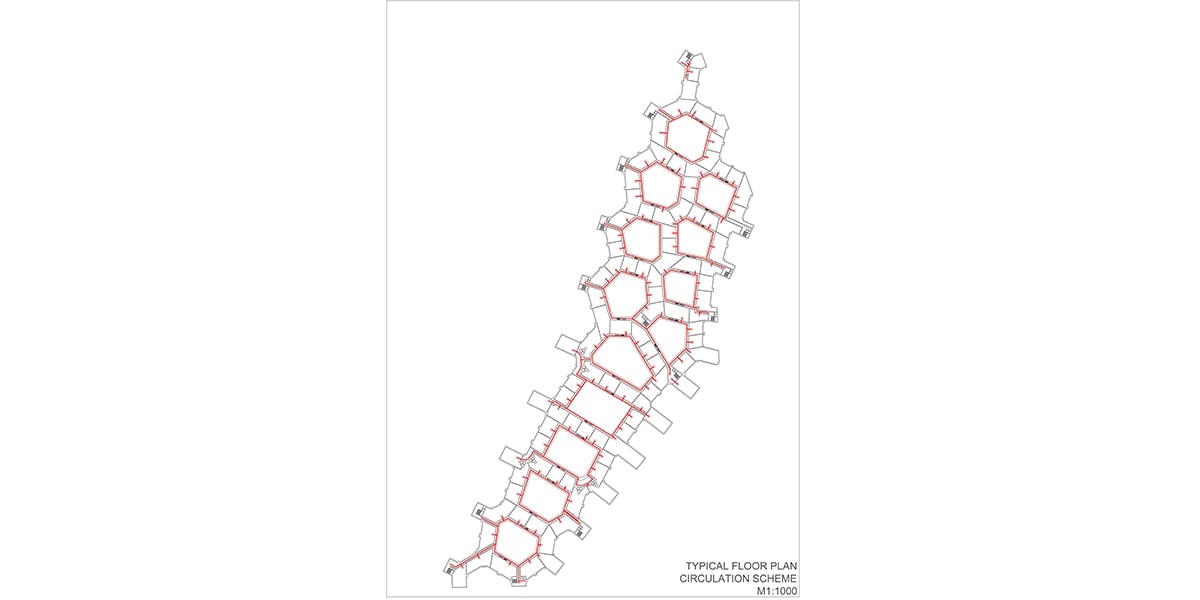
The housing is arranged in low-rise clusters around shared courtyards that act as intermediate rooms in the open air. These courtyards are the project’s key scenographic device: spaces of pause, encounter, and supervision where children can play, neighbours can meet, and family life can extend outdoors without losing privacy. The transition from public street to semi-private courtyard to private dwelling produces a more nuanced domestic environment than the repetitive apartment typologies typically associated with affordable housing.
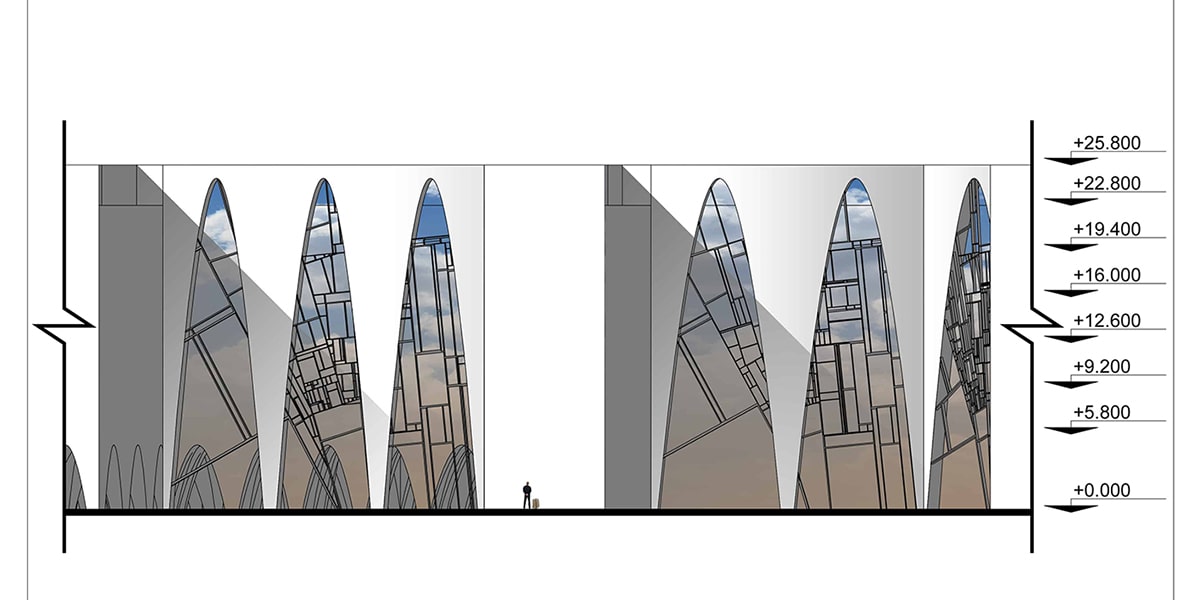
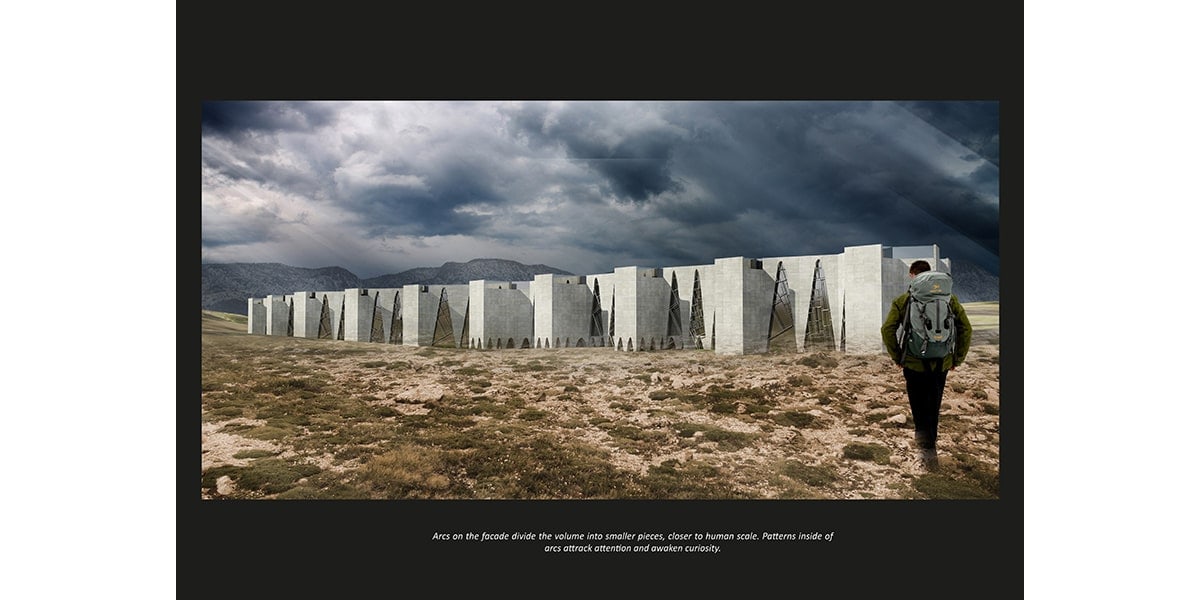
The architectural language draws on Hijazi precedents through proportion, screening, and filtered light rather than direct imitation. Mashrabiya-derived panels, recessed openings, and durable wall surfaces help manage solar exposure while giving the facades depth and visual rhythm. The low-rise massing preserves the human scale of the neighbourhood and ensures that the mosque remains the primary visual reference across the site. The office’s approach to climate-responsive residential architecture is outlined in How We Work.
Read scenographically, Deyar Al Assayla is defined less by individual buildings than by the choreography between them. Shade, distance, enclosure, and orientation are used as design tools to shape everyday experience: the walk home, the approach to prayer, the moment of gathering in a courtyard, the filtered light at the window. This is what gives the project its value. It proposes affordable housing not as a quantitative exercise in unit delivery, but as a carefully staged environment for communal life in Makkah.
The study also demonstrates the office’s broader residential thinking across scale and budget — from bespoke villas to planned communities — while retaining the same attention to context, behaviour, and climate. More residential work can be explored in the project portfolio. For new commissions, the process begins at Start a Project.