Engineering supervision For Ministry of Interior Buildings
Location          Yanbu, Saudi Arabia
Client            Ministry of the Interior
Type              Government Complex — Engineering Supervision
Area              12,000 m²
Status            Completed
Year              2015 — 2016
Principal         Ibrahim Nawaf Joharji
Scope             Full Engineering Supervision, Technical Oversight, Quality Control, Compliance Verification
Engineering supervision at the institutional scale is the practice of ensuring that what was designed is what gets built — precisely, without deviation, and within the regulatory and security frameworks that government construction in Saudi Arabia requires. This commission engaged INJ Architects in the full supervisory scope for Ministry of Interior buildings in Yanbu, covering the complete construction cycle from structural works through facade installation, service integration, and final handover.
Yanbu’s governmental and industrial districts operate under construction frameworks that combine national regulatory requirements with the specific security protocols of Ministry of Interior facilities. The buildings form part of an institutional complex where clarity of access, controlled circulation thresholds, and durable construction performance over the long term are not design preferences but mandatory conditions of the brief. The coastal location adds an environmental dimension that inland government construction does not face: salt air, humidity, and the specific material degradation patterns that the Red Sea coast produces require closer attention to facade assemblies, service penetrations, and envelope integrity than arid inland sites demand.
The supervisory approach was built around a single governing principle: that civic permanence depends not only on design intent but on the disciplined translation of that intent into built form at every stage of construction. This meant continuous presence during critical phases — structural works, facade installation, and mechanical and electrical service integration — and systematic verification at each milestone before the next phase of work proceeded. Multi-discipline coordination meetings between architectural, structural, and mechanical teams resolved discrepancies between shop drawings and contract documents before they reached the site, preventing the on-site conflicts that unresolved documentation gaps consistently produce in complex institutional projects.
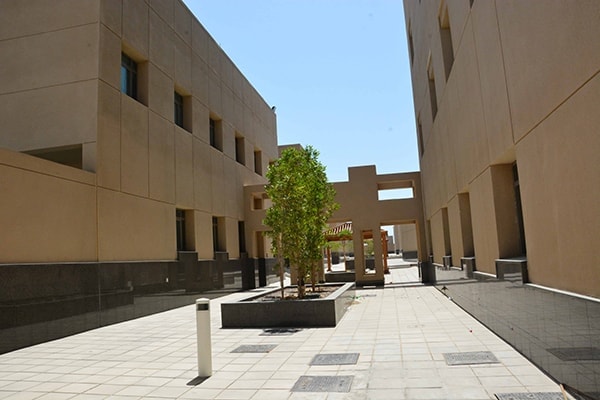
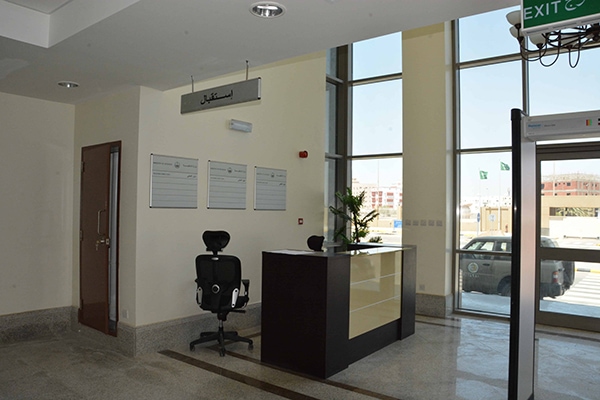
The spatial organization of the Ministry facilities followed a functional modernist logic in which clarity of plan supports administrative efficiency and security sequencing simultaneously. Supervision ensured that structural grids, service cores, and circulation paths were constructed exactly as calibrated in the approved design. Deviation from the intended plan in a Ministry facility is not merely an aesthetic problem — it is a security problem, because the hierarchy of public, semi-public, and restricted zones that the building’s circulation encodes must be physically realized in the built structure if it is to perform its institutional function. Every controlled entry point, internal corridor, and transition between access zones was inspected against the approved drawings before the work was accepted.
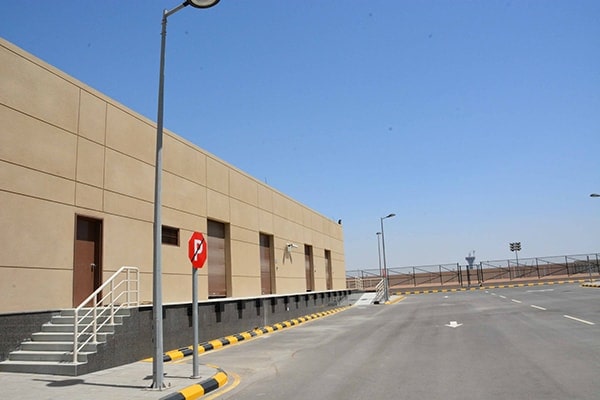
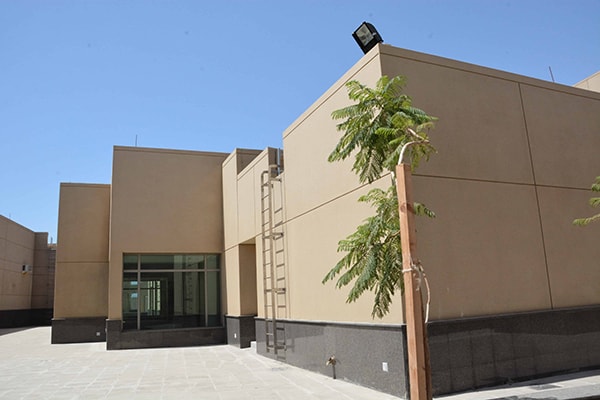
Facade execution was monitored against two requirements simultaneously: environmental performance and visual consistency within the governmental context. Yanbu’s coastal climate imposes thermal and humidity loads on external envelopes that generic specification compliance does not fully address — supervisory attention was focused on the junctions between facade systems, the quality of waterproofing layers, and the installation of shading components, all of which contribute to the long-term maintenance profile of the building. Material approvals were conducted on site against specified durability standards, with non-conforming materials rejected and replaced before installation rather than after.
Quality control procedures were structured as staged inspections with compliance reporting at each phase, producing a documented record of execution quality that supports the building’s long-term maintenance and any future modification works. BIM and CAD documentation supported the coordination review process, providing a reference against which site conditions could be verified systematically rather than by individual judgment. The result was a construction process that maintained alignment between the approved design and the built outcome across the full 12,000 square meters of the complex and its full execution timeline.
The methodology governing engineering supervision commissions of this institutional complexity is detailed in how-we-work. For government entities and developers considering engineering supervision engagements for construction projects operating within Ministry frameworks or equivalent institutional contexts, the scope and engagement structure are outlined in bespoke-architecture.