
Ghiras Al-Madina
In the third year of the Hijri calendar, on the slopes of a mountain north of Madinah, a commander called to his companions: “، ثبت عن النبي ﷺ أنه قال “اثبُتْ أُحُدُ؛ فإنَّما عليكَ نبيٌّ، وصدِّيقٌ، وشَهيدانِ — Stand firm.” The word carries more than a military instruction. It is a spatial command — a directive to the body to plant itself in the earth and hold. Ghiras Al-Madina is an architectural translation of that word into landscape.
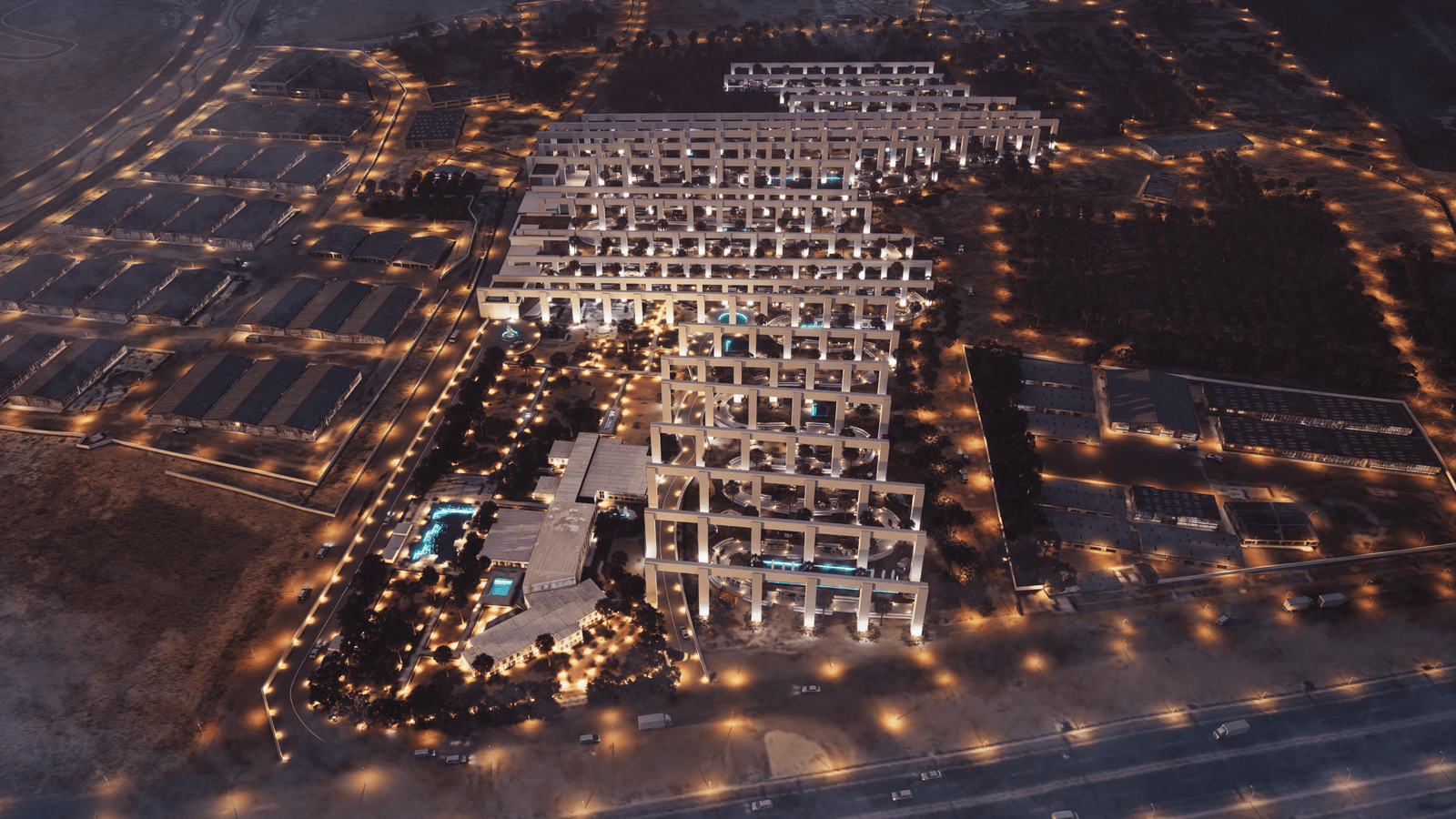
The 78,000 square meter site lies behind Beit Al-Madina — a historic palace now operating as an event and hospitality venue — and opens directly toward Jabal Uhud. The mountain is not a backdrop. It is the project’s primary reference point, visible from every position within the landscape, its presence shaping the orientation of every design decision made on the ground below it. The site’s relationship to Uhud is not incidental — it is the condition that produced the project’s conceptual origin and the spatial logic that governs its form.

Location          Madinah, Saudi Arabia
Type              Conceptual Landscape — Cultural Architecture
Site Area         78,000 m²
Context           Beit Al-Madina Historic Palace — Jabal Uhud Viewshed
Status            Conceptual Study
Year              2024
Principal         Ibrahim Nawaf Joharji
Scope             Landscape Architecture, Sacred Space, Cultural Identity
The Battle of Uhud was not lost. It was a test of steadfastness — a moment in which the Muslim community learned the difference between a position that holds and one that breaks. The companions who stood at Uhud stood in rows, their bodies fixed in the earth the way the word أثبتوا demands: not merely still, but rooted. Each figure was a column. Each row was a formation. The space between them was the space that faith occupies between one standing believer and the next. Ghiras Al-Madina takes this formation as its generative form and plants it across 78,000 square meters of Madinan ground in sight of the mountain where it happened.
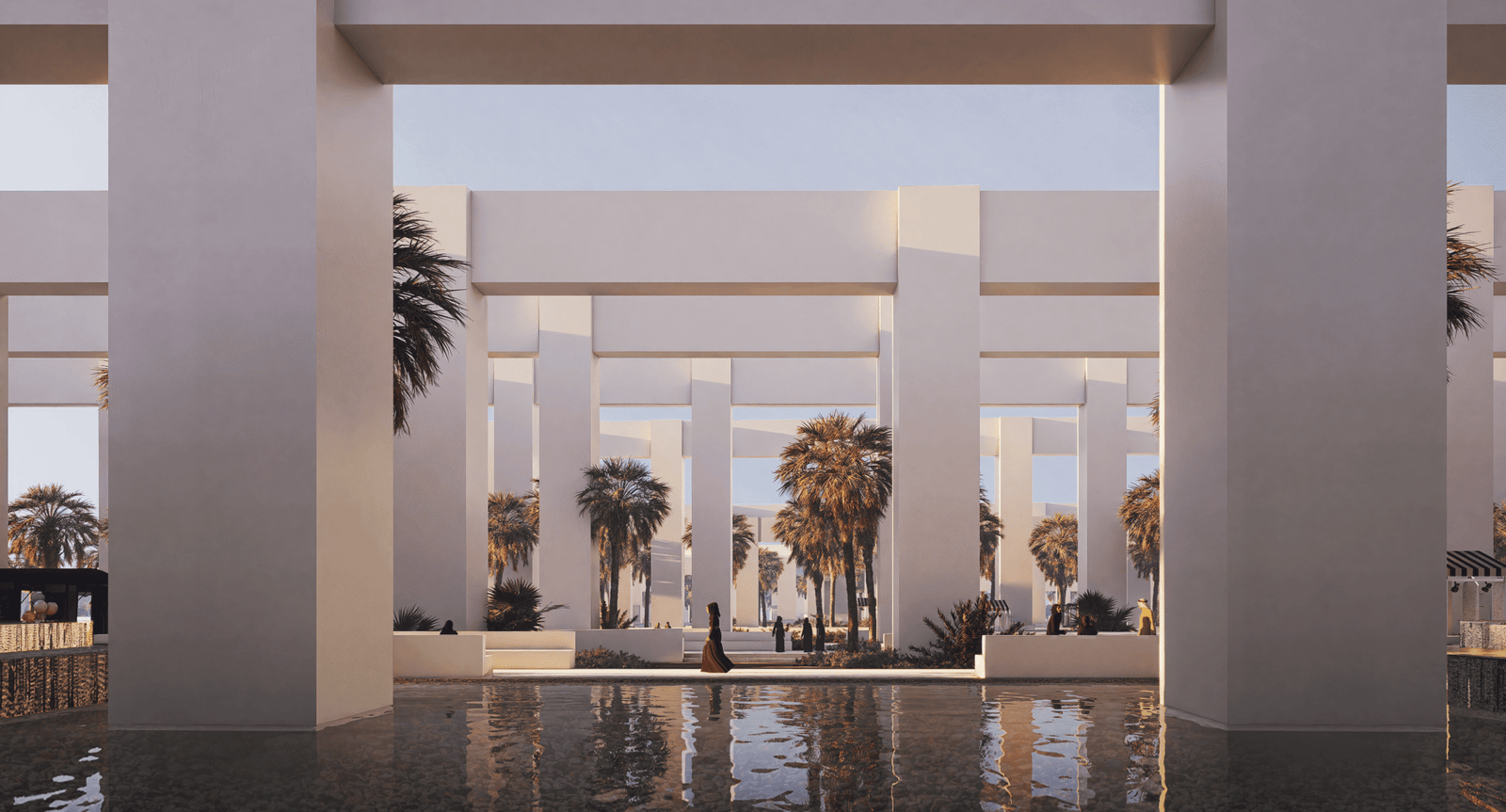
The columns rise from the desert floor with the organic variation of living things — no two identical in height or angle, but all sharing the condition of being fixed, vertical, and directed toward the mountain. The algorithmic arrangement that determines their positions follows the topographic contours of the site, the rows undulating across the ground plane in response to the natural variation of the earth beneath them. This is the project’s geometric wave: not a decorative pattern imposed on a flat surface, but the visual consequence of fixing a regular formation to an irregular landscape. The rows are straight in the way that the rows at Uhud were straight — not because the ground was level, but because the intention was absolute.
The relationship between Ghiras Al-Madina and Beit Al-Madina behind it is one of extension rather than addition. The historic palace grounds that currently receive guests for events and gatherings now open into a landscape that continues their spatial register outward toward the mountain — a threshold that transforms the arrival experience from a contained interior to a contemplative exterior, the columns visible beyond the palace as the visitor approaches, Jabal Uhud visible beyond the columns from within the landscape. The sequence moves from the historic fabric of Beit Al-Madina through the landscape’s columnar formation to the mountain itself, the three conditions reading as a single spatial argument about the depth of Madinah’s history and the layers of meaning compressed into this particular piece of ground.
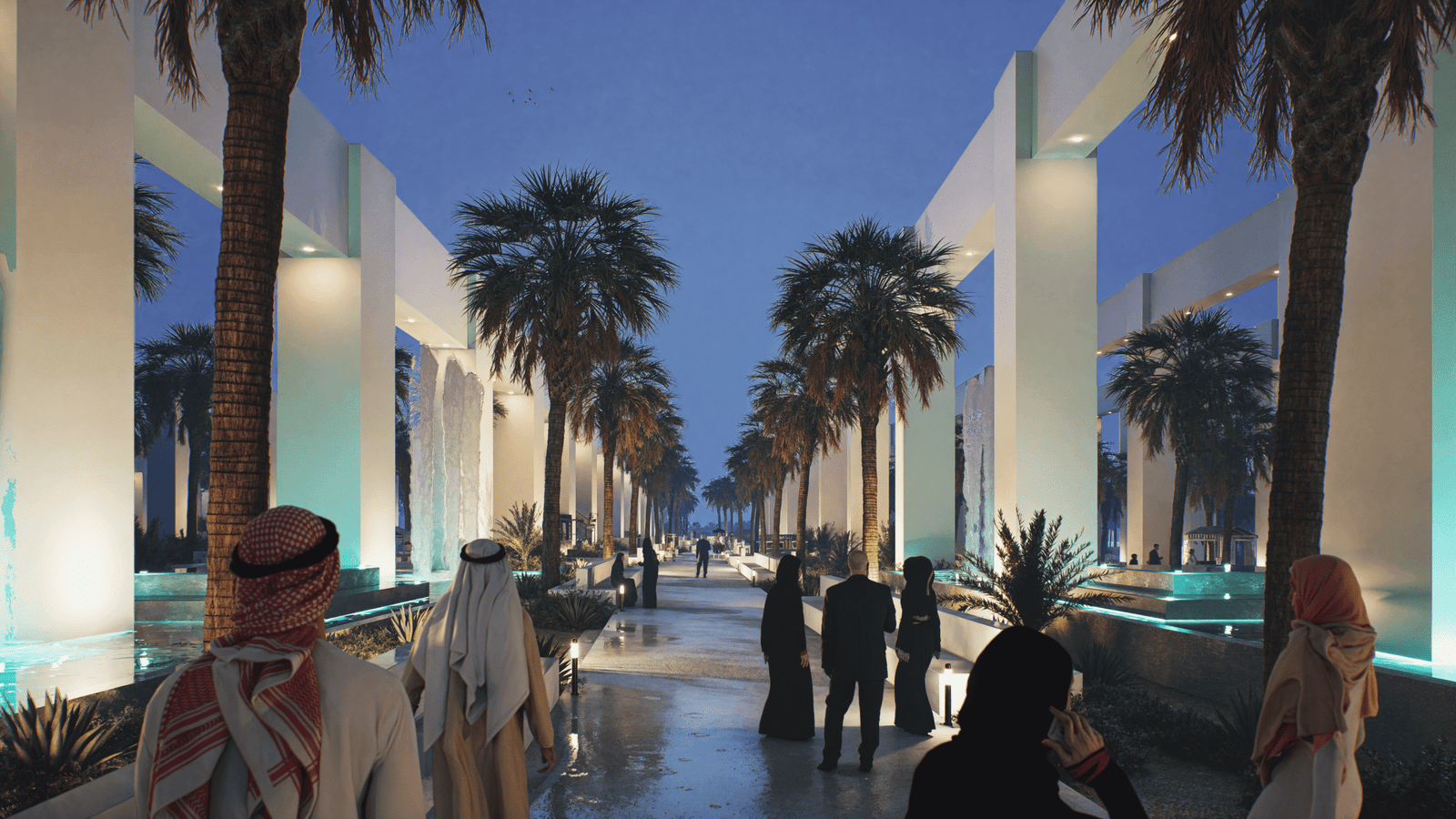
There is no calligraphy in this project. No dome, no minaret, no historical ornament. The earliest prayer spaces in Islam were defined by palm trunks and earth and intention — the minimum conditions required to establish direction, to create rows, and to mark the space between the believer and the Qibla as sacred. Ghiras Al-Madina returns to this minimum. The white columns, the Madinan earth between them, the palm crowns above, and the mountain at the horizon constitute the full material palette of the project. The shadow that each column casts across the ground changes with the position of the sun, marking the hours of prayer through the movement of light on the earth the way the first prayers were marked — without instruments, without ornamentation, through the direct relationship between the standing body and the sky above it.
A visitor moving through Ghiras Al-Madina does not follow a path. The columns suggest direction without enforcing it — the rows are legible as a formation but the spaces between them invite lateral movement, pause, and return. A person walking through the landscape experiences sequences of compression and release as the columns draw closer and pull apart, the mountain appearing and disappearing through the vertical planes of white, the sound of the site changing as the body moves from an open passage into a denser section of the formation. This is the scenographic dimension of the project: the landscape as a spatial experience that cannot be read from a single position but must be moved through, the way the Battle of Uhud cannot be understood from a single moment but only through its full sequence of advance, test, and steadfastness.
The project extends and deepens the cultural and spiritual identity of Beit Al-Madina as a destination — transforming a historic palace with an event function into a compound whose grounds carry one of Islamic history’s most significant narratives in their spatial organization. The design principles governing this approach to sacred landscape are detailed in how-we-work. For cultural institutions, religious endowments, and hospitality operators managing historic properties adjacent to sites of Islamic significance, the engagement framework is outlined in bespoke-architecture.
Explore Ghiras Al-Madina, a visionary modular landscape and architectural concept rooted in the origins of Islamic architecture. Designed by INJ Architects in Madinah, Saudi Arabia, the project merges culture, sustainability, and scenography into a bold spiritual experience.
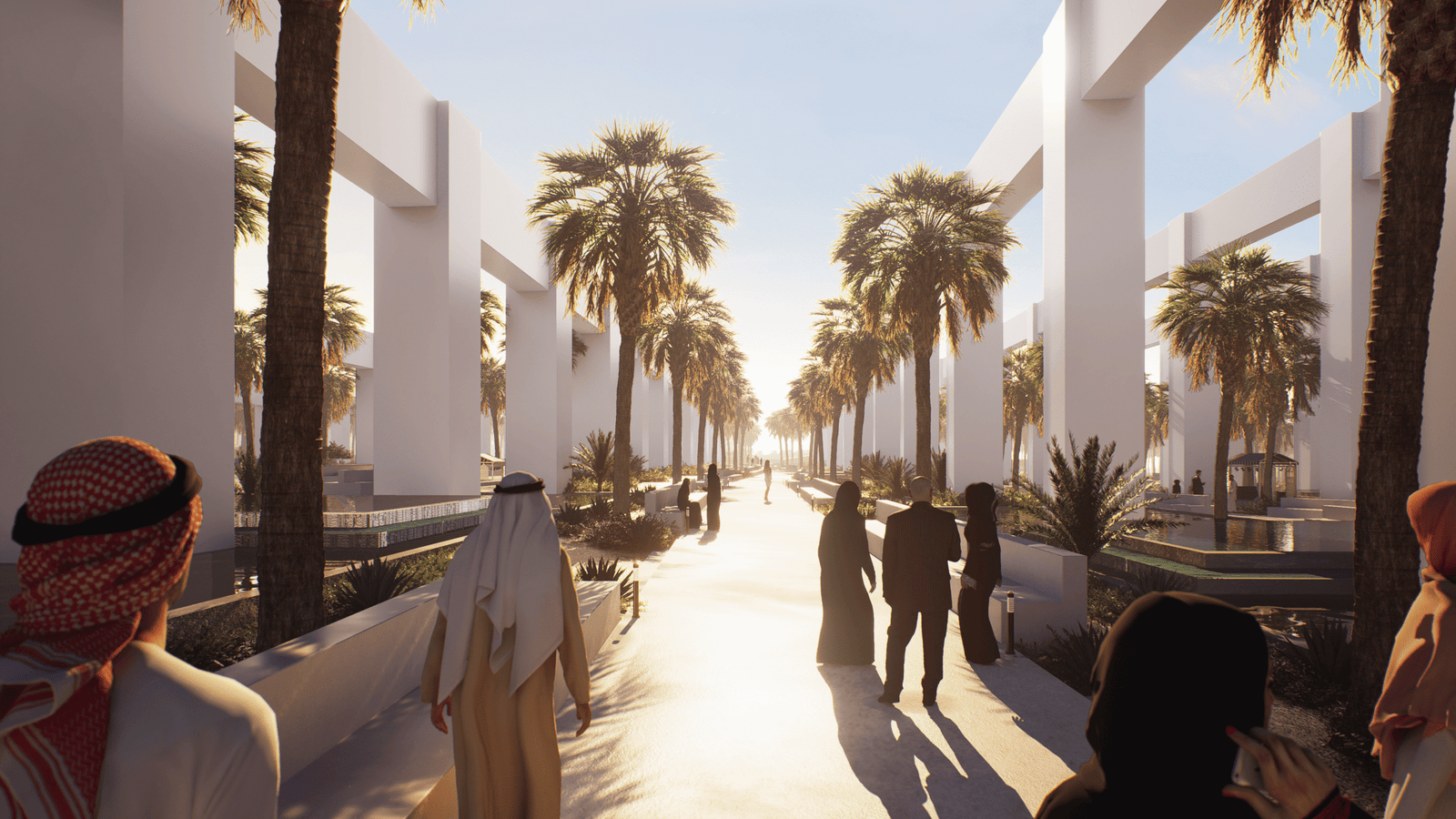
The first mosque in Islam was not built — it grew. Palm trunks were planted in the earth of Madinah, their crowns left intact above, their spacing determined by the number of believers who needed to stand between them in rows facing the Qibla. There was no stone, no ornament, no dome. The architecture was the act of planting — of fixing living material in the ground and allowing the space it defined to become sacred through the intention of those who stood within it. Ghiras Al-Madina carries this origin in its material logic: the columns that rise from the site are the palm trunks of the first mosque abstracted into their essential condition — vertical, fixed, organic, and spaced precisely enough to define a threshold between one person and the next. The palm grove that surrounds and penetrates the landscape is not landscape decoration. It is the continuation of the same material that defined Islam’s first architectural act, present here on the same Madinan ground where that act first occurred.