
IBRA Chair
A chair is among the most studied objects in design history its proportions mapped, its ergonomics tested, its forms exhausted across centuries of iteration. The IBRA Chair begins where that history ends, not by rejecting it but by asking what happens when the structural logic of a chair is treated as an architectural problem rather than a furniture one.
The name carries the designer’s own. IBRA is Ibrahim Nawaf Joharji’s mark on an object he conceived not as a product but as a spatial proposition a study of how mass, torque, and material can produce a piece of furniture that holds its own as an architectural object within an interior. The brief he set for himself was precise: a dining or reception chair capable of functioning as a standalone artistic piece, resolved in leather and embroidery, rooted in parametric logic, and built to carry the full weight of contemporary interior design without concession to convention.
Location          —
Client            Private
Type              Furniture Design — Dining and Reception Chair
Status            Completed
Year              2020
Principal         Ibrahim Nawaf Joharji
Materials         Metal frame, leather upholstery, embroidery
Scope             Industrial Design, Interior Object, Architectural Furniture
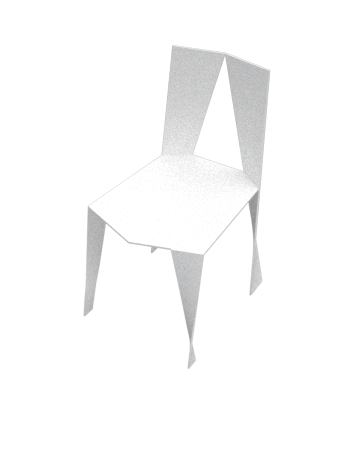
The four legs are the generating decision. Each leg rises from the floor with a twist a controlled torsion in the metal that introduces movement into what is conventionally the most static element of a chair. The four twisted legs do not simply support the seat; they perform the chair’s character. Viewed from any angle, the base reads as a structure under dynamic load, as though the object were caught mid-rotation rather than fixed in place. This is not ornamentation. The torsion in each leg is a structural response to the visual lightness demanded of a piece that must not read as heavy despite carrying the full load of the seated body.
The seating surface is suspended between the two main lateral straps of the metal frame, held clear of the structure so that the chair’s interior geometry remains legible from the side. Four vertical struts anchor the seat without closing the frame, preserving the visual openness that the twisted legs establish below. The backrest departs from the geometric precision of the base entirely. It is sculpted organically, its form approximating the meeting of two cupped surfaces the way two hands might press together at the palms to receive a weight placed against them. This detail is the chair’s most architecturally explicit gesture: a structural element resolved in a human reference, without sentiment and without literalism.


Leather was selected as the upholstery material for reasons that extend beyond tactile preference. Its surface carries embroidery a deliberate introduction of craft labor into an object defined elsewhere by parametric precision. The embroidered detail on the leather is not decorative in the conventional sense; it marks the seating surface as handmade within a frame that is machined, establishing a material conversation between the industrial and the artisanal that gives the chair its interior design register. The object belongs equally to a formal dining room and to an architectural reception space contexts where a single piece is expected to function as both furniture and focal point.
The parametric logic governing the leg geometry operates within a specific constraint: the twist must appear continuous across all four legs while each leg responds to a different load path depending on its position within the frame. The result is a base that reads as symmetrical from the front and asymmetrical in plan — a controlled tension between the chair’s apparent bilateral balance and its actual structural differentiation. This is the same problem that occupies structural engineering in long-span architecture, resolved here at the scale of an object that fits beneath a dining table.


The IBRA Chair belongs to a body of object design at INJ Architects that treats furniture as an extension of architectural thinking rather than a separate discipline — pieces where the structural problem and the aesthetic problem are the same problem, answered once. The design philosophy governing this approach is detailed in how-we-work. For clients and collectors interested in commissioned furniture objects developed under the same principles, the engagement framework is outlined in bespoke-architecture.