Southern Saudi Architecture: Terrain, Rain and Asir’s Building Traditions
Southern Saudi architecture cannot be understood as a catalogue of motifs detached from place. Even within Asir, elevation, humidity, rainfall and available materials change between the plateau, Sarat, Asdar and Tihama. Those differences reshape the dwelling, its structural section, its water management and its relationship to cultivation and movement. A serious architectural reading therefore begins with terrain and climate before it reaches colour or ornament.
This article uses Asir as a documented case rather than a substitute for the whole south. It brings Rijal Almaa, the region’s distinct construction traditions and Al-Qatt Al-Asiri into one framework, showing how identity emerges from the interaction of material technique, programme, craft and community.
The south is not a single style
Asir demonstrates why an administrative region does not produce one building material. Multi-storey earthen buildings occur on the plateau. Stone, including basalt, appears in Asdar near valleys, cultivated land and slopes. In Sarat, stone bases or lower floors combine with earthen upper walls. In Tihama, plant-based huts rise beneath tall roofs. These are not cosmetic variations; they reflect differences in heat, humidity, rain and the local supply of stone, soil and vegetation.
Calling a building “Asiri” because it has small windows or dark walls is therefore insufficient. Better questions concern where its material came from, how it meets the slope, what happens to water at the wall base, and how the house connects to paths, fields and neighbours. This method also sharpens the comparison with Hijazi architecture, where the port, pilgrimage routes, coral stone and timber generated a different urban and material logic.
Read the site before the façade
Mountain terrain is not a neutral platform. Gradient influences the position, entrance and levels of a building; paths condition the movement of people and materials; water requires careful treatment of roofs, edges and foundations. Proximity to cultivation and water sources also belongs to the structure of a settlement rather than serving as scenery behind it.
We can read such a village at three connected scales. The landscape scale includes valley, slope, farmland and routes. The urban scale includes the spacing of buildings, courts, passages and changes of level. The sectional scale includes the wall base, sequence of materials, openings and roof. Ignoring any one of them reduces “character” to an image and conceals the systems that allowed the place to function and change.
Rijal Almaa: settlement and exchange on a mountain route
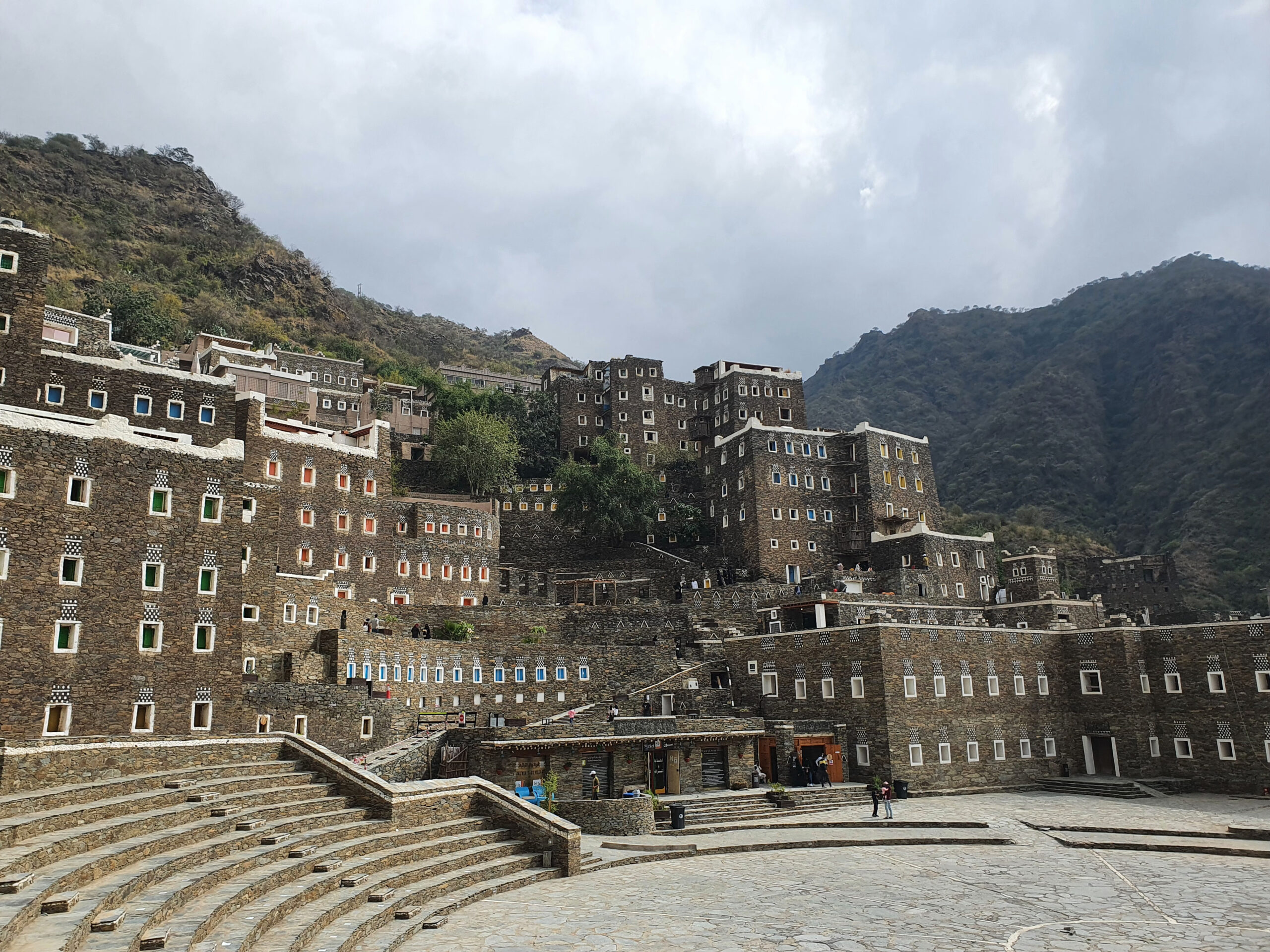
Rijal Almaa Heritage Village lies roughly 45 kilometres west of Abha. Its UNESCO Tentative List record describes around sixty multi-storey palaces built from natural stone, clay and wood. It also connects the settlement’s historical importance to corridors between Yemen and the Levant and to routes leading towards Makkah and Madinah. The village was therefore a regional centre of exchange, not an isolated mountain composition.
The stepped buildings negotiate residence, storage, access and defence. They also correct an earlier claim that Asir villages had no forts: the same record identifies a fort that has housed a community-established heritage museum since 1985. Rijal Almaa has been on Saudi Arabia’s Tentative List since 8 April 2015; that status should not be confused with final inscription on the World Heritage List.
Four material responses within Asir
Saudi documentation groups Asir’s traditional architecture into four environment-related types. Earthen plateau buildings commonly rise two storeys and can reach three or four, with raised mud decoration near their upper edges. In Asdar, local stone buildings, including basalt construction, occupy valley floors, agricultural areas and slopes.
In Sarat, construction may begin with a stone base one or two metres high, or with a full stone ground floor, followed by earthen upper walls reinforced by projecting stone slabs. The wall can be broader at the base and narrow as it rises. In Tihama, plant-based al-Ishash take a conical or pyramidal form beneath high roofs suited to hot, humid conditions. Compressing these buildings into one façade language erases the knowledge contained in their materials and sections.
The wall records material, rain and maintenance
A mixed Sarat wall is more than an alternating pattern of earth and stone. The stone base meets the ground, moisture and impact, while earthen lifts allow the building to rise in a form that can be shaped and repaired. Stone slabs project between those lifts, interrupting the face and helping cast some rainwater away from the earthen surface. Their value, however, cannot be inferred from appearance alone: projection, fall, earth composition, joint condition and recurring maintenance all matter.
A historical detail should not be copied into a contemporary building with an automatic performance claim. Designers need to characterise the material, test absorption, trace water at the roof, openings and base, and decide which components can be maintained or replaced. This is where traditional construction meets the discipline of urban heritage conservation: performance belongs to a system, not to one supposedly timeless material.
Social interiors and Al-Qatt Al-Asiri
Vertical growth and compact settlement can distribute activities across several levels, but the available evidence does not support a universal rule assigning every floor to a particular gender or service. Nor is a courtyard a requirement in every house. Plans change with location, scale and phases of growth, so entrances, stairs, rooms and storage should be interpreted from measured evidence rather than imposed on one imagined model.
Within this material world, Al-Qatt Al-Asiri is a female tradition of interior wall decoration, especially associated with guest rooms. UNESCO inscribed it in 2017 on the Representative List of the Intangible Cultural Heritage of Humanity. Its significance extends beyond colour and geometry to knowledge transmitted in families and communities, turning the interior into a record of hospitality, participation and memory. It also expands our reading of Islamic architecture from form to institution, craft and social practice.
Conserve a settlement, not a photograph
The UNESCO record considers the integrity of Rijal Almaa through the settlement, farmland, wider landscape and natural environment. That principle has practical consequences. Repainting a façade or rebuilding a stone panel is inadequate if drainage fails, access routes are severed, cultivation that supported the place disappears, or incompatible joints trap moisture in the wall.
A conservation plan begins with a documented inventory, recording cracks, lean, moisture and later alterations building by building. Interventions can then be prioritised from life safety and water management to mortar, roofs and joinery. Records should distinguish original fabric from new work and define a maintenance cycle. Tourism may support continuity, but it requires limits on capacity and use so that residence and craft are not displaced by a façade detached from community.
What can contemporary design learn?
The transferable lesson is not a small window or a decorative band. It is a decision sequence that starts with climate, terrain and resources and produces a form that can be built, inspected and repaired. A contemporary project can learn from stepping mass with level changes, reducing material transport when suitable local options exist, making drainage visible and accessible, and placing openings according to light, privacy and ventilation rather than repeating a ready-made pattern.
Thermal comfort, energy, moisture and structural safety must still be tested against present standards. Identity does not remove the need for measurement, while measurement need not erase memory. That balance is central to a useful critique of modern Saudi architecture: inherited knowledge should become a documented design logic, not a visual skin.
Read in this way, Rijal Almaa, Al-Qatt Al-Asiri and Asir’s stone and earthen construction form a multi-scalar body of knowledge. Its strength lies neither in freezing the past nor in romanticising it, but in understanding the exact relationship between ground, rain, material and collective work—and then testing what can serve a different present.