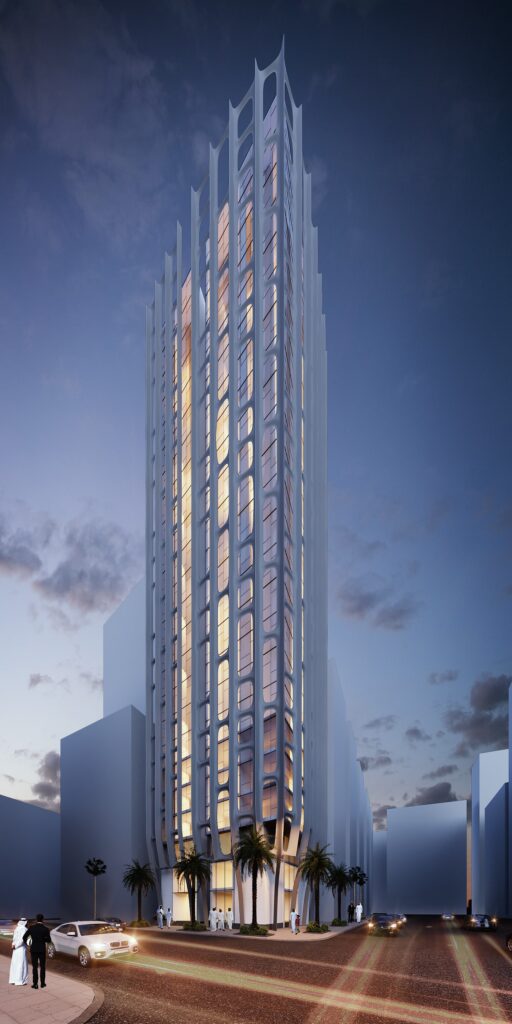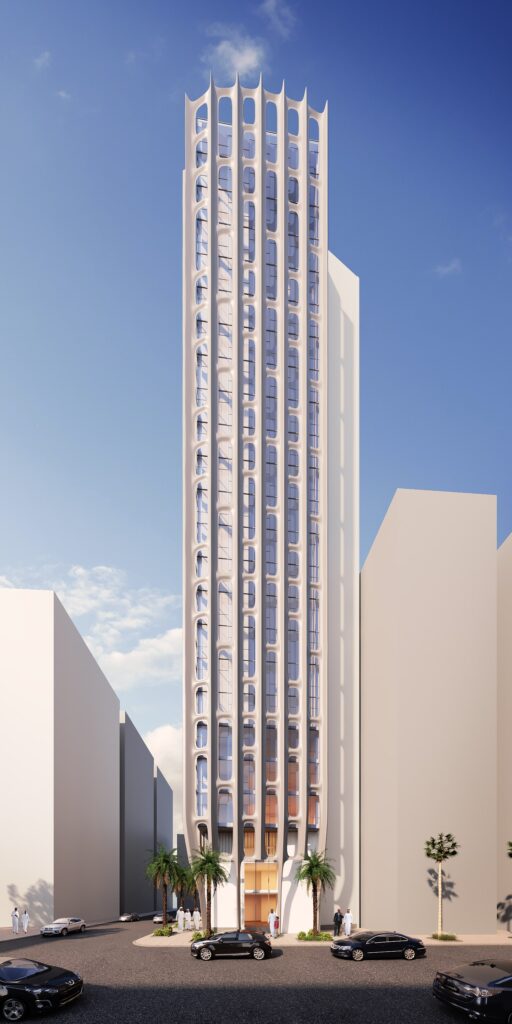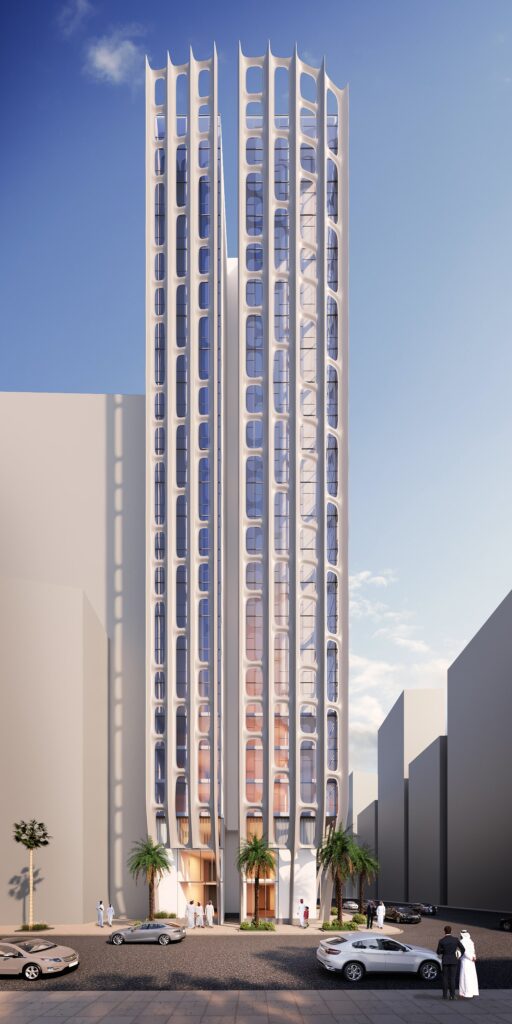
Jadwa Al-Kahlil Tower
Makkah is the most observed city on earth. Every hotel tower that rises within view of the Grand Mosque is seen by more people than almost any building in the world — pilgrims arriving from every country, at every hour, carrying the full weight of their journey in their gaze. The architectural quality of what they see matters in a way that has no equivalent in any other urban context. The Jadawi Tower commission was a study in what that responsibility requires of a facade.
The tower is located in the Al-Masfalah district at the intersection of Ibrahim Al-Khalil Road — one of the primary axes connecting the city to the Holy Mosque — with a direct panoramic view of the Kaaba. Its geographical position places it within the visual field of millions of pilgrims performing Hajj and Umrah each year. This is not a commercial hotel site in the conventional sense. It is a building whose facade participates, whether consciously or not, in the spatial experience of the holiest site in Islam. The commission engaged INJ Architects to develop the facade redesign, provide architectural consultation, review the project’s design development, and ensure the technical and cost framework aligned with the quality the location demands.
Location          Makkah Al-Masfalah, Saudi Arabia
Client            Jadwa
Type              Hotel Tower — Facade Redesign and Architectural Consultation
Status            Completed
Year              2021
Principal         Ibrahim Nawaf Joharji
Scope             Facade Design, Architectural Review, Cost Alignment
The study began with a finding that the practice’s research into Makkah’s hotel buildings had already established: approximately 95% of the hotel towers built in Makkah were designed to satisfy licensing requirements through horizontal plane solutions, with no meaningful facade development beyond what the permit process required. The Jadawi Tower, in its original state, was close to this condition. The brief for the facade redesign was therefore not merely aesthetic — it was a position on how Hijazi architectural identity should and should not be deployed in the context of a contemporary hotel tower.
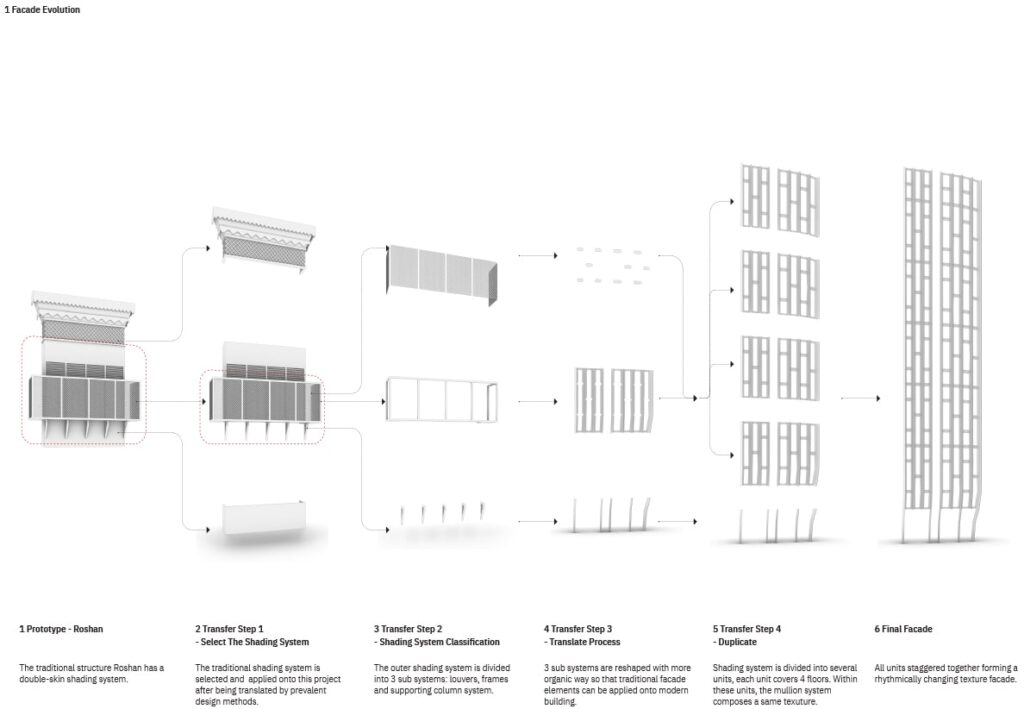
The Roshan is the element most frequently invoked when hotel developers in Makkah seek to establish a local architectural identity. Its origins are not exclusively Hijazi — historical sources trace the element to India, with related forms found in Iran, Malta, and parts of South America — but its adoption into the Meccan built environment over centuries gave it a cultural specificity that is now inseparable from the city’s architectural identity. The problem is not the Roshan. The problem is how it is used. Placing Roshan and mashrabiya elements at the upper floors of a high-rise hotel — as had become common practice in the area — is architecturally incoherent. The Roshan was developed to manage air circulation, filter light, and provide visual privacy at the human scale of occupied rooms. At tower height, where its scale is distorted and its climatic function is meaningless, it becomes a graphic gesture rather than an architectural one. The practice’s position is direct: applying heritage elements at the wrong scale is not a homage to that heritage — it is a misreading of the logic that produced it.
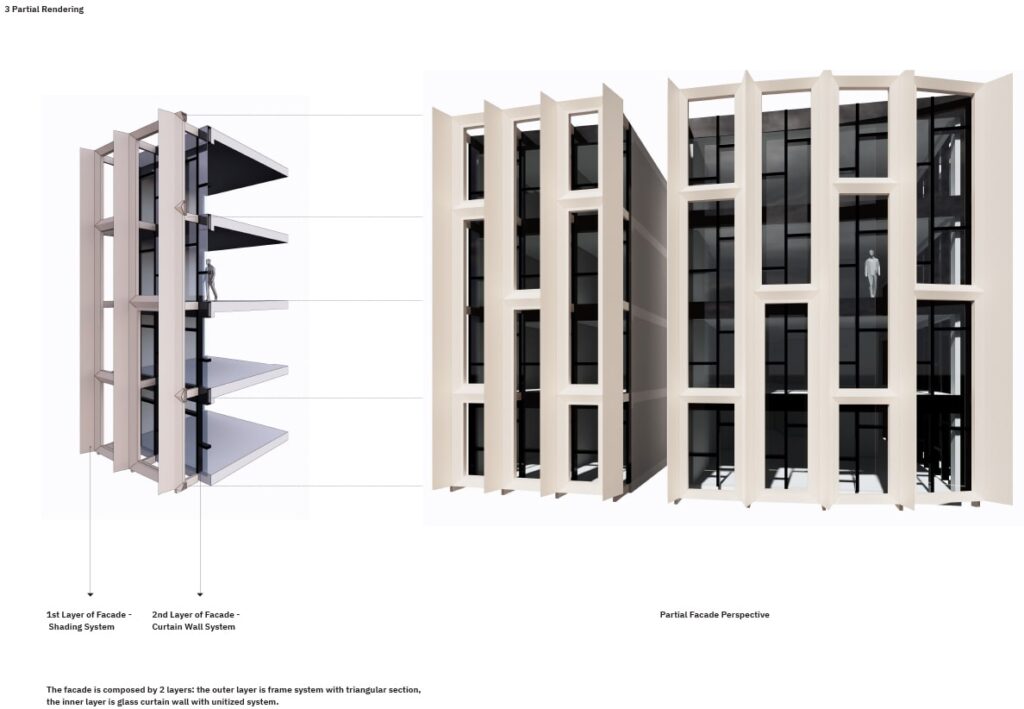
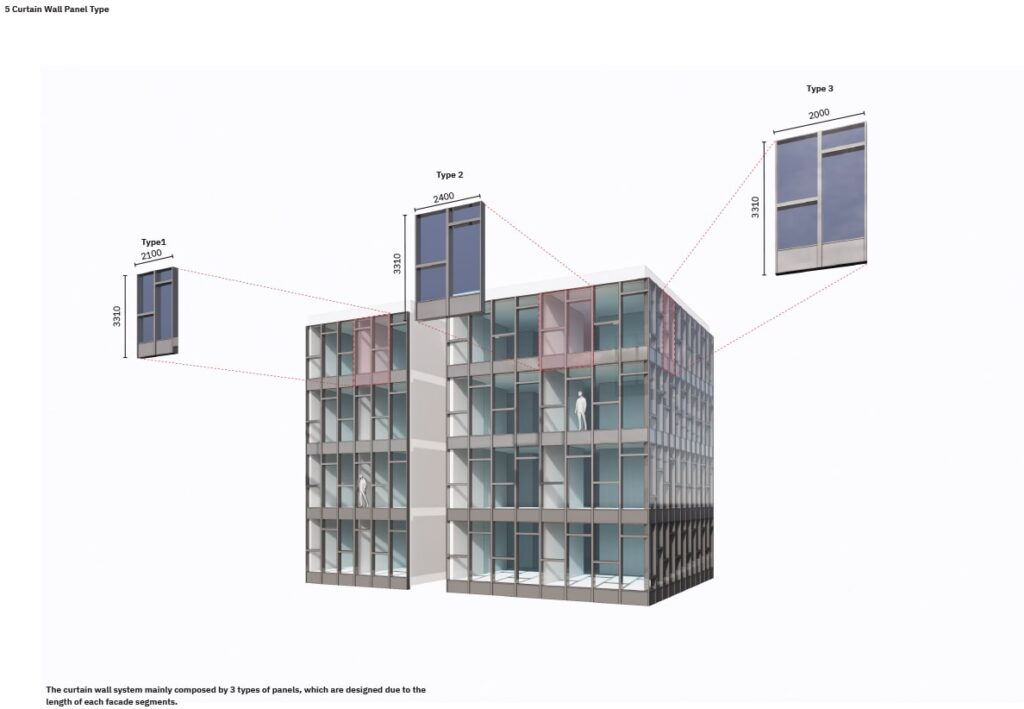
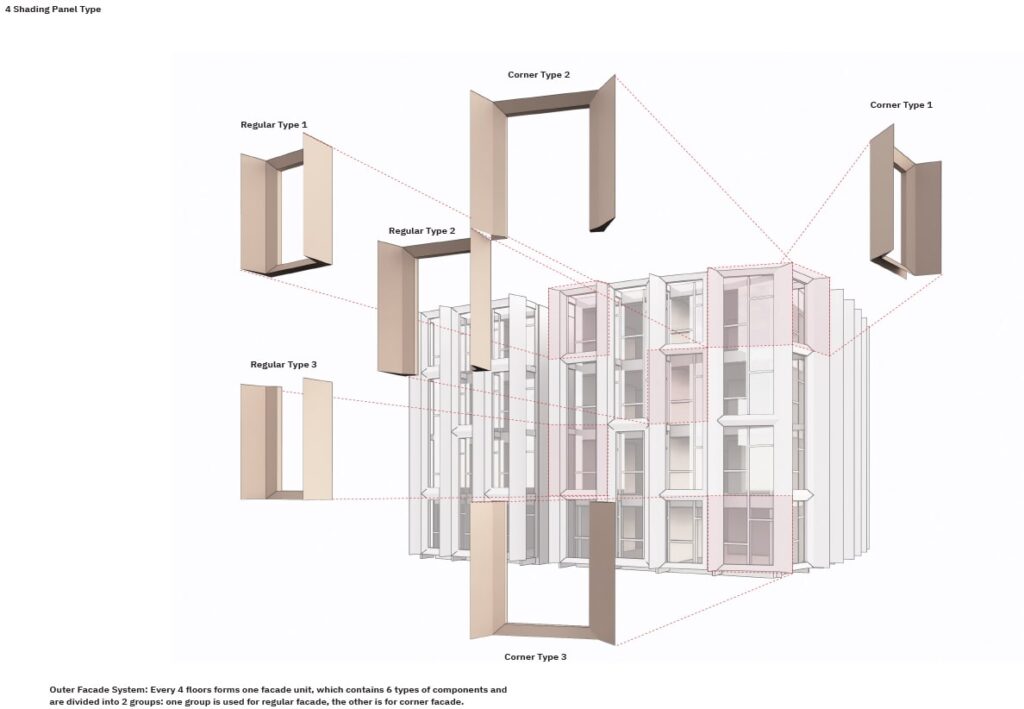
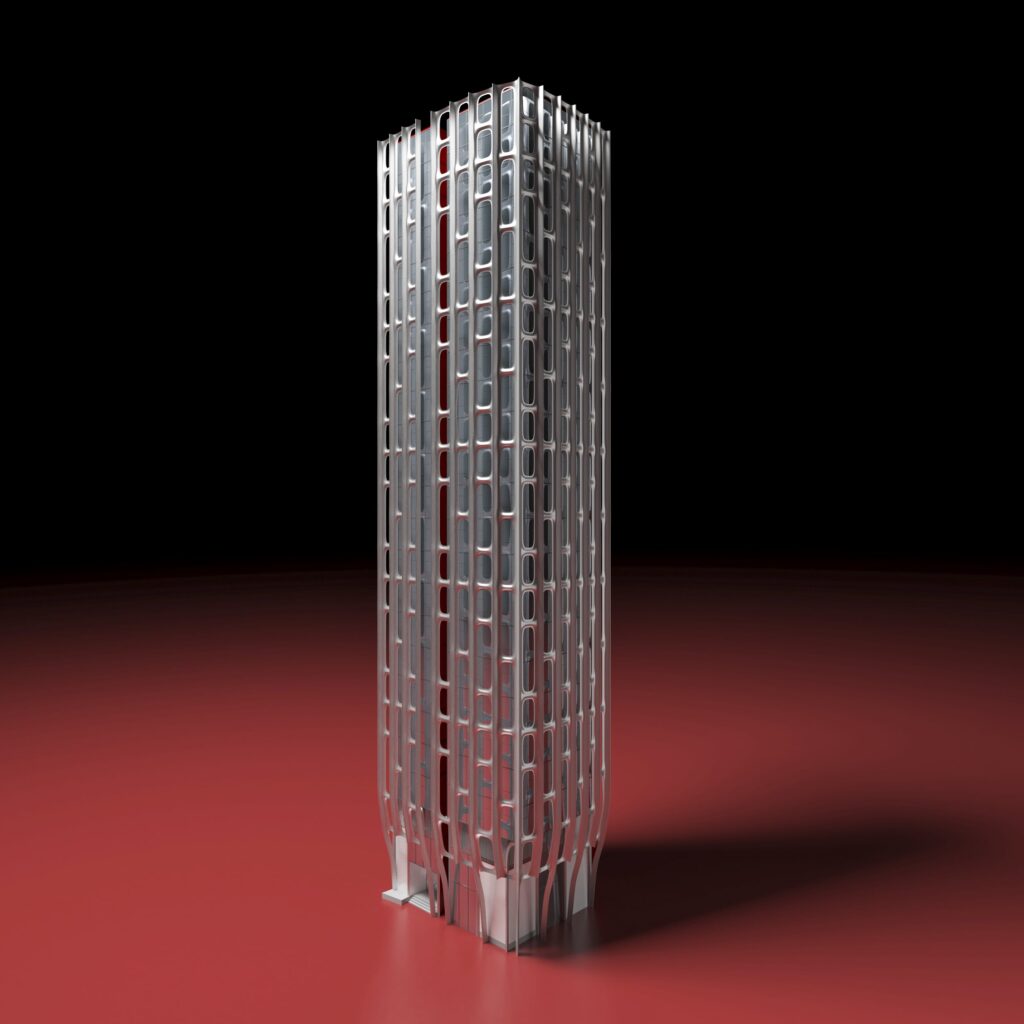
The redesign approach replaced this misapplication with a facade logic derived from nature and computational modeling rather than from applied historical ornament. The sun’s path across the tower’s specific orientation was used to determine the placement, depth, and geometry of the facade’s openings and shading elements — the solar angle at each floor level and each facade face calculating what the opening should be, rather than an applied pattern deciding it independently of the building’s actual environmental conditions. This is the methodology the practice describes as letting architecture design through nature: the sun determines the fate of the openings, the reflection determines the best use of light within the hotel rooms, and the parametric model resolves these inputs into a facade that performs its environmental functions while carrying the formal language of Hijazi architectural culture in its geometry rather than its applied surface.
The hotel guest’s primary requirement at this location is unobstructed visual communication with the Grand Mosque. Natural light is an essential component of that experience and of the quality of life within the hotel rooms. A facade that blocks that light in pursuit of a heritage reference it does not functionally justify is a facade that has misunderstood its own brief. The redesigned facade maximizes natural light admission to the rooms facing the Holy Mosque while providing the shading geometry that Makkah’s climate requires — the two conditions resolved in the same parametric surface rather than traded against each other. The organic modeling that produces this surface operates within the scope of Hijazi architectural elements, but derives its geometry from computational analysis of the building’s specific environmental conditions rather than from the reproduction of historical form.
Hijazi architecture has been characterized since ancient times by many important data such as reconfiguring the culture of Rawashin in a new and modern way and making this formation a sign of Hijazi linked to the Hijazi architectural culture.
The cost alignment and general project review component of the commission ensured that the facade redesign’s material and structural ambitions were matched to the project’s construction economics — the parametric complexity of the facade resolved within a specification that the project’s budget and timeline could sustain. This integration of design development with technical and financial review is part of the full-scope architectural consultation that INJ Architects provides, the creative and the constructional treated as inseparable dimensions of the same professional responsibility. The methodology governing this approach is detailed in how-we-work. For hotel developers and property owners seeking architectural consultation and facade redesign in Makkah or comparable high-context urban locations, the engagement framework is outlined in bespoke-architecture.