
JED Art
JED: The Bilingual Prism
Along the corniche, where the Red Sea breeze meets the rigid datum of the urban grid, a luminous threshold emerges. The eye travels across a landscape waiting to be anchored, catching the golden glint of a civic monument that refuses to face only one way. This is an object choreographed for the circular gaze, a spatial translator born of Jeddah’s dual soul. It stands as a kinetic anchor, designed to be read and revealed from every vector of approach. Light, language, and tectonic form collide in a quiet procession of parametric layers.
Location          Jeddah, Saudi Arabia
Type              Public Art Installation — Urban Design Object
Status            Proposal
Year              2024
Principal         Ibrahim Nawaf Joharji
Design Rights     © INJ Architects — All rights reserved
Scope             Industrial Design, Public Identity, Parametric Construction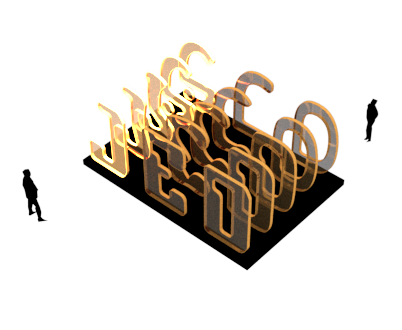
Every civic typography of this scale—those massive letters that stage an airport, a waterfront, a plaza—harbors the same spatial flaw: it performs for only half the audience. From the front, the word declares itself; from the back, it retreats into a mirrored illegibility. The object addresses a unidirectional gaze, abandoning the returning spectator. The Jeddah Art installation was conceived to shatter this convention, scripting a spatial choreography where the facade performs equally from all approaches.
Jeddah bears one of the region’s most resonant trigrams: JED. It is the typographic cipher flickering across boarding passes and departure boards globally—a compressed identity for a city acting as the gateway to the Two Holy Mosques. The installation seizes this code as its foundational script, asking what a civic landmark should stage that a conventional sign cannot. It demands an architecture that speaks in the round, engaging the traveler and the local alike.
The resolution arrives through a three-layer parametric system, a tectonic articulation of bilingual reveal. Approaching from the front, the spectator encounters JED in Latin script. Circling to the rear—the vantage conventional landmarks forsake—the identical physical volume unfolds to present جده in Arabic. The three strata are engineered so the forward face spotlights the Latin letterforms, while the rear face, through the calculated rotation of an intermediate connecting layer, spotlights the Arabic characters. The letter J and the Arabic ج share a geometric logic that permits a seamless transition; E and ه resolve via the same parametric mediation; D and د complete the transformation.
The result is a monument entirely legible from every vector of approach, rather than half-legible from one. A visitor moving from the corniche reads JED in English; another approaching from the opposite threshold reads جده in Arabic. The object privileges no language, no direction, no single audience. It is a singular physical form serving dual readings simultaneously—a mirror of the city it represents, where the international and the deeply local have coexisted for three millennia.
The structural assembly is composed of five golden elements: two bearing Arabic letterforms, two carrying English, and a central intermediate piece that mediates the transition. The base is a stratified composition of four layers: black steel outer shells, heavy-duty internal structural cores, and a connecting system anchoring the assembly to the civic block. The letter body is clad in a transparent golden plastic surface, housing neon strip lighting along both interior and exterior faces, supported by a steel frame. This illumination allows the installation to perform after dusk, the letters glowing in both languages from all directions—the city’s name present for any person crossing the plaza at any hour.
The selection of JED as the English identifier is far from arbitrary. It is the IATA code for King Abdulaziz International Airport—the designation signaling every international arrival into Jeddah, the three letters through which the city is first imagined by travelers. The Arabic جده is its direct equivalent: the city’s name in its own tongue, for its own people. The installation holds both within a single object, the parametric engineering of its three-layer system rendering the bilingual double-reading effortless, devoid of visible complexity. From the exterior, it reads as a simple luminous landmark; the technical resolution that sustains its dual performance is contained entirely within its depth.
All design and intellectual property rights are owned by INJ Architects. The parametric letter-transition system, the bilingual double-reading mechanism, and the installation’s full visual and technical identity are registered under the practice. The design methodology governing this type of public identity object is detailed in how-we-work. For municipalities, cultural institutions, and developers considering civic identity installations of comparable technical and conceptual depth, the engagement framework is outlined in bespoke-architecture.


