
Border Guard Officers’ Club
Military border complexes require a distinct architectural language that reconciles the severity of the desert environment with the necessity of human recovery. Operating under the direction of the Engineering Corps of the Border Guards, this project delivers an integrated hospitality and athletic infrastructure designed specifically to support stationed officers in remote territories.
Information Security Protocol: As a Ministry of Interior development, absolute confidentiality is foundational to the project’s execution. Specific geographic coordinates, capacity metrics, and internal operational schematics are strictly classified. The architectural narrative presented here focuses exclusively on the spatial quality, environmental adaptation, and structural resilience of the facilities.
Location: Saudi Arabia [Classified]
Client: Ministry of Interior (Border Guards)
Type: Institutional / Sports & Residential
Status: Completed
Year: 2014
Principal: Ibrahim Nawaf Joharji
Design System: Secure perimeter massing, climatic adaptation 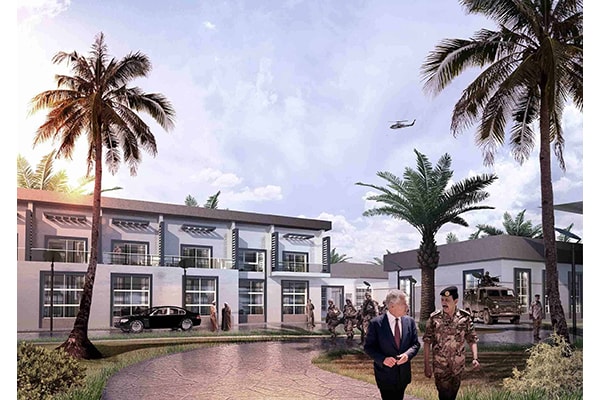
The spatial program is divided into rigorous functional zones: advanced athletic arenas, health gymnasiums, and secure visitor dormitories. Sited deep within an arid landscape, the architecture acts as a defensive shield against extreme climatic conditions. Heavy geometric massing and strategic structural shading generate a sustainable internal micro-climate, ensuring that the physical and psychological well-being of the officers is maintained without compromising the integrity of the secure perimeter.


This project proves that remote military outposts can provide high-performance living and training standards. By integrating robust materials with precise environmental engineering, the complex serves as critical morale-boosting infrastructure. The methodologies governing the design of highly secure, site-specific civic architecture are part of the firm’s broader analytical approach, outlined in how-we-work. For governmental and institutional bodies requiring classified architectural interventions, the engagement framework is available through bespoke-architecture.

