White Land: Hajj Design Competition
Hajj and Its Importance
Hajj is an essential pillar of Islam, and annually approximately 2-3 million Muslims flock from around the world in order to lead this main pillar to Makkah Al-Mukarramah, and according to the vision of the Kingdom 2030, the Kingdom’s government has made 86 points for the Holy Places and the Two Holy Mosques and has made 39 points for housing services This is equivalent to 72% of the total focus points for serving the pilgrims.
Future Projections and Developments
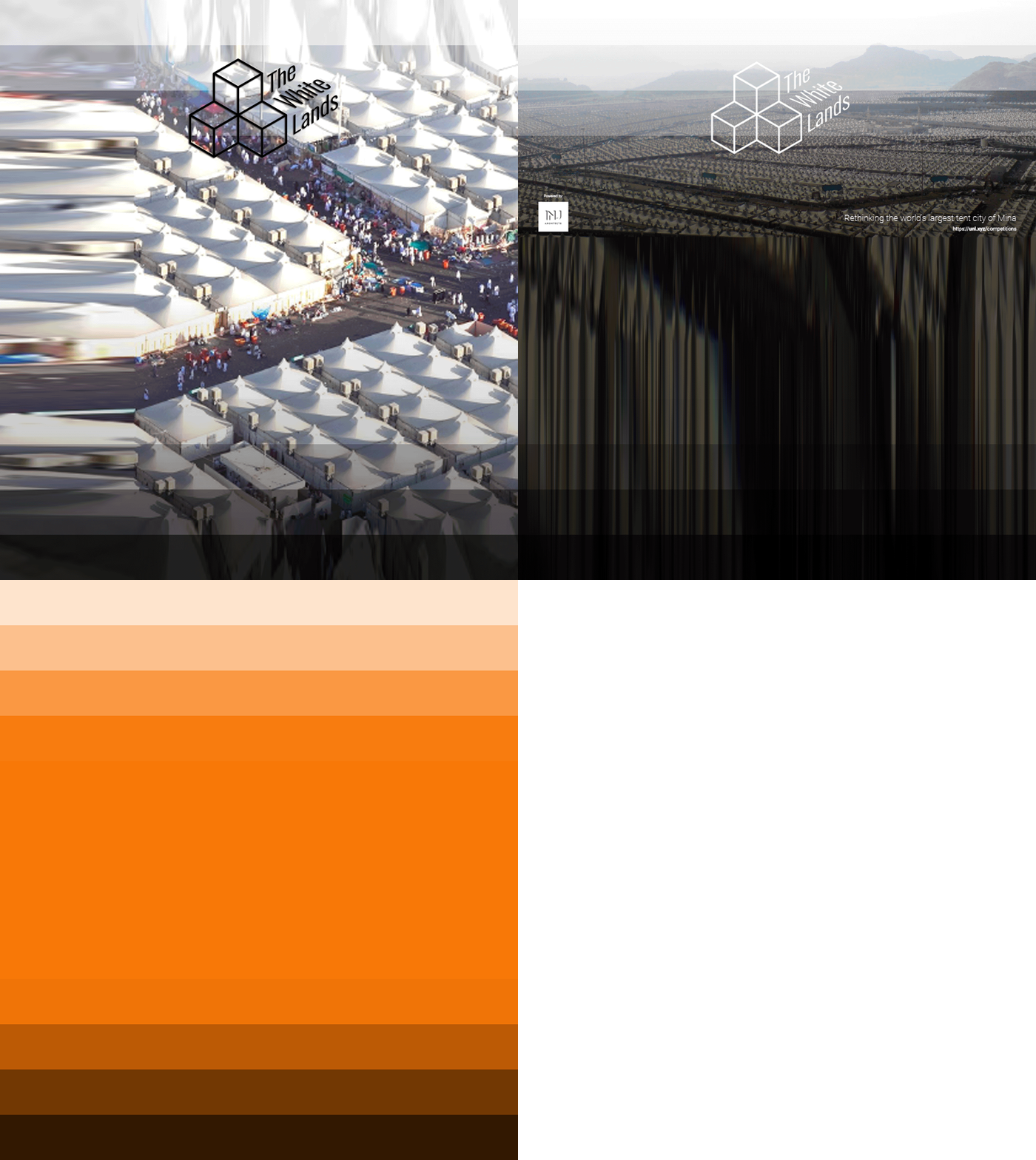
Based on court plans, the number of pilgrims is expected to increase to more than 5 million per year after the Kingdom develops the projects of the Two Holy Mosques. The only deterrent to increasing the numbers will be the capacity of the Mina area (Al-Mashaar Al-Haram). This area is known as the largest tent city in the world, where pilgrims live for 3-4 days and perform rituals in groups inside 20-meter tents. Each tent accommodates 8 people and is equipped with air conditioning and other services.


Introduction
Based on the previous data, the demand is high and high, and the innovation environment is considered an incubator and ready for activation and proceeding with the invention of a new style of geometric shapes or architectural patterns or modules through which a room can be constructed as part of a building, part of a neighborhood, part of a neighborhood, Everyone is linked with each other in a distinctive way, and the interconnectedness with each other is extremely cohesive.
Challenges
- Vertical and Horizontal Linkage: Ensuring practical connectivity.
- Group Accommodation: Designing for groups of 4-6 people.
- Terrain Adaptation: Suitability for mountainous areas.
- Accessibility: Ease of access, particularly for elderly pilgrims.
- Sustainability: A crucial evaluation criterion.
- Realism and Feasibility: Essential for selecting winning designs.
- Cost Efficiency: Focus on lowering construction costs.
- Health and Safety: Innovations to reduce epidemic risks and ensure safe communication.
- Service Areas: Effective design for bathrooms, food gathering, and eating areas.
Brief
Architectural competitions aim to solve future problems, and this Hajj Design Competition seeks designs that ensure the Hajj season, a vital economic period, is not lost. Innovations must address the practical needs of the pilgrimage while maintaining economic viability.
About the Organizer
Founded in 2009, INJ Architects is a young, dynamic studio in Saudi Arabia dedicated to implementing Vision 2030, which are the basis for a very important matter for the local community. The studio focuses on providing high-end, unique architectural designs and contributing to the local community’s development through sustainable solutions. Providing architectural, social and economic solutions is part of the sustainable vision of our team and we always aspire to develop the best.
Spatial Determinants
Participants must design a space unit that accommodates people comfortably and healthily, considering the following:
- Space units accommodating people comfortably and healthily.
- Average area per person: 3 square meters.
- Vertical extension: one floor above the ground floor.
- Construction capacity, cost and mobility.
- Emphasis on safety, including fire safety, flow, entry, and exit.
- Designs must prevent choking and stampedes.
Conclusion
The Kingdom’s efforts to enhance the Hajj experience through innovative architectural solutions aim to accommodate the growing number of pilgrims, ensuring safety, comfort, and sustainability.


For more on INJ Architects: