
Xi’An Train Station
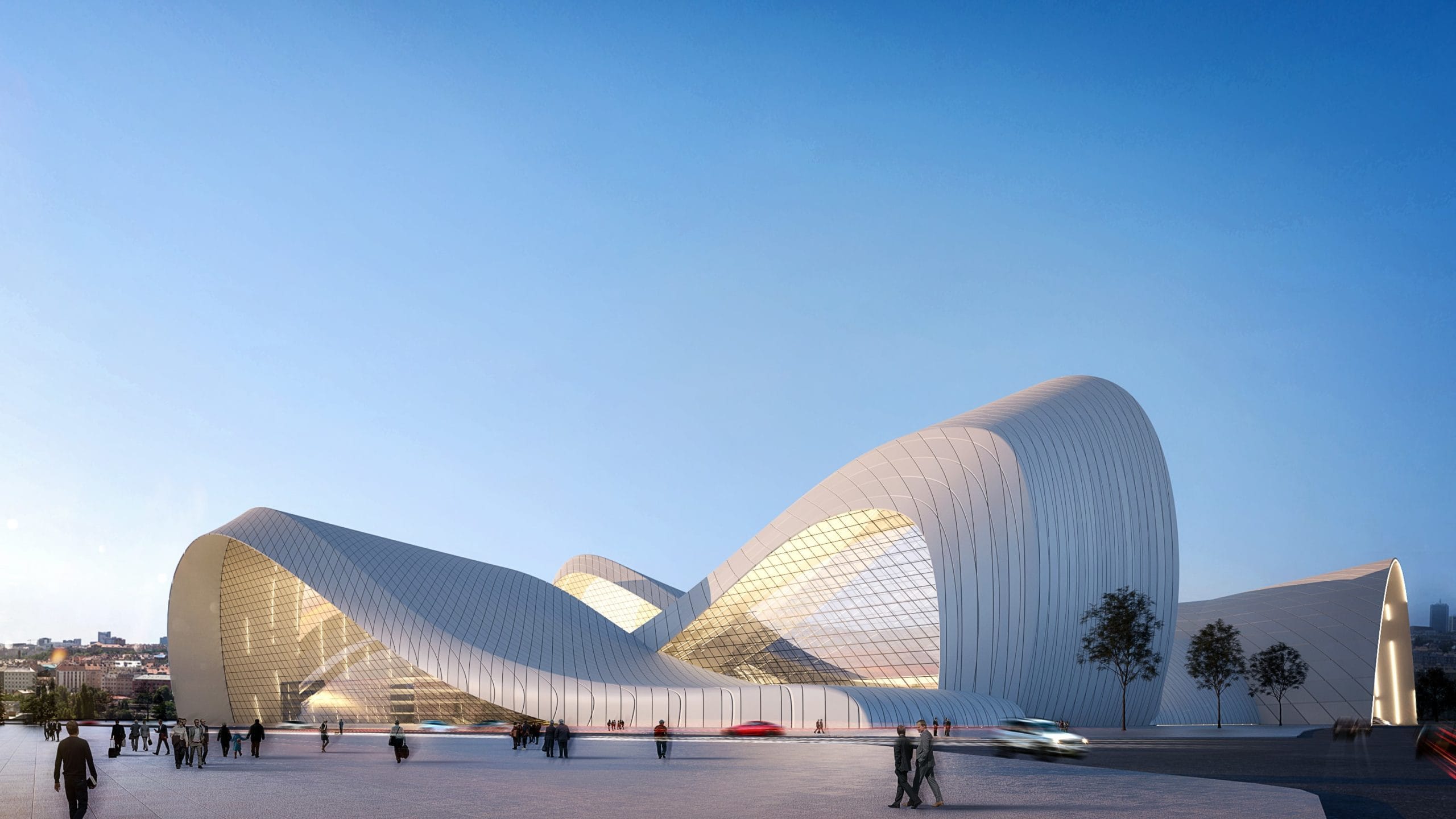
The site imposed its own conditions before design began. Irregular plot geometry, street setbacks running at oblique angles, and the fixed presence of the railway infrastructure produced a ground plane that resisted conventional orthogonal organization. Instead of a standard approach, the Xi’an Train Station proposal absorbed these irregularities. The controlling design decision was to place a single continuous undulating roof across the entire complex. This surface rises and falls in response to the programmatic volumes beneath it. For example, it bends over the hotel frontage, lifts above the concourse, and settles low over the arrival platforms. The site’s geometry became the rhythm of the form.
Location          Xi'an, China
Client            Xi'An Train
Type              Mixed-Use Transit Hub — Competition Entry
Program           Train Station, Hotel, Offices, Retail, Waiting Halls
Status            Competition Proposal
Year              2020
Principal         Ibrahim Nawaf Joharji
Scope             Urban Infrastructure, Environmental Performance, Civic Identity
Xi’an does not receive visitors quietly. It is a city that carries the full weight of Chinese civilization on a flat plain. It marks the terminus of the Silk Road and is the city of the Tang Dynasty court. It is also home to the Terracotta Army buried beneath its outskirts. Every infrastructure project here arrives into a skyline already dense with historical claim. Consequently, the question facing this competition proposal was not how to design a train station. Instead, it was what kind of horizon line a new transit landmark like Xi’an Train Station should draw across that particular sky.
Sweeping structural gestures simulate kinetic metropolitan energy while casting protective shadows over future pedestrian walking paths beneath the concrete shell
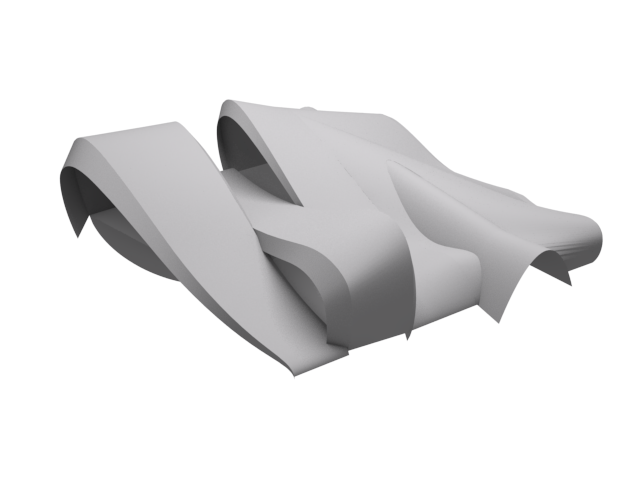
The roof is the project. Everything else program, structure, circulation, environmental systems follows from the logic of that single undulating surface. Its wave form is not decorative. Hot air rising from the concourse below is channeled upward through the curve. As a result, this produces natural ventilation without mechanical dependency across the full span of the station hall. The same curvature admits daylight from all sides. Thus, it eliminates the artificial twilight that characterizes most enclosed transit infrastructure. The form that produces the building’s visual identity is simultaneously the mechanism that keeps it habitable. The silhouette visible from across the city is performing environmental work at every moment. Moreover, Xi’an Train Station’s roof serves multiple functions for both environment and form.
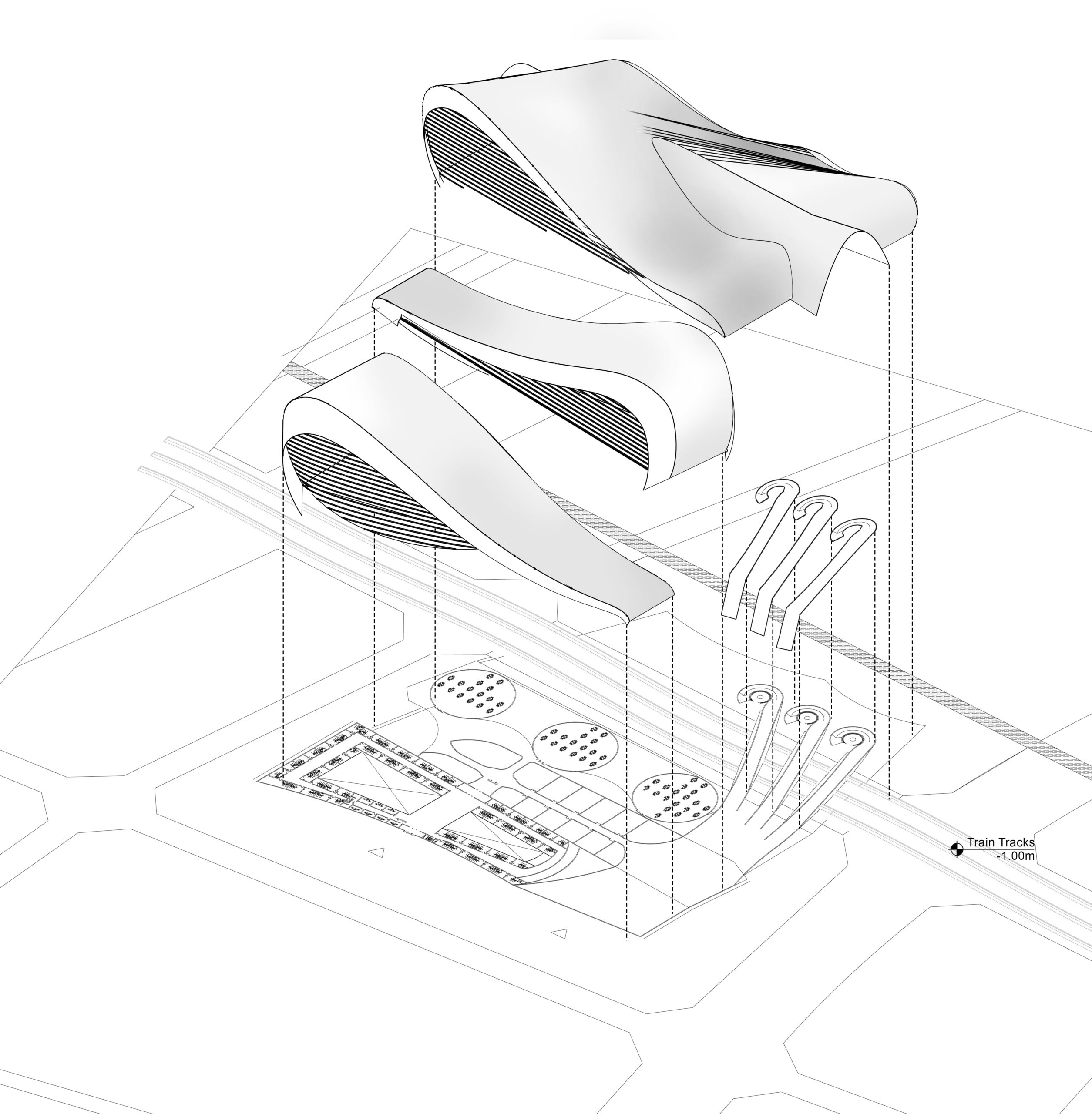
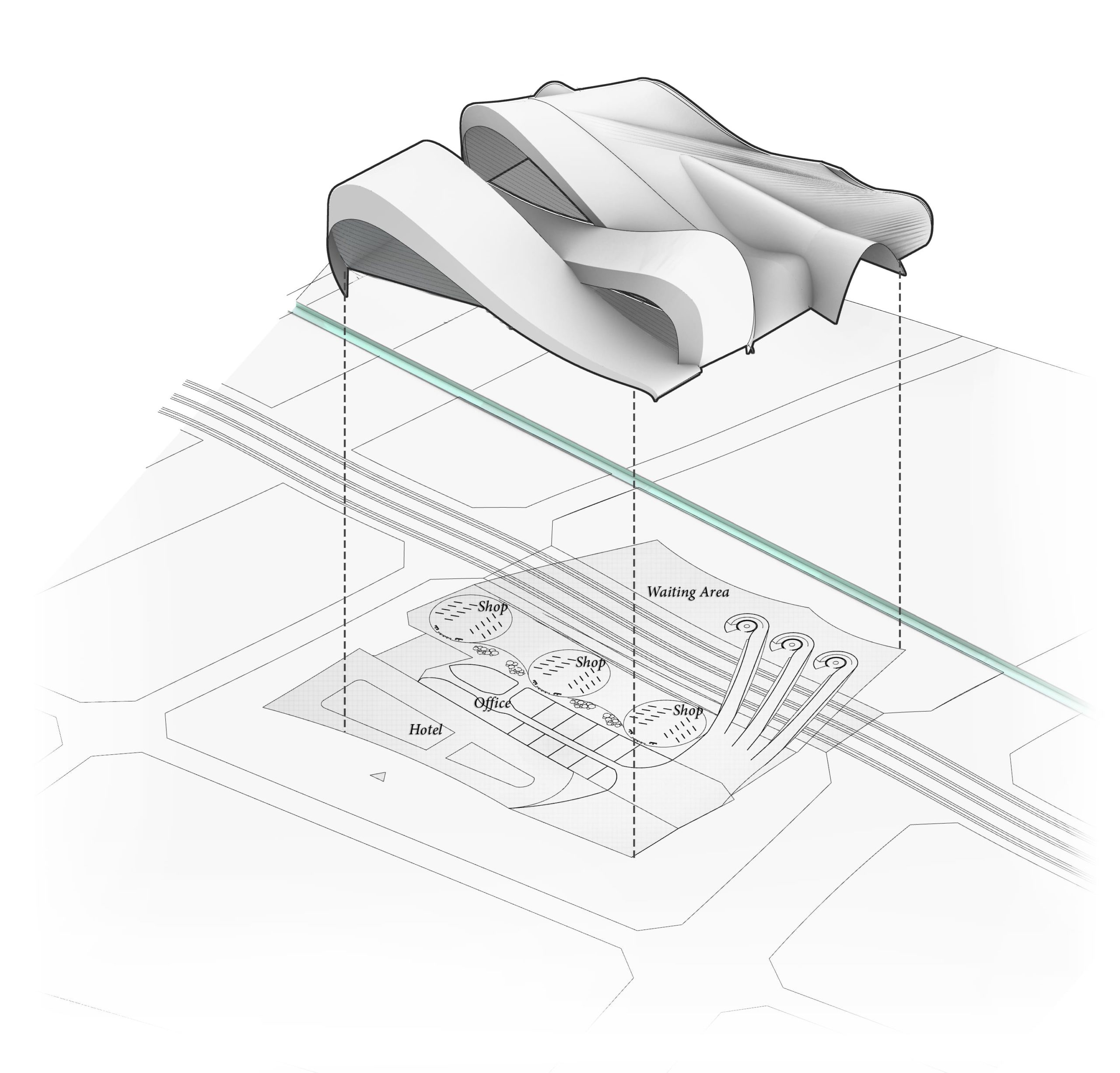
The program beneath the roof follows a clear spatial logic organized from street to rail. The hotel occupies the front edge, running parallel to the main street. It is the first thing arriving by car or foot, the building’s urban face. Offices occupy the middle band, functioning as a transitional zone. This is between the public intensity of the hotel frontage and the operational intensity of the station concourse. The rear of the complex opens into shopping halls and waiting areas, the deepest layer of the building. This area is insulated from street noise and organized for the slower rhythm of passenger preparation. The sequence from hotel to office to concourse to platform is a compressed urban section. It is a small city organized along a single axis of arrival. In fact, Xi’an Train Station is structured as a micro-city, seamlessly integrating urban needs and transit operations.
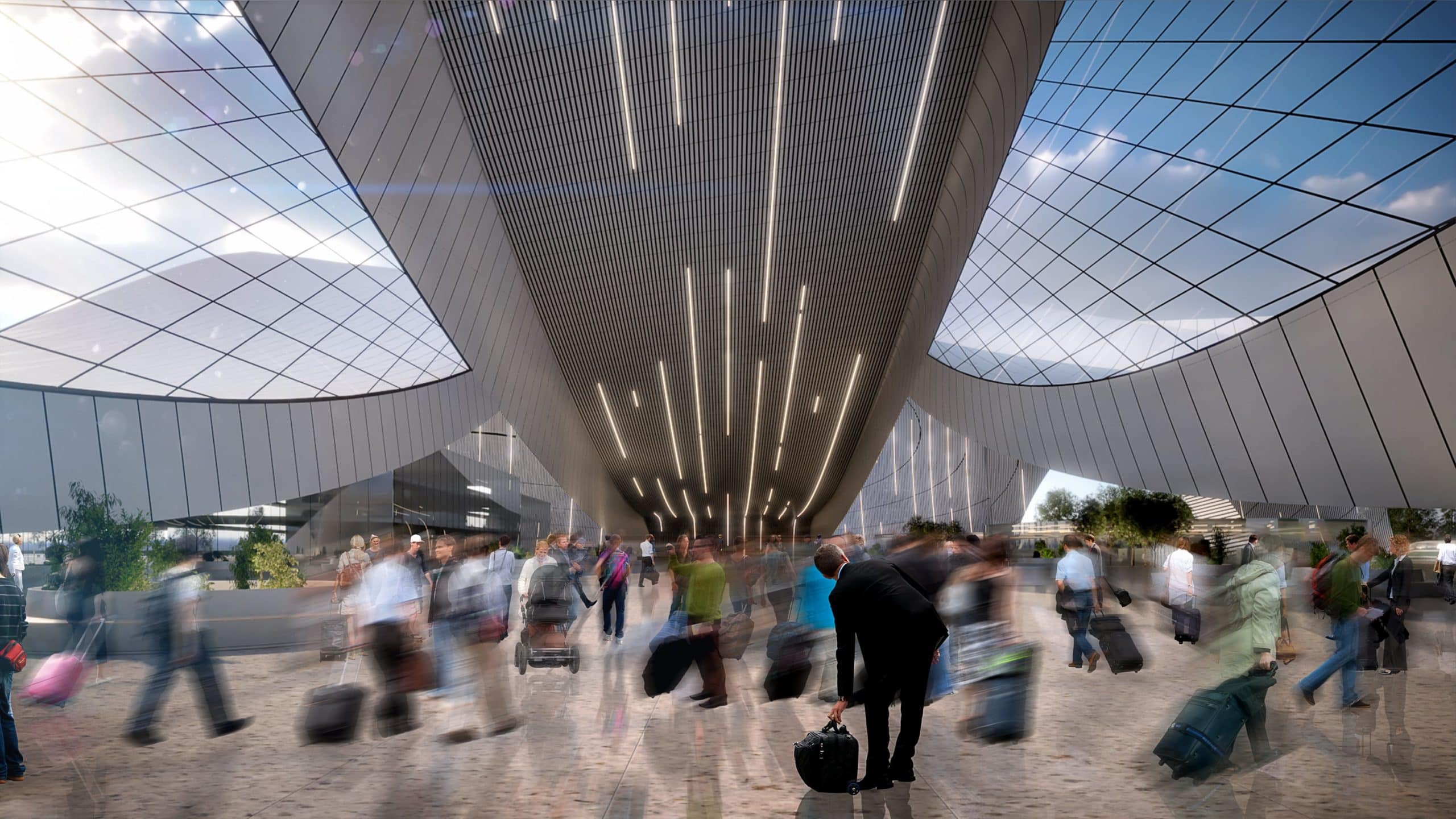
The sinography of arrival at this station is deliberate. Approaching from the main street, the visitor reads the hotel volume as a conventional urban facade — a point of orientation and scale. Moving through it, the roof begins its climb, and the concourse opens beneath the highest arc of the wave. This moment of entry into the station hall is spatially choreographed. The ceiling rises, daylight floods in from the glass wall enclosing the full length of the building, and the platform zone becomes visible at the far end through the transparent rear envelope. The traveler sees the destination. The train, the track from the moment of entering the building are in view. There is no disorientation, no sequence of low corridors before the reveal. The section reads clearly from end to end.
The glass perimeter wall was chosen in direct response to Xi’an’s urban air quality. The city carries industrial and dust particulate at density levels that make open-air platforms a chronic discomfort. The full glass enclosure protects the passenger environment while maintaining visual continuity between interior and city. Thus, the traveler remains aware of the urban landscape throughout, watching it from within a controlled climate. The roof panels are specified as lightweight cold-formed steel with a green roof substrate capable of supporting cultivation over time. The building’s upper surface becomes a planted horizontal landscape, absorbing heat and rain at roof level and returning organic matter to a site otherwise entirely given over to infrastructure. As a result, Xi’an Train Station demonstrates sustainability by integrating green architectural solutions.
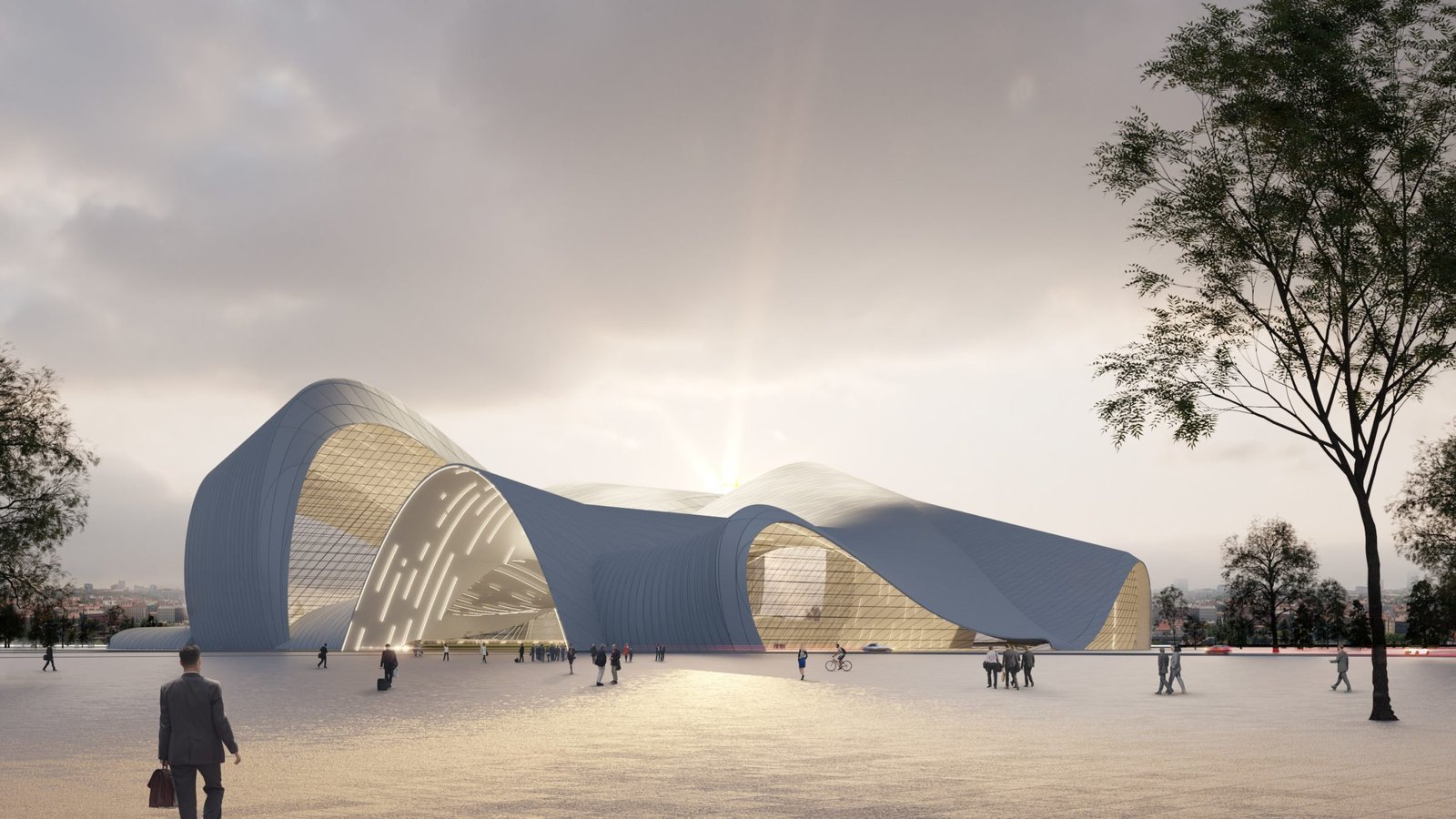
From the forecourt at dusk, the building reads as a settled landform rather than an imposed structure. © INJ Architects


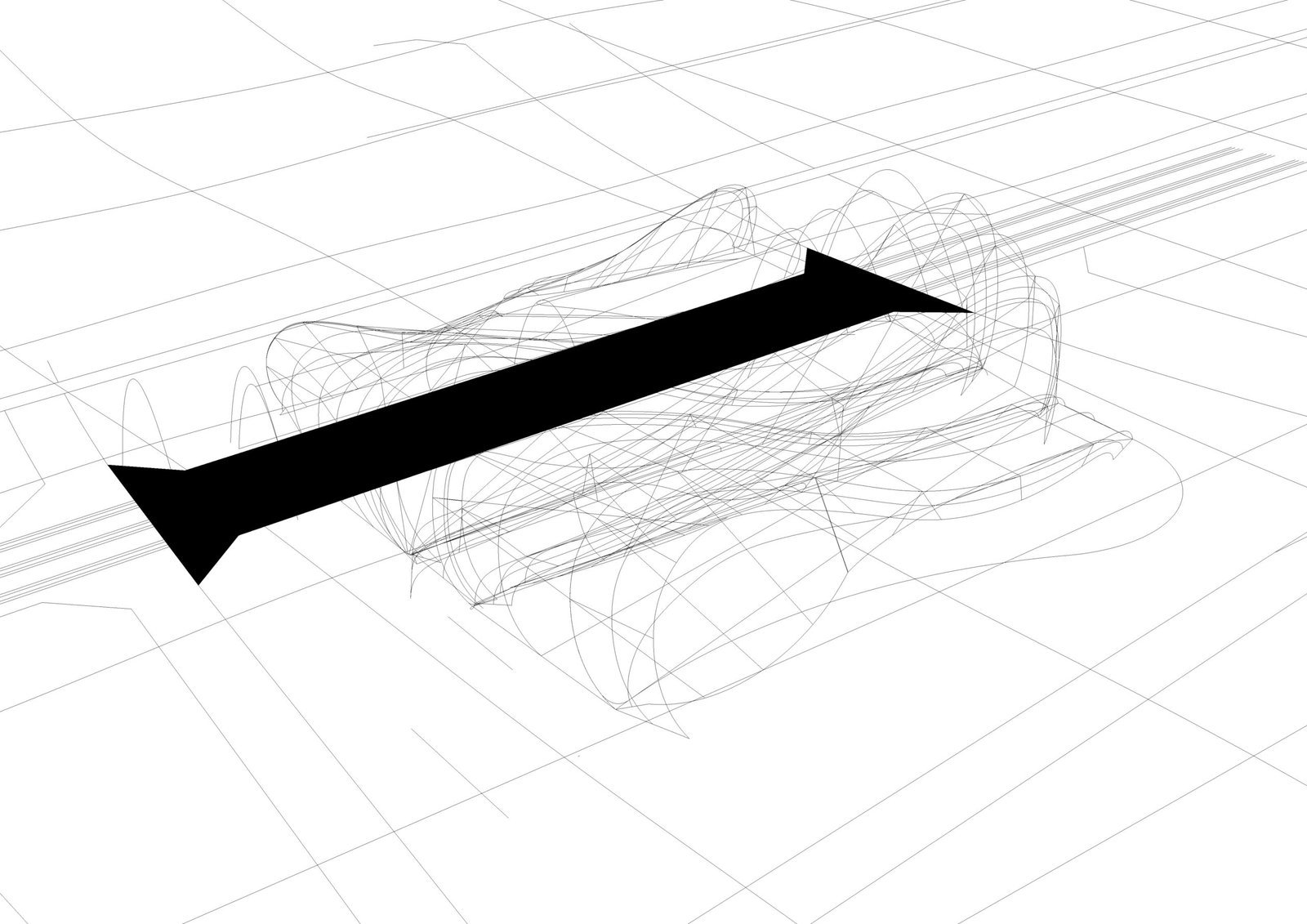
The arrow drawn through the wireframe names the single axis the entire building is organized to serve. © INJ Architects

This proposal belongs to a body of work at INJ Architects concerned with infrastructure buildings that earn their civic scale. These are structures that serve high-volume movement without reducing the experience of that movement to pure utility. The design methodologies governing projects of this complexity are detailed in how-we-work. For government bodies and developers exploring comparable transit and mixed-use commissions, the engagement framework is outlined in bespoke-architecture.