The impact of technological progress on dynamic architecture
Continuous change and innovation has become a feature of our modern age. Man has a constant desire to change and renew everything around him.
This is because of the psychological and physiological impact it has on both sides.
We have noticed this in the modern architectural trends that followed the idea of change in the form of movement,
as they dealt with two types of movement either objectively in the visual field, or mentally in the process of perception.
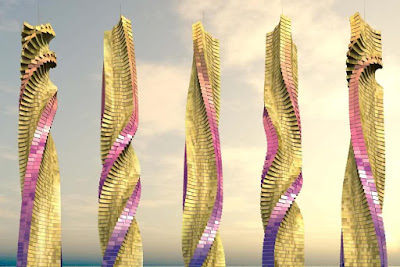
It is the dynamic movement, based on technological advances in inventing methods and techniques to help the designer access the movement of the building’s imagination and how to control it.
As for the (static) movement of the mind, it results from the designer’s ability to manipulate the blocks and plastic elements that create a different atmosphere of movement.
Which adds aesthetics and mental rhythm to the recipient,
and this shows the importance of the cognitive aspect of the fourth dimension in the design.
And its reflection on the psychological, environmental and aesthetic aspects of the recipient,
which will increase the quality of the design by using the thought of movement to create a dynamic architectural structure.
An interactive design that will have a direct impact on the interior design.
The effect of dynamism on the interior space
And by understanding the concept of the fourth dimension and its impact on the cognitive side of the user on the interior space and the building in general.
This will appear through a set of models that illustrate the different forms of the movement and its impact on the philosophy of the movement.
Through the cognitive aspect of the recipient,
and its impact on the psychological and physiological aspects of the human being in the void as a user and outside it as a receiver.
This brings us to a set of results, the most important of which is the effect of movement on the user,
the space and the elements in the space and how to analyze the form of movement in the design,
to achieve the philosophy of movement.

Static and dynamic architecture
Systems have a static and dynamic architecture,
where a static architecture is represented by a set of components that are organized into a hierarchy of components.
Each component in the hierarchy, the application of its components,
determines the internal structure in terms of sub-components and interactions in terms of connections.
The dynamic architecture is represented by a set of component and connection configurations that are controlled by modes.
Modes effectively represent the operating modes and fault-tolerant configurations of both software and hardware,
as well as the standard behavior of individual components.
The fourth dimension (time) is classified as one of the new concepts in contemporary architecture,
which is considered a means and a reference tool for the “temporal flow”.
Which was designed to run from the past through the present to the future, and on the other hand,
the architectural theorists dealt with the relationship between architecture and time in the design process.
This made time one of the dimensions of the visual perception of the place through the formation of a sequence of visual movement,
which causes an intellectual dynamism that generates movement in the design.
Which expresses in the visual field “dynamic”,
as it is considered a direct movement, or mentally it appears either objectively from the indirect movement.
This “static” mental movement results from sequentially arranging the plastic elements in the design,
in which the dynamic movement is simulated, but at a lower rate.
It depends on the ability and imagination of the designer on the kinetic structure of the mass, and the return on the elements of the interior design will appear.