Shuaibah Visitor Center
Water in Saudi Arabia is not a resource — it is a national project. The Shuaibah Desalination Plant, currently expanding to become one of the largest facilities of its kind in the world, extracts drinking water from the Red Sea at a scale that makes it one of the most consequential pieces of infrastructure on the Arabian Peninsula. The question ACWA Power brought to INJ Architects was not how to build a visitor center beside this plant. It was how to build a building that makes the plant’s story legible to the people who come to understand it.
The Shuaibah Visitor Center receives distinguished guests, government officials, researchers, and educational delegations at the threshold of one of Saudi Arabia’s most significant water security projects. It is the building through which the plant introduces itself — not its engineering, not its output, but its meaning. The commission required a structure capable of holding that introduction with architectural authority: a building that communicates the complexity of water transformation before a single exhibit is read, and that prepares the visitor for the scale of what they are about to encounter inside the plant itself.
Location          Shuaibah, Makkah Region, Saudi Arabia
Client            ACWA Power
Type              Visitor Center — Museum
Site Area         1,400 m²
Status            Completed
Year              2024
Principal         Ibrahim Nawaf Joharji
Scope             Architecture, Exhibition Design, Visitor Experience
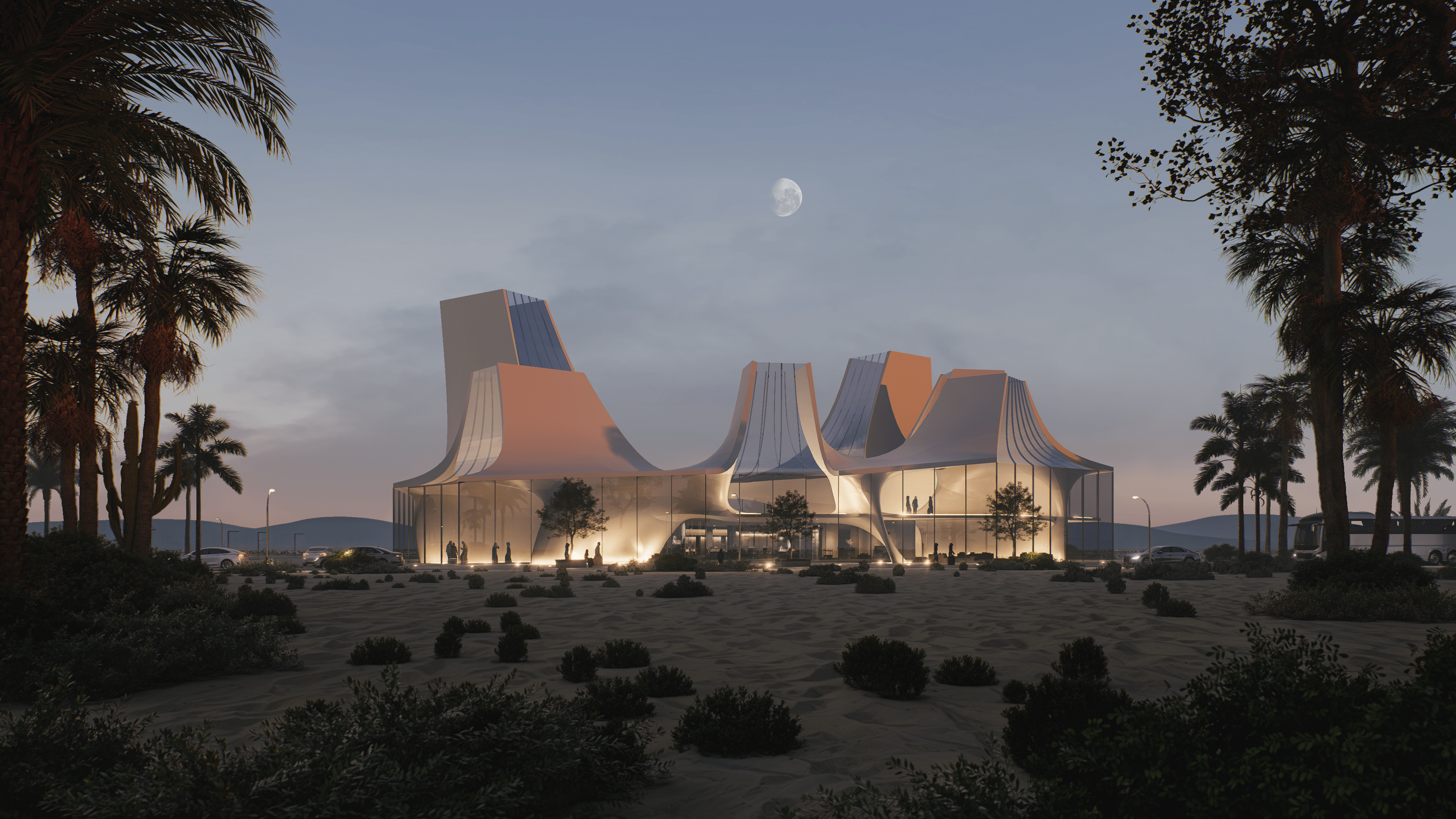
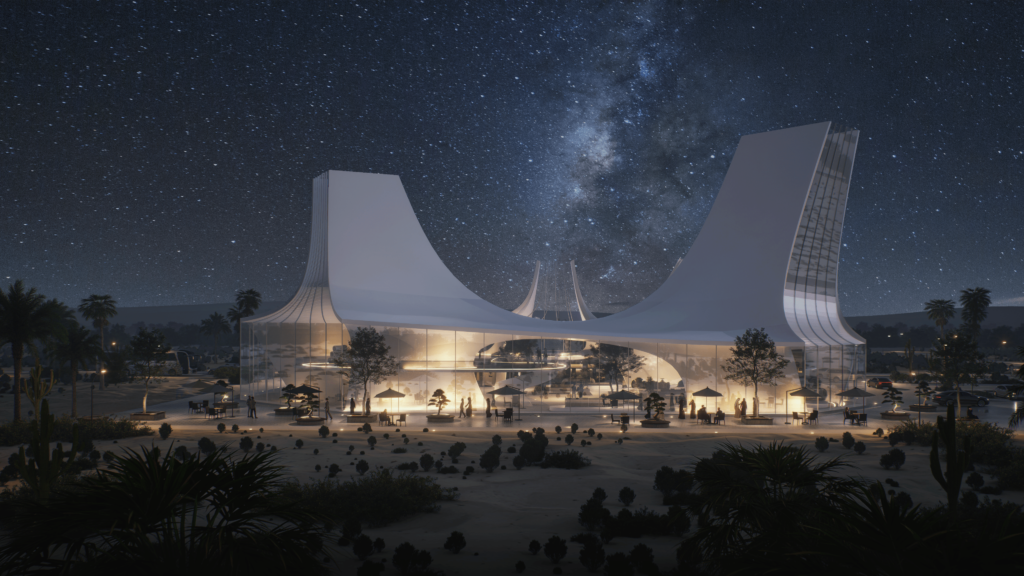
The design began with the water molecule itself. H₂O is not a symmetrical structure — its two hydrogen atoms bond to the oxygen atom at a specific angle that gives the molecule its polarity and its behavior. This angular, asymmetric geometry was the starting point for the building’s formal logic. The five towers that rise from the visitor center’s base correspond to the five stages of the water cycle: evaporation, condensation, precipitation, infiltration, and collection. Their heights are not arbitrary. Each was generated through mathematical modeling calibrated to the physical characteristics of its corresponding stage — the ascending, expansive quality of evaporation producing the tallest tower, the gathering, compressive quality of collection producing the most grounded. The towers are not symbols of the water cycle. They are the water cycle resolved as built form through parametric calculation.

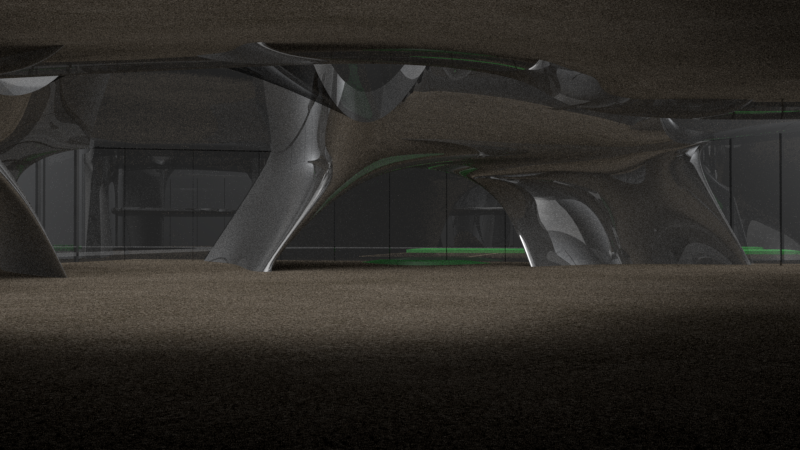
The visitor enters through a sequence designed to slow arrival rather than accelerate it. The approach to the building produces the first spatial experience before the threshold is crossed — the five towers reading against the coastal sky at varying heights, their organic GRC surfaces catching the Red Sea light differently at each angle of approach. The entry sequence channels the visitor into the building through a compressed transitional passage that opens into the Grand Exhibition Hall — a two-floor space whose simplicity is deliberate. The exhibition content traces the history of the Shuaibah plant in a spatial register that is clear and unhurried: the story of a plant that has been producing water for the region for decades, now expanding to a scale that places it among the world’s most significant desalination facilities. The two-floor organization keeps the visitor oriented while the organic ceiling geometry above — drawn from the same molecular logic as the exterior — makes the simple spatial arrangement feel continuous with the building’s larger architectural argument.
The Water Knowledge Gallery extends the exhibition into a digital and interactive register, its installations exploring water sustainability, desalination technology, and the environmental conditions that make the Red Sea a viable source for the scale of extraction the plant performs. The VIP lounge and guest reception areas occupy a zone calibrated for the delegations that the plant regularly receives — heads of state, ministers, corporate boards, international researchers — providing a hospitality environment whose material finish matches the significance of the visitors it serves without competing with the exhibition spaces that flank it. The dining and recreational zones open toward the coastal environment, the Red Sea visible from the same building that is dedicated to explaining how the water it contains becomes safe to drink.
The observation decks positioned within the five towers are the visitor center’s most direct spatial argument. From their platforms, the full extent of the Shuaibah plant becomes visible — the infrastructure of desalination at its actual scale, the pipes and processing units and storage facilities that the exhibition has just described in diagram and model now present in their physical reality below and around. The towers orient these views deliberately. Each deck faces a specific aspect of the plant’s operational landscape, the tower’s height and position calculated so that the view it provides corresponds to the stage of the water cycle it embodies. The visitor who ascends the evaporation tower looks outward toward the sea from which the water comes. The visitor who ascends the collection tower looks inward toward the plant’s storage and distribution infrastructure. The building is a pedagogical instrument as much as an architectural one — its sections producing the understanding that its exhibitions describe.
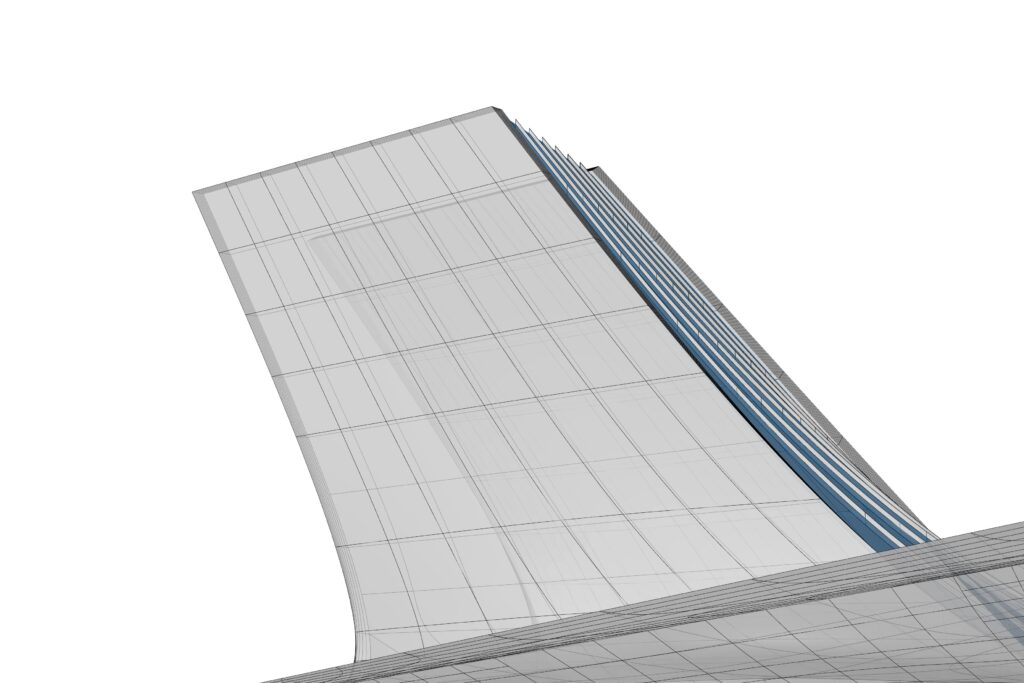
The coastal climate of Shuaibah shaped the environmental specification of the building directly. Passive cooling strategies leverage the sea breeze from the Red Sea, its direction and seasonal variation mapped against the building’s orientation before any mechanical cooling system was sized. The advanced shading system — its profile derived from the ripple geometry of water in motion — reduces solar heat gain on the facades most exposed to the afternoon sun. A greywater treatment system maintains the building’s landscape, the water recovered and reused in the same cycle of conservation that the plant itself embodies at regional scale. Locally sourced and sustainable materials minimize the construction’s carbon footprint, the building’s environmental performance aligned with the values of the institution it serves.
The Shuaibah Visitor Center belongs to a body of work at INJ Architects in which a building’s generative logic is derived entirely from the scientific and operational reality of its subject — architecture that does not represent water but is built from its mathematical and physical structure. The methodology governing this approach is detailed in how-we-work. The environmental performance framework embedded in the building’s passive systems and water management strategy is part of the broader approach outlined under sustainability. For institutions and government bodies considering visitor and educational facilities for infrastructure projects of comparable national significance, the engagement framework is available through bespoke-architecture.