Villa 200
The Saudi family’s relationship to domestic space is shifting. A generation that constitutes 70% of the Kingdom’s population is rethinking what a home needs to contain — moving away from the ceremonial rooms that accumulate square meters without accumulating use, toward spaces that are inhabited fully, daily, and by everyone who lives in them. The Villa 200 project is a design response to that shift, built four times on four identical plots.
Each of the four villas occupies a 200 square meter plot — a footprint that the conventional Saudi villa typology would consider constrained, its spatial customs having evolved around the assumption of significantly larger ground areas. The design does not treat 200 square meters as a limitation to be overcome. It treats it as a precise brief: eight residents, a full domestic program, and the quality of architectural space that the occupants’ daily experience demands. Every square meter is assigned to a function that is used. No room exists for ceremonial purposes that produce presence on a floor plan but absence in daily life.
Location          Jeddah, Saudi Arabia
Client            Private
Type              Residential Villa
Plot Area         200 m² per villa
Units             4 identical villas
Capacity          8 residents per villa
Status            Completed
Year              2022
Principal         Ibrahim Nawaf Joharji
Scope             Architecture, Interior Spatial Planning, Parametric Design
The spatial organization is built around multi-use living rooms — interior volumes whose dimensions and configuration allow them to serve different functions across the day without requiring physical reconfiguration. A room that is a family gathering space in the evening can be a work or study space in the morning because its proportions, its lighting, and its relationship to adjacent spaces were designed with that flexibility as a primary condition rather than as an afterthought. This is what the practice means by micro-home design: not the compression of a larger program into a smaller footprint, but the redesign of the program itself to match the way a contemporary Saudi family actually lives.
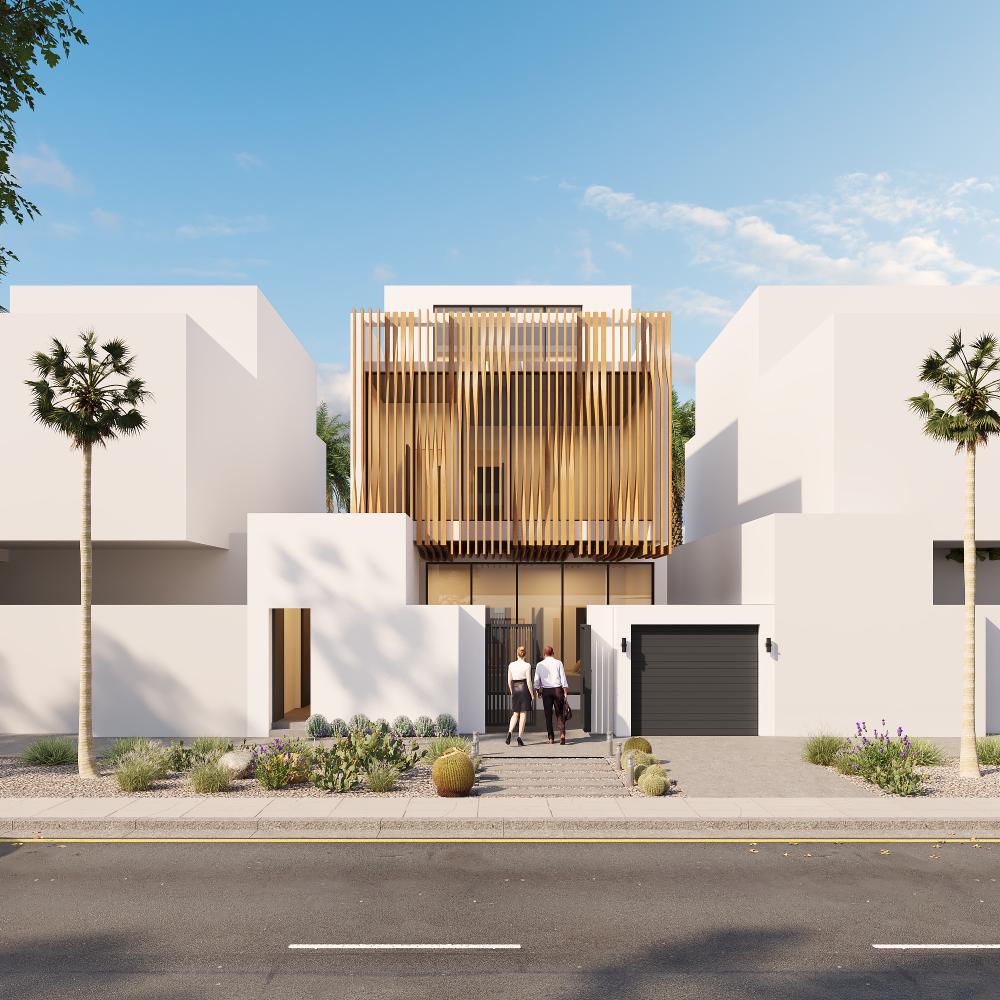
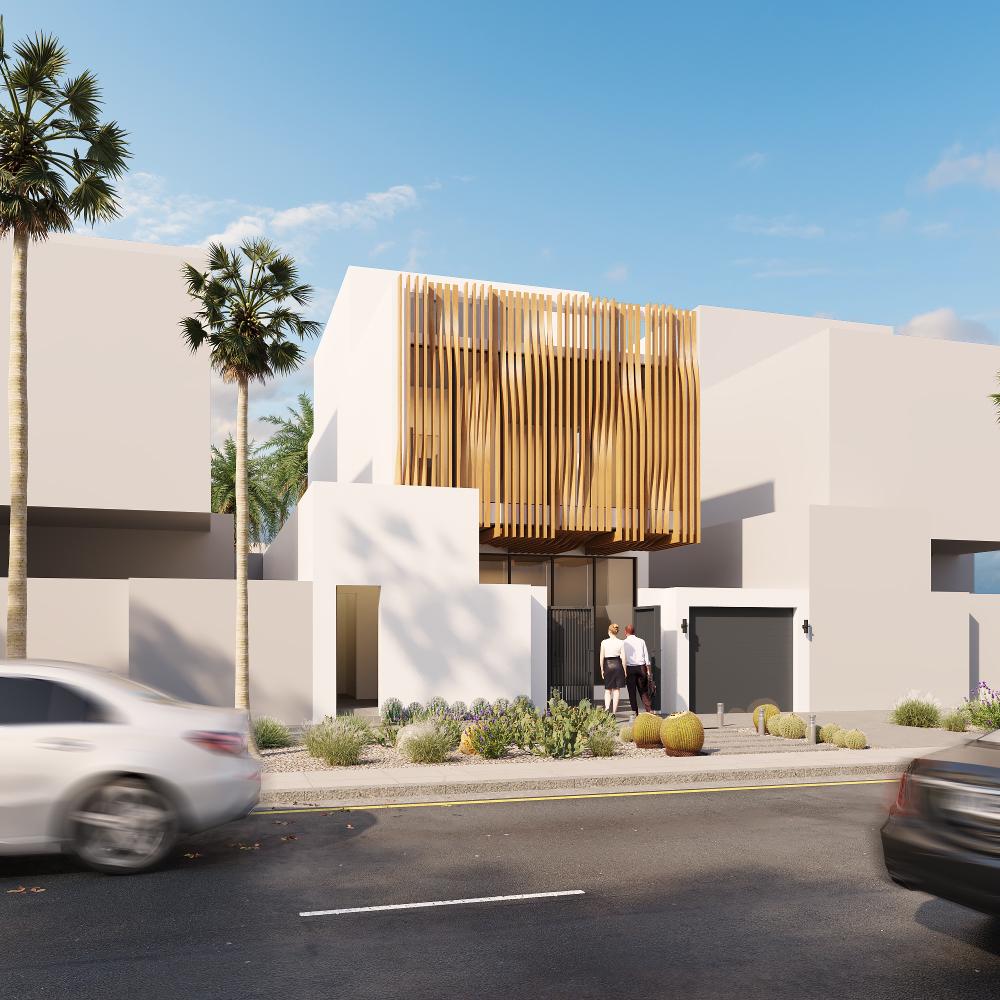
The facade of each villa is resolved in a modern parametric language that departs from the design conventions that have dominated Jeddah’s residential streetscape. The building’s external expression follows from its internal spatial logic rather than from the application of a stylistic identity onto a neutral volume. The facade orientation, the placement and proportion of openings, and the relationship between solid and glazed surfaces were calculated against the specific solar exposure of each plot and the privacy requirements of the street-facing and neighbor-facing elevations. The result is a villa that reads as contemporary and resolved rather than as generic — a building whose exterior is the direct consequence of the decisions made inside it.
The four-villa commission allowed the design to be tested and refined across identical conditions — the same plot area, the same program, the same client typology — producing a residential prototype that demonstrates what the 200 square meter plot can contain when the design begins from how people live rather than from how villas have traditionally been built. The methodology governing residential work of this type is detailed in how-we-work. For private clients seeking residential design that responds to the realities of contemporary Saudi domestic life within precise spatial and budgetary parameters, the engagement framework is outlined in bespoke-architecture.