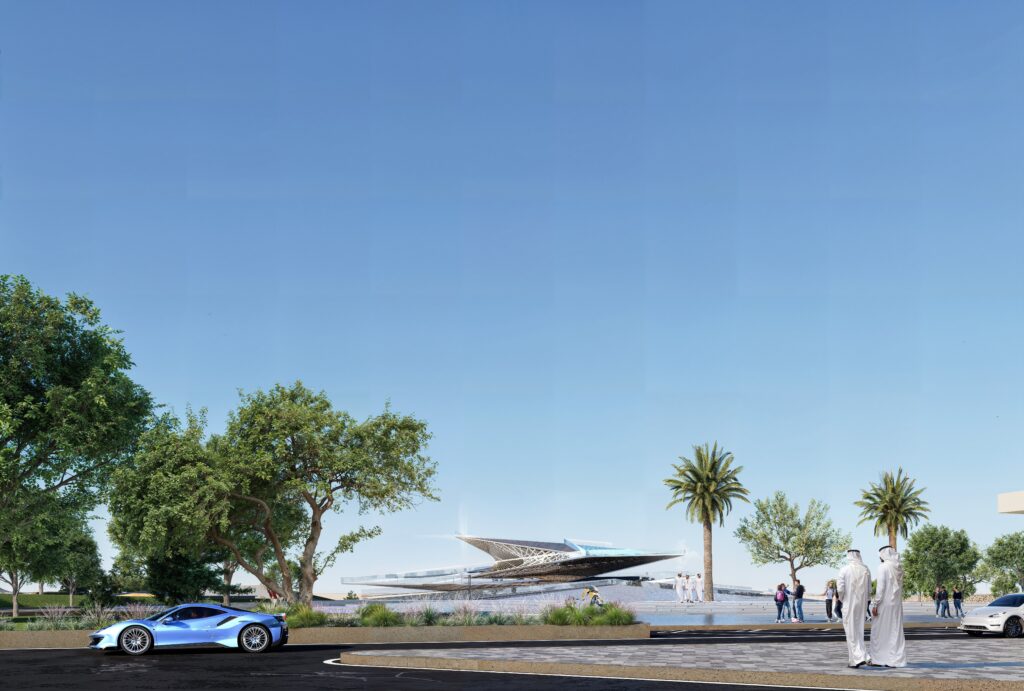
Riyadh Vista
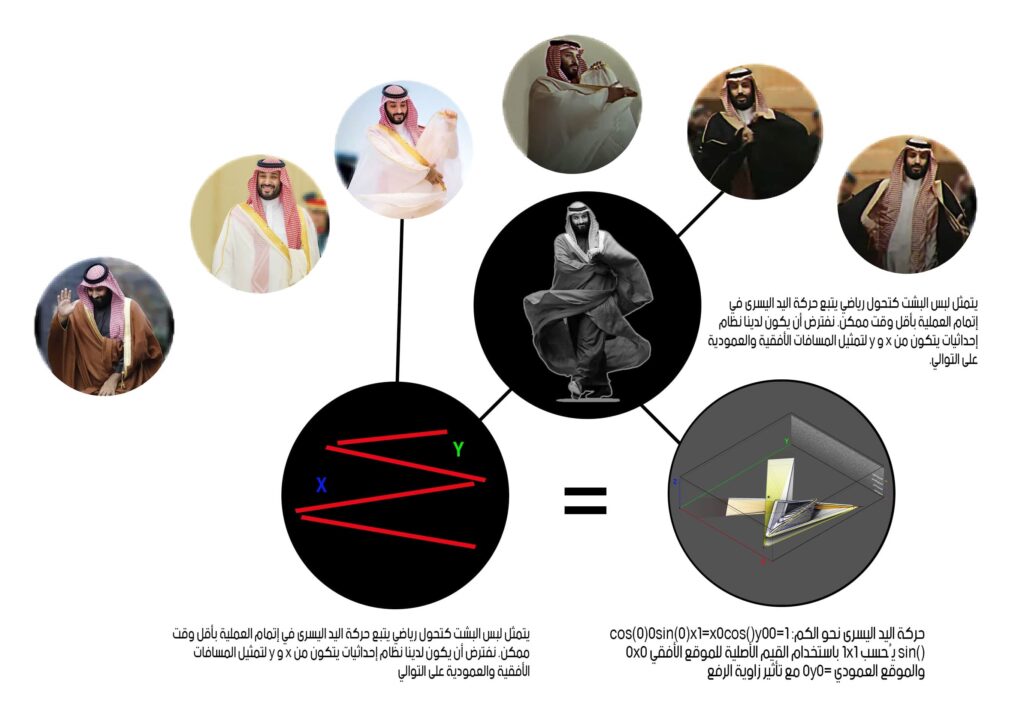
There is a specific moment in the wearing of the Saudi Bisht that lasts approximately 1.2 seconds. The left hand rises, the right passes beneath it, a loop forms, and the garment settles into its final shape around the shoulders. Crown Prince Mohammed bin Salman performed this gesture in a way that became culturally significant a movement that expressed something about Saudi identity that words had not yet named. The Riyadh Vista proposal translated that gesture into the organizing form of a civic landscape.
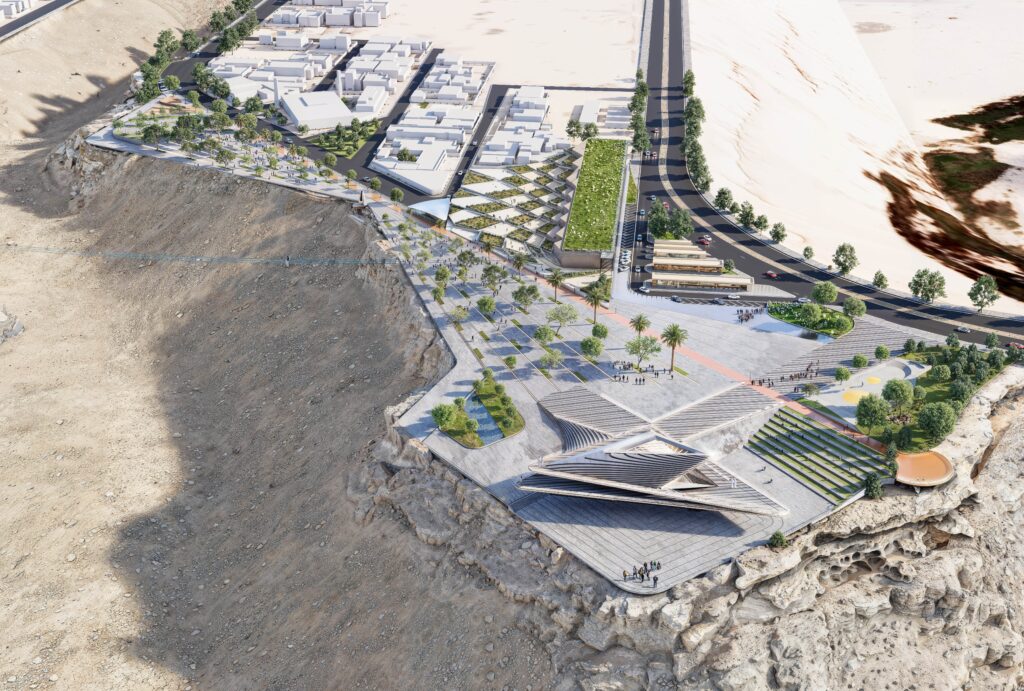
The site occupies a valley-edge promontory within the Saudi capital a topographically active ground that drops toward Wadi Hanifah and opens toward the Riyadh skyline simultaneously. The competition brief, submitted to Riyadh Municipality, called for a multi-use public destination that could serve as a cultural, commercial, recreational, and civic landmark. The proposal organized the full site around a single planning decision: a 550-meter primary axis that follows the longest possible line through the land, running from the project’s urban entry to the valley overlook at its far end. Everything else is distributed along and around this spine.
Location          Riyadh, Saudi Arabia
Client            Riyadh Municipality
Type              Public Civic Landscape — Competition Entry
Primary Axis      550 m
Built Coverage    25% of site area
Status            Competition Proposal
Year              2024
Principal         Ibrahim Nawaf Joharji
Scope             Urban Design, Pavilion Architecture, Landscape, Cultural Infrastructure
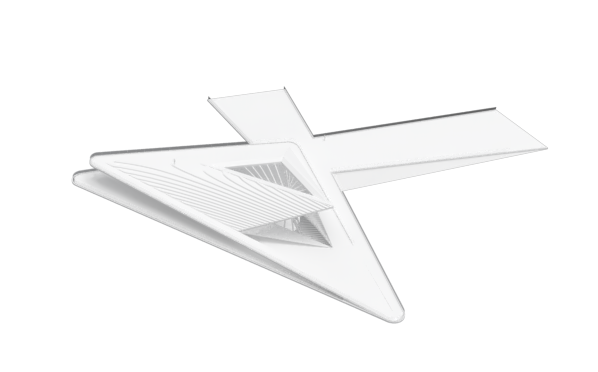
The Bisht’s draping movement was translated into architectural geometry through two parametric equations. The horizontal displacement of the left hand toward the sleeve follows the rotation equation x1=x0·cos(θ)−y0·sin(θ), and the vertical elevation of that same movement follows y1=x0·sin(θ)+y0·cos(θ). These equations describe the arc and height of the garment as it settles into its final draped position. Applied to the site’s horizontal axes, they produce the curved organic forms of the pavilion not as a symbolic reference to the gesture but as its direct geometric consequence. The pavilion is the Bisht’s movement held in concrete and steel at architectural scale.
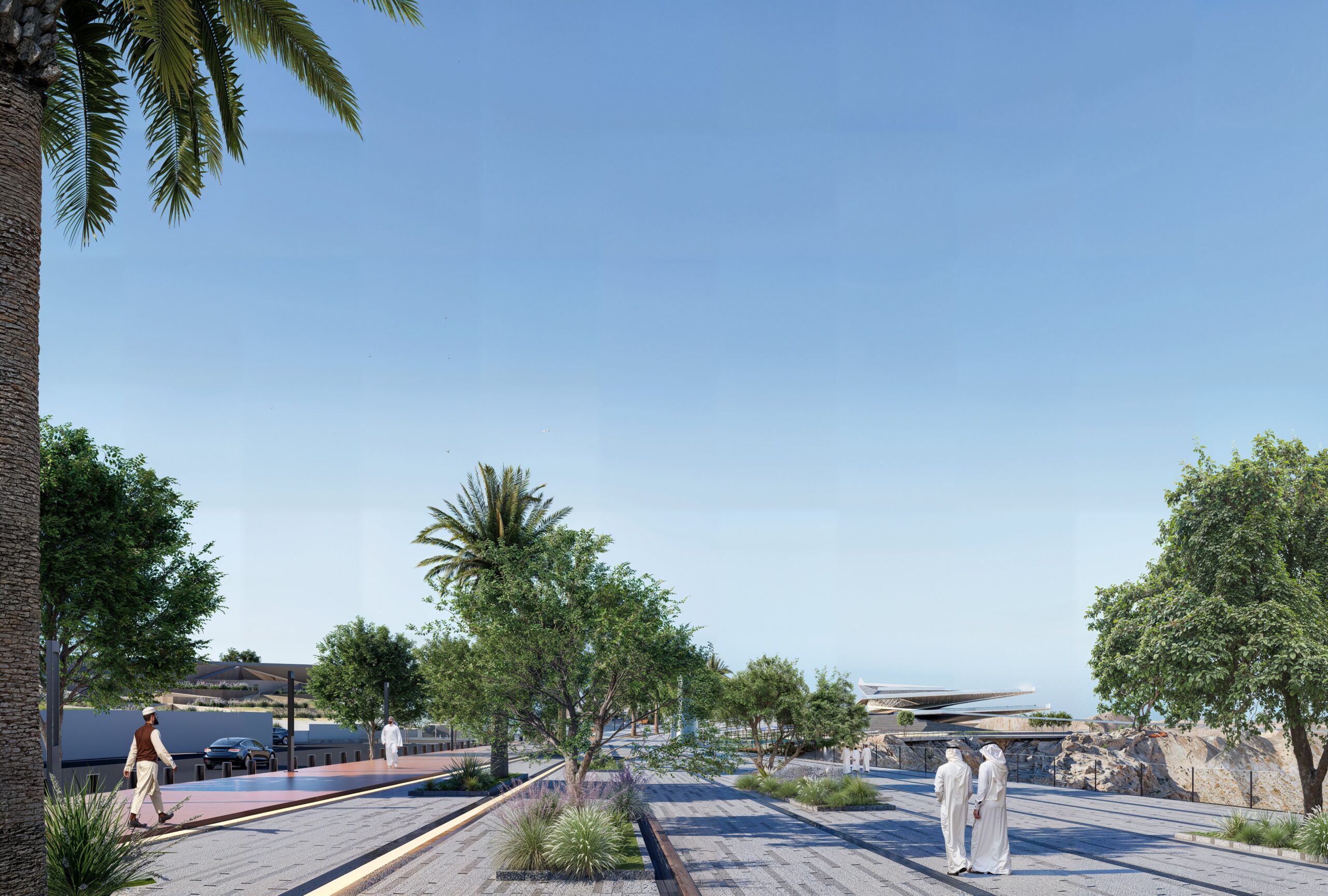
The 550-meter promenade is the project’s organizing spine and its primary civic offering. It begins at the urban threshold accessible, shaded, and calibrated for people of determination with fully inclusive design across its full length and moves through the site’s graduated landscape toward the valley edge. Along its length it encounters each of the project’s programmatic zones in sequence: the mosque square, the commercial and dining pavilion, the valley swing area, the camping terraces, and the panoramic overlook at the far end. The sequence is not incidental. It follows the site’s topography, with the ground rising and falling in gradients that the design reads rather than flattens, the path tracing the contour lines that the wadi’s geography has established over centuries.
The mosque square occupies a position of precise urban significance within the plan. It is oriented toward the Qibla the direction of Mecca and its open plaza faces this direction as a formal urban gesture rather than a programmatic afterthought. The square functions as the site’s gravitational center, the point where the promenade’s civic character is most fully expressed and where the project’s relationship to Riyadh’s religious and cultural identity is most directly stated. The triangle form that governs the pavilion’s architectural geometry reappears here as the organizing shape of the plaza, the three-layered triangular section referencing the density and architectural identity of Riyadh’s built environment in a form that reads as both local and contemporary.
The valley swing area sits at the site’s geographical center the promontory’s midpoint above the wadi and operates as the proposal’s most scenographic element. It is the moment in the promenade sequence where the visitor’s attention shifts from the path they are walking to the landscape they are standing above. The swing activates the valley view physically rather than passively: the body in motion, the horizon moving, the wadi visible below and the Riyadh skyline visible across it simultaneously. This is the project’s Wadi moment the spatial equivalent of the Bisht’s loop, where the movement of one element reveals the full extent of the space around it.
Ski and skating areas are positioned along the site’s graded slopes, their orientation and surface specifications calculated for the topographic conditions the contour analysis established. Camping zones are distributed across terraces at varying heights up to six levels, each terrace providing both privacy for its occupants and a view angle different from the one below it. Restaurants and food and beverage outlets are placed along the pavilion’s commercial zone with drive-through access from the site’s vehicular perimeter, their investment value established by their position between the promenade’s foot traffic and the valley overlook’s destination draw. The 25% built coverage limit established by the competition criteria was distributed across these programs to maximize the ratio of landscape to built footprint, the green spaces constituting the dominant material of the site and the buildings reading as points of arrival within a continuous outdoor experience rather than as the experience’s primary content.
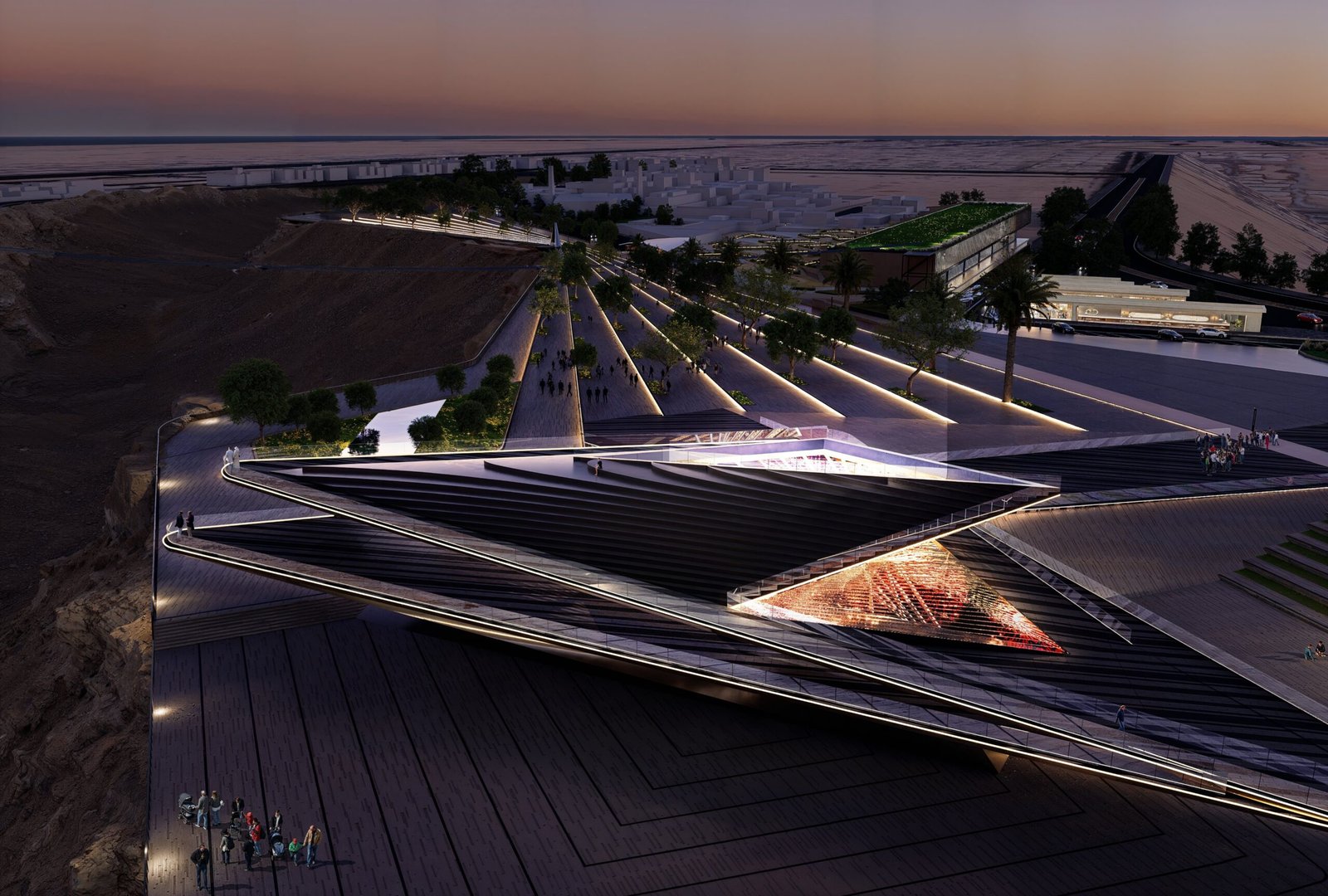
The pavilion is the proposal’s primary architectural object. Its form derived from the Bisht equations, calibrated against the site’s primary and secondary axes, and oriented toward Riyadh’s architectural landmarks to the south operates as a porous angled structure that uses solid mass and cut-in air corridors rather than glass facades to manage its thermal environment. The slits and cuts that produce the pavilion’s external rhythm are passive ventilation devices: they channel air through the structure, create shade on the interior surfaces, and reduce the solar gain that a fully enclosed building of comparable footprint would accumulate. The building breathes through its form before any mechanical system supplements the result.
The color and material palette was drawn from Riyadh’s built environment and its desert ground: warm limestone tones, exposed concrete in the valley-facing sections, and planting species selected for the site’s arid conditions. The visual identity of the project reads as belonging to this specific piece of ground rather than as imported from a global design vocabulary. This is the argument that the Bisht gesture makes about Saudi identity — that the contemporary and the inherited are not in tension but are the same thing, expressed differently in different moments. The Riyadh Vista proposal makes the same argument in plan and section.
The urban planning methodology and cultural research approach that produced this proposal are detailed in how-we-work. The environmental and landscape performance principles embedded in the site’s design are part of the framework outlined under sustainability. For municipalities and public authorities considering civic landscape commissions of comparable cultural and programmatic ambition, the engagement framework is available through bespoke-architecture.