
Al-Falak Mosque
The Quran does not describe a ship as a vehicle. It describes it as a sign — a condition in which the believer, stripped of all other recourse, turns to God with undivided intention. When the sea is beneath them and the shore is not yet visible, the call is pure. Al-Falak Mosque takes this moment as its architectural origin.
The RIBA competition for a new mosque near Preston, Lancashire placed the brief within a specific English context: a Muslim community in a mid-sized northern city, a prominent plateau site visible from multiple approach directions, and the need for a building that could serve as both a place of worship and a legible civic presence in a landscape where mosques have historically been absorbed into converted buildings rather than built as purpose-designed structures. The proposal rejected every convention of that inherited typology. It began instead from the Quranic verse in Surah Luqman — “Do you not see that ships sail through the sea by the favor of Allah that He may show you of His signs?” — and built the architecture from the spatial and structural logic of a vessel moving through open water.
Location          Near Preston, Lancashire, UK
Client            RIBA Competition
Type              Mosque — Competition Entry
Total Area        2,382 m²
Capacity          410 prayer mats (ground floor)
Floors            4
Status            Competition Proposal
Year              2021
Principal         Ibrahim Nawaf Joharji
Scope             Parametric Design, Religious Architecture, Landscape
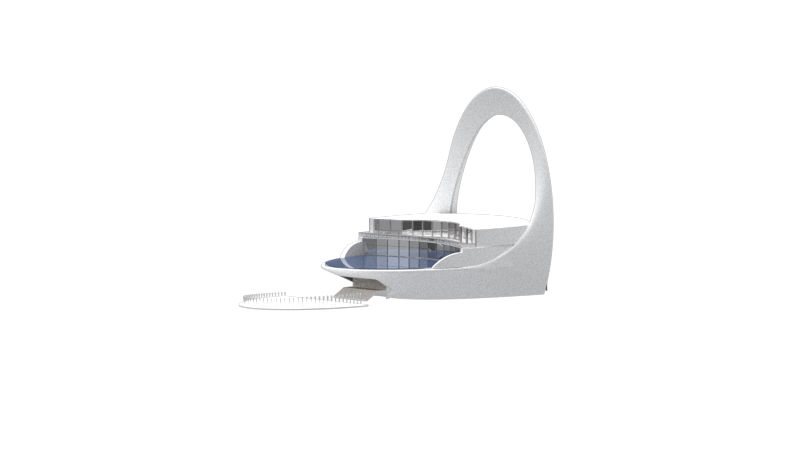
In this project, we introduce a bold design approach called Parametricism, leveraging computational design techniques. The proposed mosque is a statement of contemporary architecture, characterized by its sculptural and curvilinear form. The design is both a place of worship and a landmark, with its tall arch symbolizing the minaret and serving as a focal point. Inspired by a ship, a motif with profound significance in Islam, the architecture echoes the Quranic verse, “Do you not see that ships sail through the sea by the favor of Allah that he may show you of His signs?” (Al Quran 31:31).
The building’s primary form is a curvilinear sculptural mass whose tall arch rises above the horizontal body of the structure and functions as the minaret. There is no traditional tower. The arch is the minaret — a single gesture that marks the building’s presence on the plateau skyline from every approach direction and simultaneously declares the Qibla orientation to anyone standing in the surrounding landscape. The mihrab, which in conventional mosque design is an interior niche visible only from within the prayer hall, is expressed here as a large curved curtain wall on the ground floor exterior — a concave glazed surface that can be read from outside as the building’s sacred directional marker. The faithful can locate the Qibla from the car park. The building communicates its religious geography to the landscape before the visitor has crossed its threshold.
The section distributes four floors of program within the building’s curved geometry without allowing the upper floors to compromise the spatial clarity of the primary prayer hall below. The ground floor of 862 square meters contains the main prayer hall — a volume whose ceiling is kept clear of all vertical circulation, which is routed to the building’s perimeter so that the 410 prayer mats can be arranged without structural interruption. The large curved curtain wall floods this space with natural light from the Qibla direction, the light arriving through the same surface that marks the mihrab externally. The first floor lobby of 377 square meters receives visitors from the internal street, covered by the building’s overhanging form at the drop-off point, opening into a large entrance hall lit by a space frame skylight above. The second floor of 392 square meters houses the ladies’ prayer hall, positioned directly above the main hall and connected visually to it through a concave glazed floor element that allows the two congregations to share spatial awareness of the prayer below. The third floor of 753 square meters contains the library, community room, and meeting facilities — the building’s civic and educational program elevated to its highest level, overlooking the Lancashire landscape from the full extent of the plateau’s view.
The external landscape contains the proposal’s most intellectually precise element. The plaza immediately opposite the mosque entrance is a half-ellipse of paved surface surrounded by a field of twisted concrete monoliths of varying heights. Each monolith has a different angle at its base — different orientations, different starting positions, different heights — but at their crowns, every one of them turns to face south-east, toward Mecca. The monolith field is a spatial statement about the nature of the Muslim ummah: people arrive from everywhere, from different directions and different distances, with different histories and different heights of faith, and they converge at the same point. The monoliths are also sundials. Their shadows move across the plaza through the day, marking the hours and the prayer times through the action of light rather than through any electronic or mechanical system. The landscape performs the same religious functions as the building’s interior — orientation toward Mecca, awareness of prayer time — using only concrete, shadow, and the movement of the sun.
The structural material is concrete. The exterior cladding is glass fiber-reinforced concrete — GRC — specified for its capacity to be formed into any geometry the parametric design produces, its structural weight advantage over conventional concrete panels, and its durability beyond a century without loss of tensile or flexural strength. The entire exterior surface is white. The interior is kept white and unornamented — a deliberate position on the history of mosque design. The first mosques in Islam were built from clay and palm fronds. The conditions required for valid prayer are two: cleanliness and orientation toward the Qibla. Everything else that Islamic architecture accumulated over centuries — the tile work, the calligraphy, the elaborate muqarnas — arrived as additions to these two conditions, not as expressions of them. The Al-Falak Mosque returns to the two conditions and builds the architecture from them directly. The curvilinear white interior, flushed with indirect light along its curved walls and flooded with natural light through its glazed elements and space frame roof, is not minimalism as an aesthetic preference. It is the mosque at its structural origin — a clean surface facing the right direction, filled with light.
This project was not awarded a prize in the RIBA competition. The site redline, contours, and additional brief information arrived late in the design process, limiting the proposal’s ability to fully address every competition criterion. The architectural argument it makes about mosque design — that the building’s form can carry the full weight of Islamic spatial meaning without ornament, that the Qibla can be communicated to the landscape rather than concealed within the interior, that the minaret can be resolved as a structural arch rather than a conventional tower — remains intact and continues to inform the practice’s approach to religious architecture. The methodology governing this approach is detailed in how-we-work. For Muslim communities and institutions considering mosque commissions that demand this depth of architectural and theological engagement, the framework is outlined in bespoke-architecture.


