
Across the Gulf region, smart villas are becoming a central element in modern residential development. This shift is driven by environmental conditions, lifestyle expectations, cultural values, and rapid technological advancement. Instead of relying on traditional construction practices alone, today’s villas adopt integrated systems that reshape how residents experience comfort, security, privacy, and long-term sustainability. Many evolving projects in the region, such as innovative master-planning strategies similar to those seen in contextual community developments, show how technology is now embedded directly into the architectural DNA of contemporary homes.
Intelligent Spatial Organization Adapted to Gulf Climate
Smart villas in the Gulf are deeply influenced by climate demands. High temperatures, intense solar radiation, and seasonal humidity require carefully engineered building envelopes. Modern villas integrate sensor-based systems that monitor heat gain across each façade, enabling adaptive shading and automated ventilation patterns. Architectural strategies such as deep overhangs, thermal zoning, and internal courtyards have always been part of regional design, but technology now elevates them by coordinating shading devices with real-time environmental data.
For example, thermal zoning becomes significantly more effective when combined with automated climate controls. Public and private zones in villas, a concept explored in modern spatial layouts like those examined in urban multi-family planning studies, now benefit from temperature mapping that adjusts cooling intensity depending on occupancy levels and time of day. This leads to major reductions in energy consumption while improving comfort.
Advanced Home Automation and Integrated Living
Home automation is no longer limited to remote-controlled lighting or simple air-conditioning timers. Smart villas in the Gulf use fully integrated ecosystems that unify lighting, HVAC, security, water management, appliance control, and energy monitoring under one interface. These systems are typically operated through voice, multi-device apps, or automated routines that learn user behavior.
The goal is not luxury for its own sake but efficiency and comfort. For example, lighting scenes adapt to circadian rhythm cycles, blinds calibrate based on glare detection, and greywater systems respond to usage peaks. Architectural planning supports these systems by creating seamless service routes, concealed control panels, and flexible spaces that can evolve with new generations of digital infrastructure.
Privacy-Oriented Technology for Culturally Rooted Living
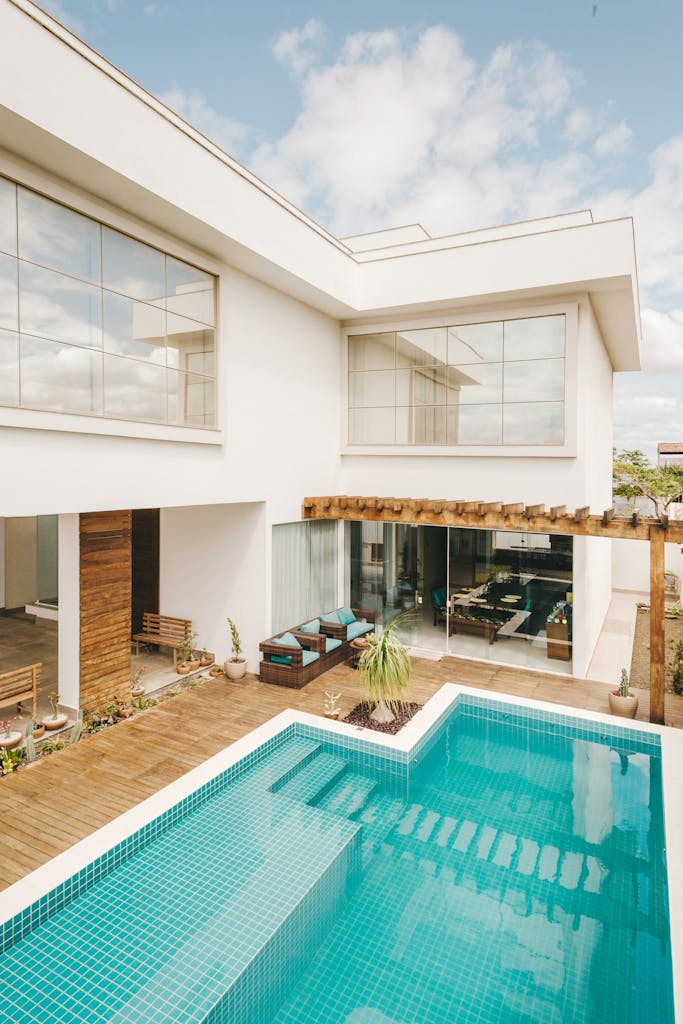
One of the most distinctive aspects of residential architecture in the Gulf is the importance of privacy. Smart technology enhances privacy principles without compromising openness or natural light. Smart glass, directional shading devices, and façade-embedded sensors enable transparency or opacity depending on external movement or interior needs.
The concept of layered privacy is supported by spatial hierarchies similar to those explored in private residential villa studies, where outdoor living spaces, guest areas, and family zones are arranged to protect personal routines while maintaining hospitality traditions. Technology strengthens this by controlling visual access, regulating exterior lighting, and enabling adjustable security thresholds for different users within the household.
Energy Efficiency and the Shift Toward Self-Sufficient Homes
With rising environmental awareness, Gulf residents are increasingly interested in reducing energy dependence. Smart villas incorporate photovoltaic roofs, battery storage, intelligent water networks, and highly efficient building materials. Energy dashboards track consumption patterns, providing homeowners with a detailed understanding of where energy is used and how it can be optimized.
Cooling remains the region’s highest energy demand, so many villas integrate earth-coupled cooling, high-albedo materials, advanced insulation, and thermal mass strategies. Architectural research trends similar to those reflected in adaptive climate-responsive planning highlight that a combination of passive and active systems is the most effective pathway to long-term sustainability.
Security Systems Reimagined Through Technology
Security in the Gulf has evolved from physical barriers to intelligent monitoring. Smart villas rely on layered systems consisting of real-time surveillance, geofenced access points, biometric entry, and predictive threat analysis. Instead of being intrusive, these systems integrate subtly into building elements, creating a secure environment that still feels residential and welcoming.
Architectural detailing plays a major role, ensuring that sensors, cameras, and monitoring infrastructure remain visually discreet. The design of thresholds, entry canopies, and circulation paths supports the logic of these systems, ensuring that technology enhances the architecture instead of overshadowing it.

Interiors Designed Around Connected Lifestyles
Inside the home, technological integration influences how spaces are shaped and used. Kitchens use smart appliances that track inventory and energy loads. Living rooms include concealed AV systems that adapt to different activities. Bedrooms incorporate climate and lighting programs that improve sleep quality. Bathrooms employ water-saving fixtures synchronized with occupancy sensors.
Even the structural planning of villas is evolving to accommodate home offices, digital workstations, and multipurpose rooms—reflecting shifts toward hybrid work cultures in the Gulf. Many contemporary layouts, such as refined villa formations studied in spatial sequencing research, show how interiors are now designed with infrastructure pathways that support future technologies for decades.
The Future: Cognitive Homes and Predictive Architecture
The next phase of smart villas in the Gulf will move toward cognitive environments. These systems will not only respond to user commands but anticipate needs based on behavioral patterns. Predictive cooling, self-adjusting materials, robot-assisted maintenance, AI-driven energy optimization, and personalized environmental profiles will define the future of residential living.
Architecture will play a central role by embedding structural adaptability, flexible partitions, and universal wiring conduits that make upgrading technologies seamless. As the region continues to invest in advanced living environments, smart villas represent a natural evolution in the Gulf’s architectural identity—merging heritage, climate logic, and modern innovation.