
JED Art
Every city-branded landmark of this typology — the letters that mark an airport, a waterfront, a civic plaza — has the same structural problem: it works from one direction only. From the front, the word reads correctly. From the back, it is mirrored and illegible. The object addresses half its audience and ignores the other half. The Jeddah Art installation was designed to solve this problem rather than repeat it.
Jeddah carries one of the most recognizable three-letter airport codes in the region: JED. It is the code that appears on boarding passes, on luggage tags, on departure boards in cities across the world — the compressed identity of a city whose position as the gateway to the Two Holy Mosques gives it a global significance that most cities of comparable size do not share. The installation takes this code as its starting point and asks what a civic landmark built around it should do that a conventional sign does not.
Location          Jeddah, Saudi Arabia
Type              Public Art Installation — Urban Design Object
Status            Proposal
Year              2024
Principal         Ibrahim Nawaf Joharji
Design Rights     © INJ Architects — All rights reserved
Scope             Industrial Design, Public Identity, Parametric Construction
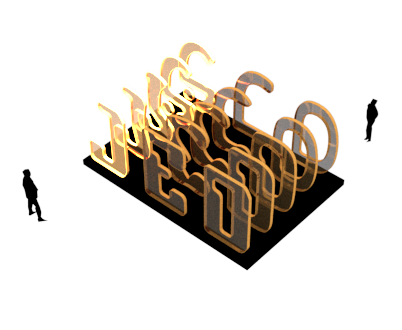
The solution is a three-layer parametric system. The installation presents JED in English to a viewer approaching from the front. From the back — the direction that conventional landmarks abandon entirely — the same physical object presents جده in Arabic. The three layers that constitute the letter forms are engineered so that the front face highlights the Latin letterforms and the rear face, through the rotation and positioning of an intermediate connecting layer, highlights the Arabic characters. The letter J and the Arabic ج share sufficient formal logic to allow the transition. The letter E and the Arabic ه resolve through the same parametric mediation. The letter D and the Arabic د complete the transformation.
The result is an installation that is 100% legible from every approach rather than 50% legible from one. A visitor arriving from the corniche reads JED in English. A visitor approaching from the opposite direction reads جده in Arabic. The object does not favor one language, one direction, or one audience over another. It is the same physical form serving both simultaneously — which is precisely what the city it represents does, as a place where the international and the deeply local have coexisted for three thousand years.
The structural assembly is built from five golden elements — two carrying the Arabic letterforms, two carrying the English letterforms, and a central intermediate piece that manages the transition between them. The base consists of four layers: black steel outer layers, heavy-duty internal structural layers, and a connecting system that anchors the assembly to its block. The letter body carries a transparent golden plastic outer surface, neon strip lighting on both interior and exterior faces, and a steel support frame. The neon illumination makes the installation functional at night as well as in daylight — the letters glowing in both languages from both directions, the city’s name present for any person approaching from any position at any hour.
The choice of JED as the English identifier is not arbitrary. It is the IATA code for King Abdulaziz International Airport — the designation that appears on every international flight arriving in Jeddah, the three letters through which the city is known to travelers before they have ever visited it. The Arabic جده is its direct equivalent: the city’s name in its own language, for its own people. The installation holds both in a single object, the parametric engineering of its three-layer system making the bilingual double reading possible without visible complexity. From the outside, it reads as a simple luminous landmark. The technical resolution that makes it work from both directions is contained entirely within its depth.


All design and intellectual property rights are owned by INJ Architects. The parametric letter-transition system, the bilingual double-reading mechanism, and the installation’s full visual and technical identity are registered under the practice. The design methodology governing this type of public identity object is detailed in how-we-work. For municipalities, cultural institutions, and developers considering civic identity installations of comparable technical and conceptual depth, the engagement framework is outlined in bespoke-architecture.