TopoArtic 2026: The Precision Behind the Colour
By Ibrahim Joharji
I am currently developing the TopoArtic works for 2026: reviewing their data, building their models, and testing the relationships between cuts, layers and colour. During this process, a task I expected to be straightforward gave me pause: applying three colours to a model whose geometry I had already completed. When I tried to save time with artificial intelligence, the results revealed just how much concentration this step requires.
From a distance, the work might appear to be a mountain divided into coloured bands. Look closer, and each band follows a path, each surface belongs to a layer, and each cut shapes the shadows and depth. These relationships give TopoArtic its particular character and set its visual experience in motion.
From terrain data to a geometric fingerprint
I begin by reviewing the drawings and their associated numerical data: contour lines, elevations, dimensions and available coordinates. I then build the three-dimensional model from this information. The mountain’s form is grounded in a specific reference; changes in elevation, the spacing of contour lines and their turns are reflected in the mass taking shape before me.
Technically, a contour line connects points at the same elevation. When terrain is represented as layers with thickness, the relationships between those lines become surfaces, edges and perceptible changes in level. The model’s geometric fingerprint rests on these relationships. Its accuracy remains tied to the quality of the reference data and the way that data is translated into geometry.
This connection to the ground gives me a starting point with its own character. My artistic decisions then develop what can be seen within it: which part to select, where to intervene, and how to reveal the composition’s depth.
The cut: the moment the mountain changes
After building the model, I apply the cutting system and arrange its layers manually within the digital environment. I review the position and shape of each cut, its relationship to the surrounding mass, and the successive surfaces it exposes. A small intervention can change how the entire composition is read: the resulting void directs the eye, its edge exposes the thickness of the layers, and shadow gives them a different presence.
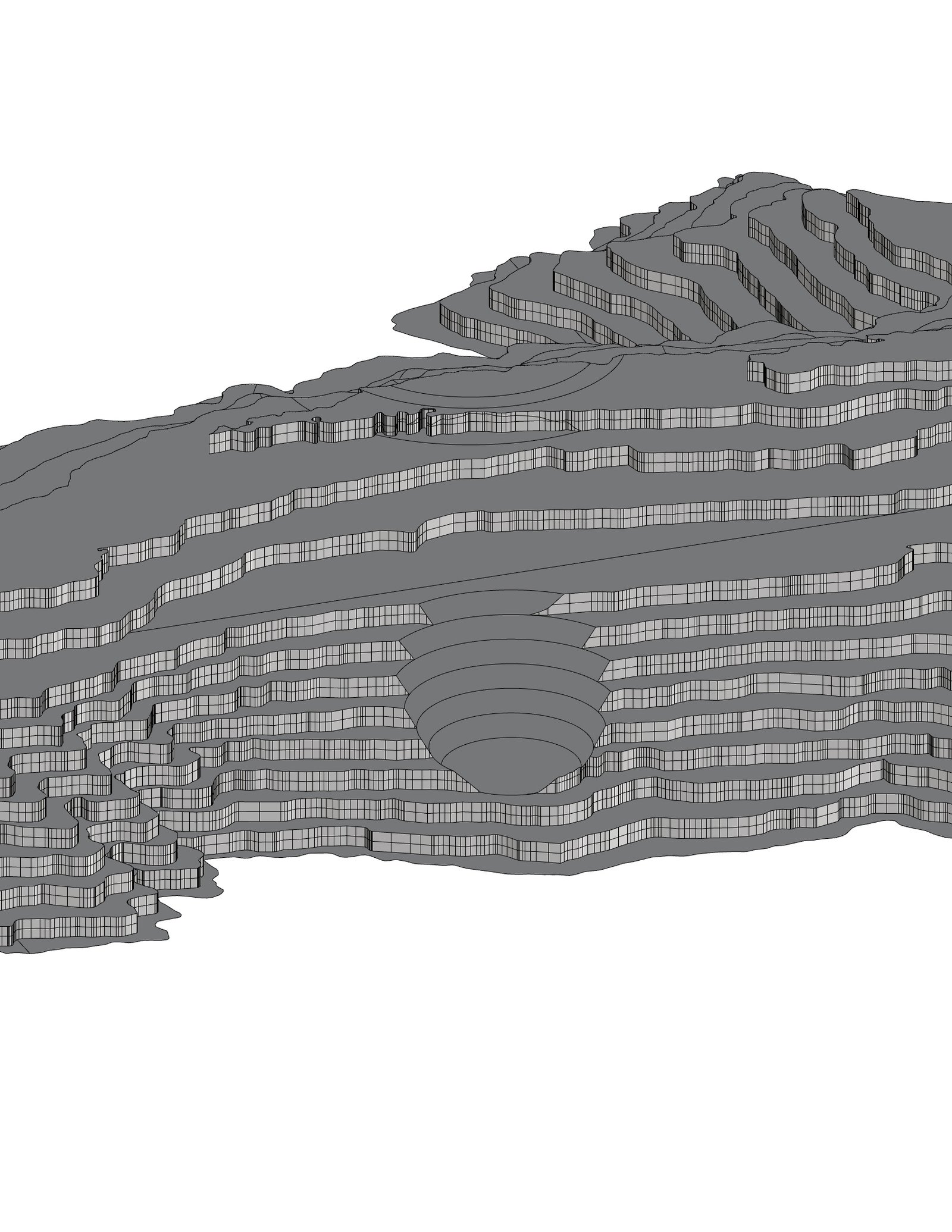
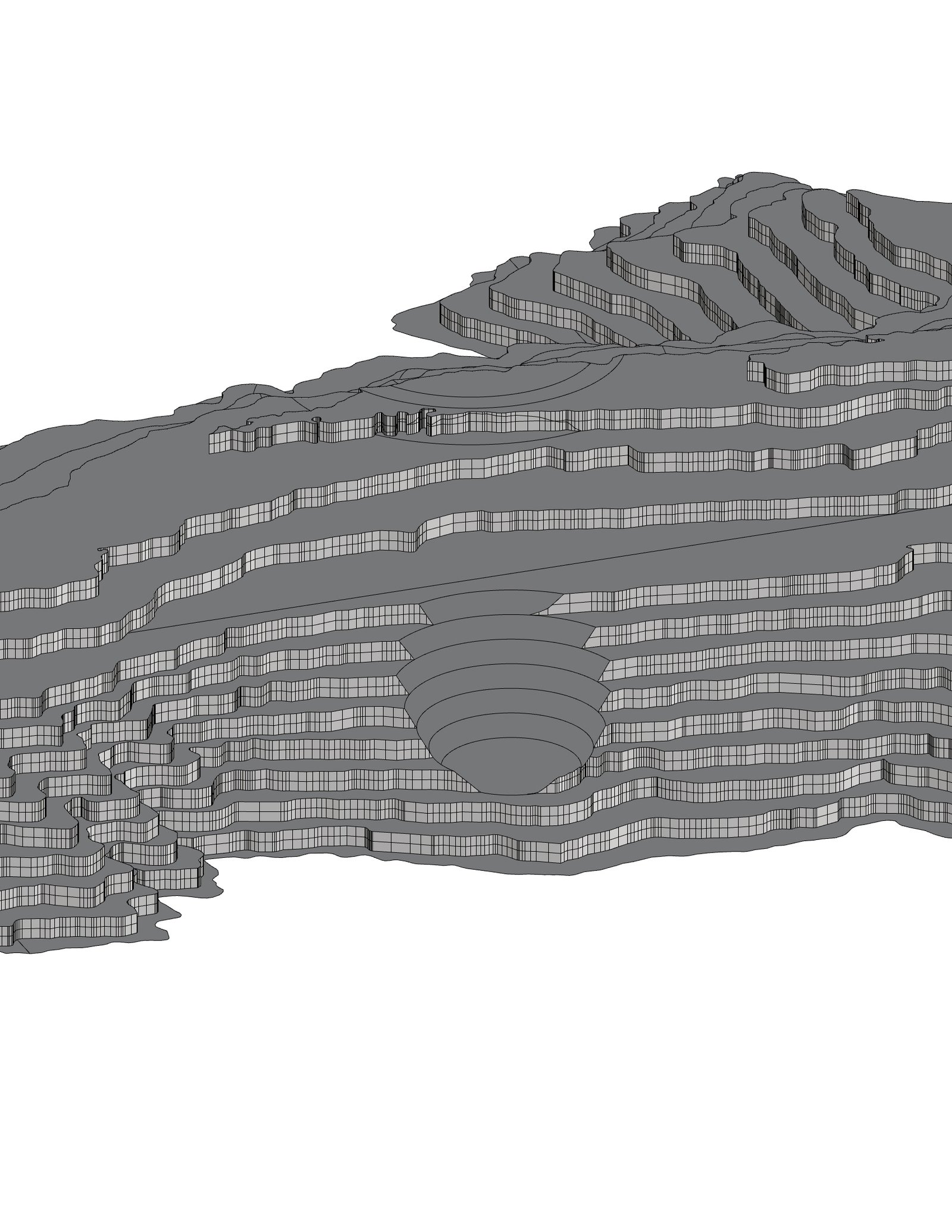
At this stage, I work continually between two scales: the complete composition and details that may disappear when the image is reduced. The apparent order of the layers depends on careful control where curves turn and cuts meet. The original model image shows the surface boundaries and edges that form the basis of the work before colour is applied.
Three colours, hundreds of visual decisions
Once the geometry and cuts are complete, I select colours in relation to the visual story I want to tell. For this experiment, I chose green, melon and yellow. The palette establishes the mood of the work, but its application tests the coherence of the whole.
My working rule is to preserve each layer’s colour identity across the surfaces that belong to it. A long horizontal surface may wrap around a cut, while its edge appears elsewhere in the image. That relationship must be followed so that the colour identity does not drift into an adjacent layer or change within the same surface without a deliberate decision.
This demands sustained visual and spatial concentration. What looks like a small patch on screen may belong to a layer extending across the model. Colouring therefore took considerably longer than the small number of chosen colours might suggest.
Where did AI enter the process?
It was at this specific stage that I tried AI tools to accelerate surface colouring. The model had been built, the cuts executed, and the composition established. I used images of the model as references for the trials. The task was to apply the colours while preserving the existing geometry and layer system.
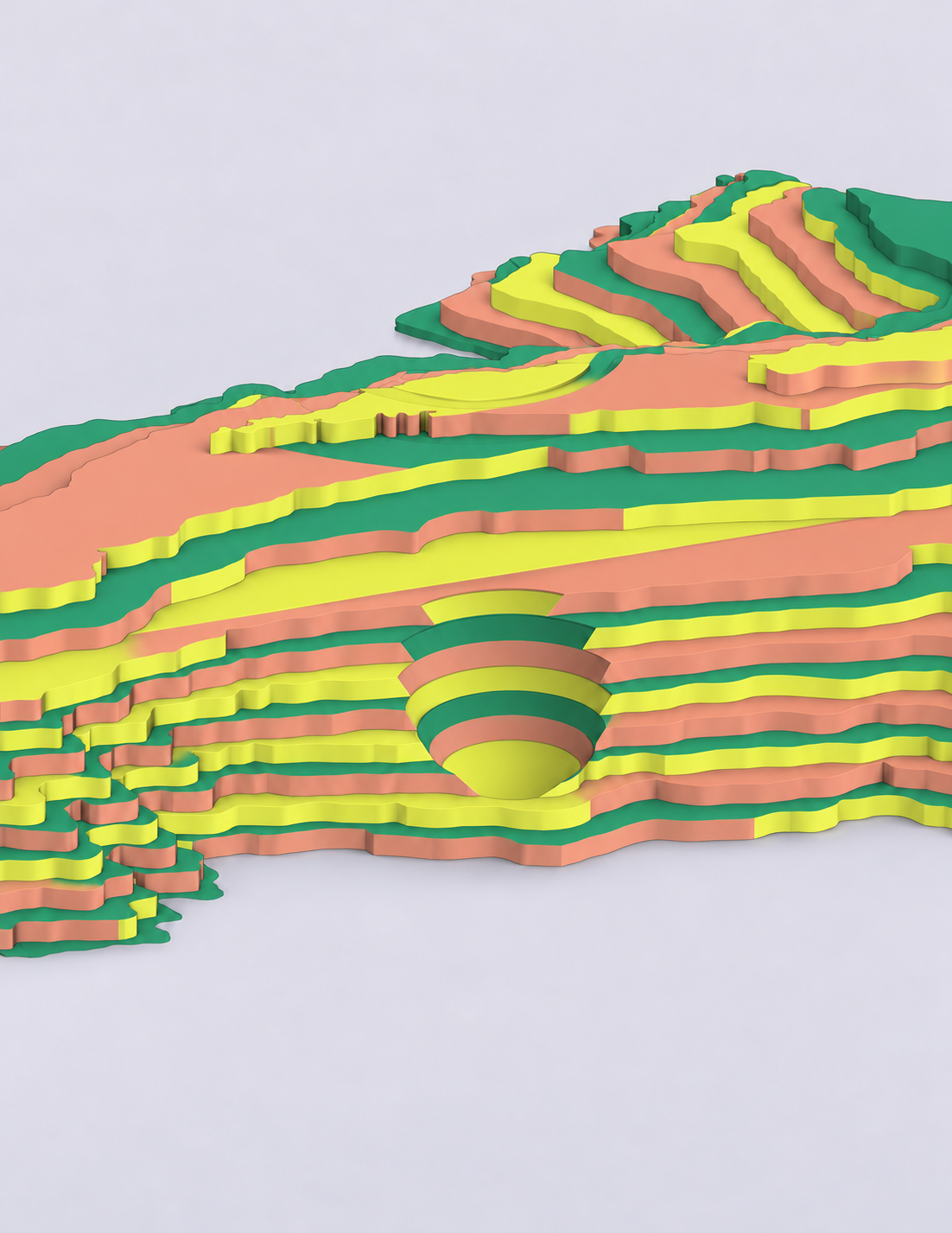
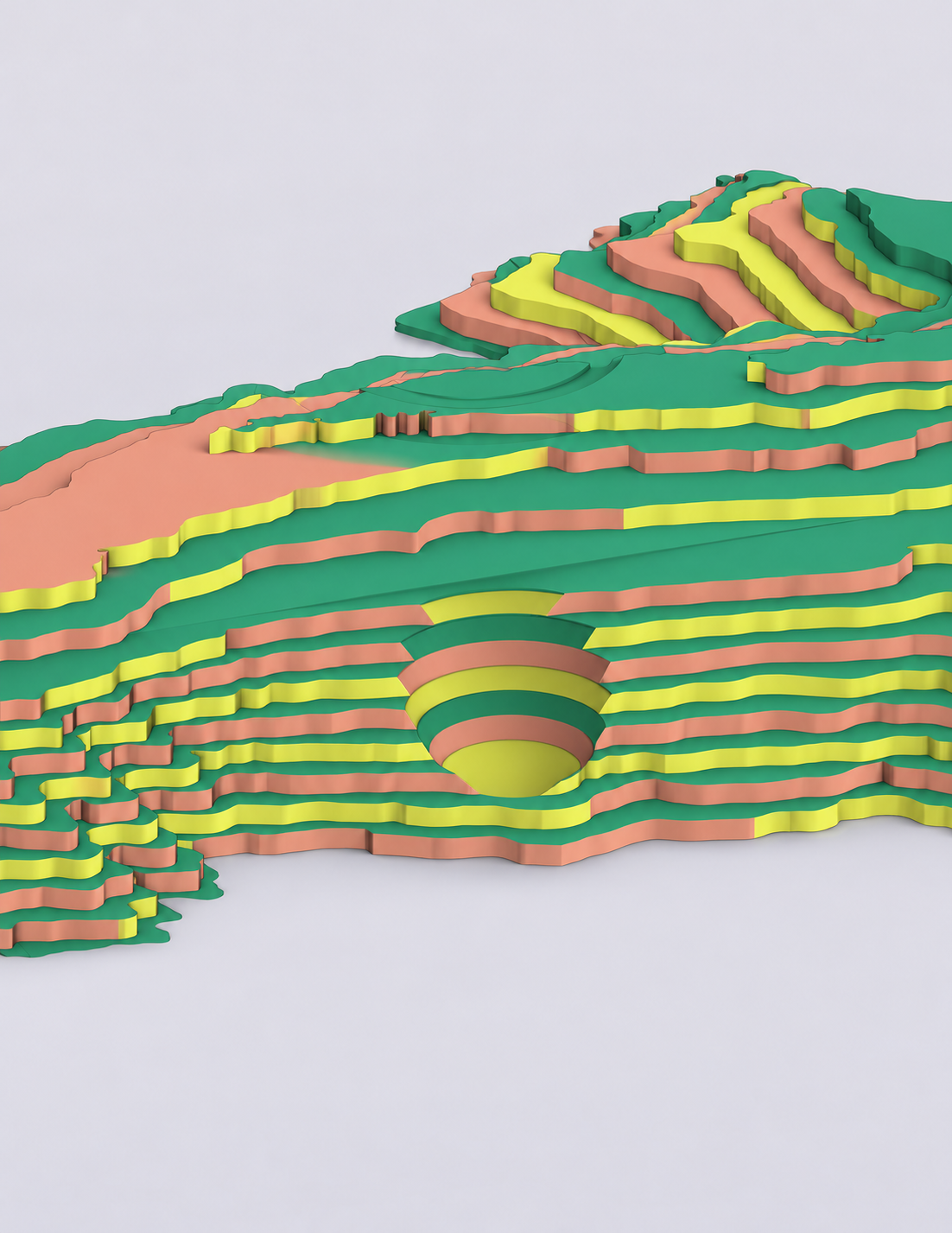
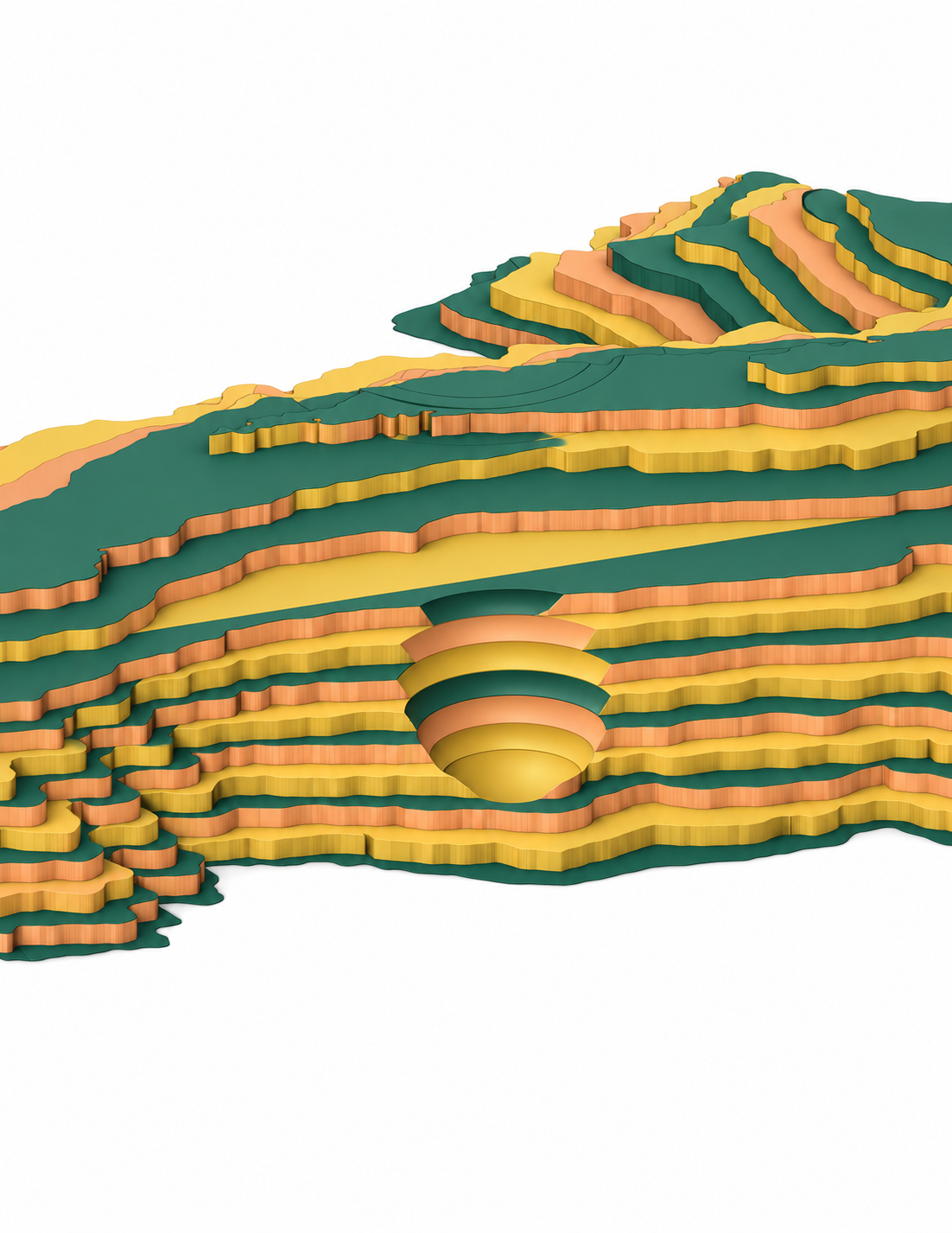
I made more than five attempts using more than two tools. None of those attempts achieved the precision I needed. The images offered convincing volume, soft lighting and attractive colours, but following the surfaces revealed errors in colour distribution and continuity.
The following three images document experimental results that were not accepted as finished work. They show the difference between an image that looks convincing at a distance and geometry that remains coherent under close inspection.
Knowing where a surface ends
When I examine the results, I follow each layer from one point to another. Has it retained its colour? Does the colour on its edge belong to the same surface? What happened as it entered the cut? These questions determine whether the colouring has succeeded.
In the three-dimensional model, I can return to the geometry and verify a surface’s boundaries. An image compresses that information into a single perspective: some parts conceal others, shadows can resemble boundaries, and neighbouring surfaces may appear connected. In the trials shown here, automated image processing did not preserve all these relationships.
This is a finding from a particular experiment, with particular tools and inputs. In practical terms, it showed me that accelerating the colouring process requires a method that keeps colour attached to the correct surface, together with a review of the details on which the work depends.
What gives TopoArtic its character?
TopoArtic’s distinctiveness develops through a complete process: data gives the terrain its structure, cutting decisions reshape its presence, and colour guides the eye through it. Bringing these elements together requires geometric understanding and artistic judgement at the same time. A surface may be correctly modelled yet need a different colour decision to fulfil its role within the composition.
As I develop the 2026 works, I return to this process to test new possibilities and review each layer in relation to the whole. In this experiment, manual work within the digital model remained the means of achieving the control I needed. The value of that effort becomes visible in the continuity of the small details that hold the larger image together.
I want TopoArtic to offer an experience that unfolds gradually. Colour draws you in first; the layers lead you towards the cut, and the shadows invite you to reconsider the depth. Returning to the work, you notice a relationship that was not apparent at first glance. That distance between what you see immediately and what you discover through attention is what I continue to explore.
Explore the TopoArtic series and its works on the project page.