INJ Architects Launches URBEXA: AI, Employment and the Future of Cities
INJ Architects has launched URBEXA, a research and urban foresight project examining the relationship between artificial intelligence, automation-driven changes in work, and the consequences that may later appear in housing, real estate, and urban planning.
The research team began developing the study in early summer 2026 around a question that is no longer merely technical or occupational: if the jobs supporting a city change, what happens to the homes, neighbourhoods, employment districts, and services organised around them?
URBEXA combines three terms: URBan + EXpert + AI. The name reflects an attempt to bring the city, human expertise, and artificial intelligence into one framework rather than study automation in isolation from the places where workers live and households spend their income.
Three Transitions Inside One Question
The study connects three processes often discussed separately. The first is the expansion of AI across production and services. The second is the reorganisation of work: some tasks contract, others emerge, and job titles and skill requirements change even when a person remains employed. The third is the spatial effect of those changes on housing affordability, property demand, commuting, office use, and the distribution of services across a city.
URBEXA does not assume that every occupation exposed to automation will disappear, or that every affected worker will leave a city. One person may remain employed and become more productive. Another may move into an adjacent occupation after training. A third may lose income yet be unable to afford relocation. Similar technical exposure can therefore produce very different urban outcomes.
Housing Pressure May Precede Population Change
The project’s central exploratory result is that housing pressure may emerge before population totals change. A household can remain in the same home and city while its purchasing power or income security declines. Housing then consumes a larger share of the budget, spending on local services contracts, household formation is postponed, or demand shifts toward smaller and less expensive dwellings.
The model presents a transparent illustration: if disposable household income falls by 20% while housing costs remain unchanged, housing rises from 30% to 37.5% of the household budget. This is not an observed AI effect or a forecast for a particular market. It demonstrates how an income shock can reach housing before migration occurs or property prices change.
History Does Not Repeat in One Direction
The research design reviews earlier technological transitions: agricultural change and mechanisation, industrialisation, steam and electricity, the reorganisation of production, and later computerisation, robotics, the internet economy, and the dot-com boom. These episodes are not used to claim that AI will reproduce one historical outcome. They help identify why technology has different effects depending on skills, institutions, infrastructure, adoption speed, and the ability of people to adapt or move.
Some technologies displaced labour, some increased demand or created new occupations, and others redistributed economic activity between regions and cities. URBEXA therefore treats history as a set of mechanisms and testable questions, not as a ready-made map of the future.
A Multi-Layered Evidence Base
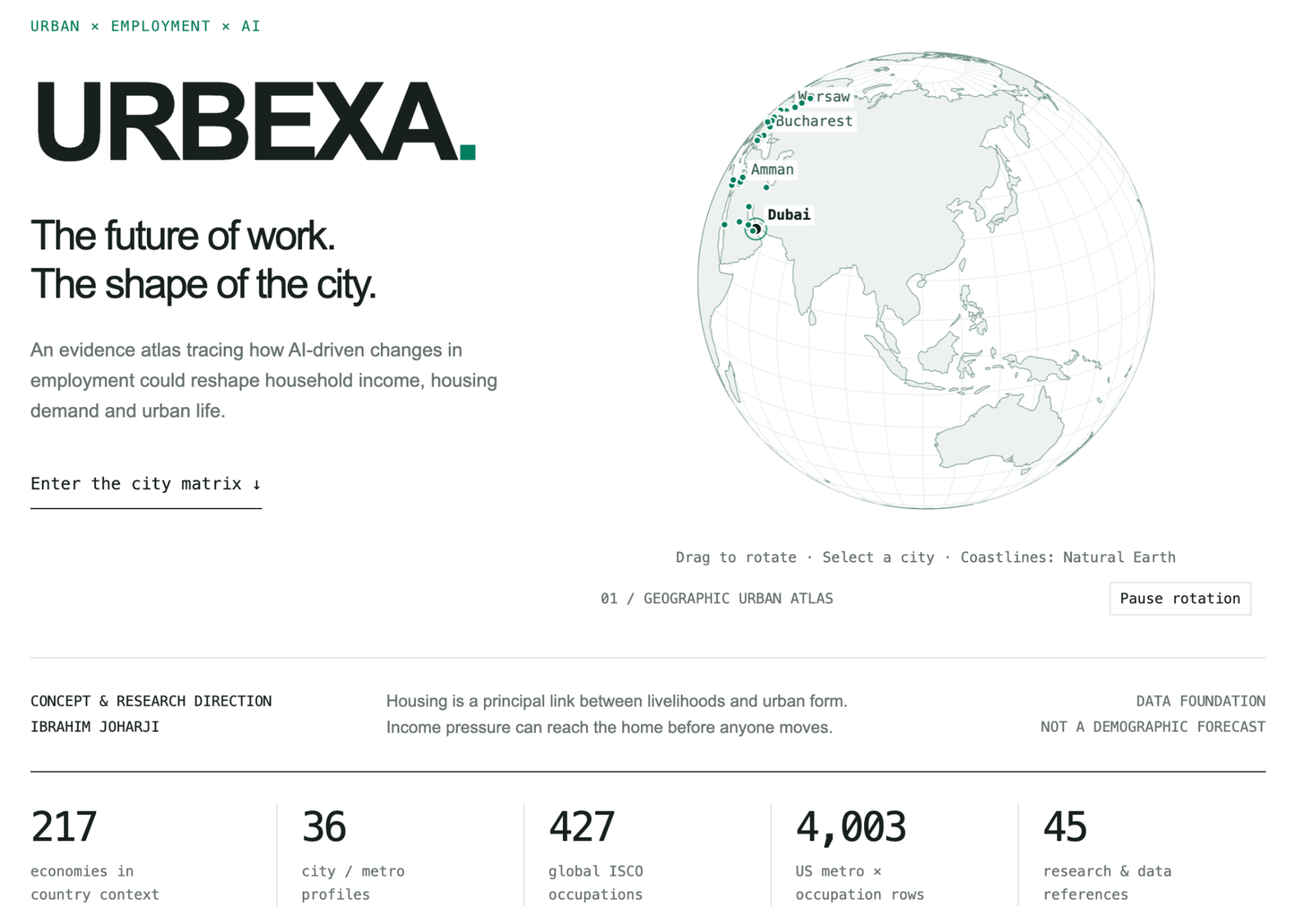
The current research edition contains 36 urban profiles: 18 European cities, six US metropolitan labour-market benchmarks, and 12 Middle East urban centres. It adds an economic context covering 217 reporting economies, an occupational reference spanning 427 occupations, 4,003 detailed metropolitan occupation and wage records in the United States, and 45 research and data references.
The project deliberately refuses to collapse these layers into one promotional score. National export statistics are not local jobs. Exposure to automatable tasks is not a direct probability of job loss. A workplace recorded inside a metropolitan area does not always mean that its worker lives within the same boundary. The database therefore preserves geographic definitions, reference years, missing values, and the limits of each source.
Not a List of Losing Cities
URBEXA is not a global census, a validated vulnerability index, a demographic forecast, or a map of AI-attributable migration. Its interactive tools allow users to test visible assumptions about changes in work, local re-employment, potential mobility, and household budget pressure. The outputs are conditional scenarios, not predictions hidden behind a digital interface.
These limits are part of the project’s value. The aim is not to produce a dramatic ranking of cities that will grow or disappear, but to establish an instrument that can improve as occupational, household, income, and mobility data become more detailed and comparable.
From Economic Change to Urban Decisions
The study becomes useful when economic questions are translated into spatial decisions. Which dwelling sizes and tenure types may households need during occupational transition? Where should retraining be located? Can office buildings adapt to new working patterns? Which neighbourhoods require transport and services capable of responding to changing employment geographies? How should receiving cities prepare if demand moves rather than disappears?
Some cities may need more flexible housing, adaptive reuse of administrative buildings, different distributions of workspace, or stronger protection for households losing income without moving. Others may continue to grow because AI raises productivity or creates new demand for human expertise. Anticipatory planning begins by recognising these opposing pathways rather than assigning one result to every city.
Foresight, Not Prophecy
URBEXA provides a framework for tracing how changes in work may pass through the household and into property and the city. It is an invitation to bring urban planning into the AI discussion early, rather than waiting until changes in income, housing, and building use have become difficult realities.
The study will remain open to revision as data improves and observed evidence of adoption and occupational transition becomes available. In its current edition, it offers a documented foundation and an open scenario instrument that keeps every assumption visible to the user.
Explore the URBEXA project, interactive evidence atlas, and full study.