
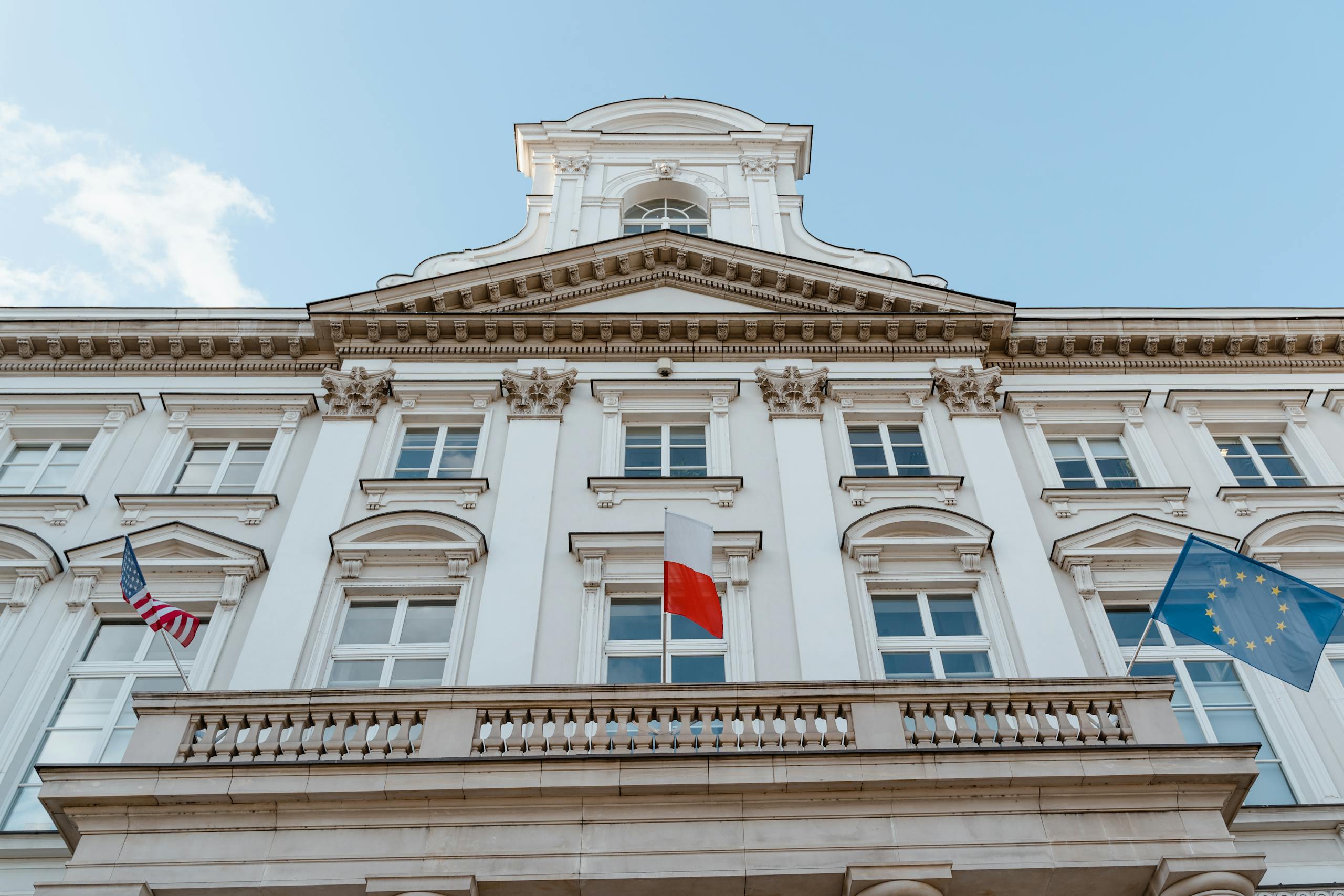
The Difference Between an Embassy, a Consulate, and an Attaché Office: Functions and Architectural Reflections
Embassies, consulates, and attaché offices all represent a country beyond its borders, but they do not perform the same role. Each institution has a different political function, operational structure, level of public access, and set of architectural requirements.
An embassy is the principal diplomatic mission and usually manages political relations between governments. A consulate focuses more directly on citizens, visas, regional affairs, and commercial services. An attaché office, meanwhile, handles a specialised field such as culture, education, defence, health, or trade.
These differences are not only administrative. They shape where each institution is located, who enters the building, how security is organised, how movement is separated, and how national identity is expressed through architecture.
The Difference in Brief
An embassy is the main political and diplomatic mission of a country and is normally located in the host nation’s capital.
A consulate provides services to citizens, travellers, and businesses, and is often located in major cities outside the capital.
An attaché office is a specialised diplomatic unit working in a defined field, usually under the authority of an embassy.
Embassy vs Consulate vs Attaché Office
| Aspect | Embassy | Consulate | Attaché Office |
|---|---|---|---|
| Typical location | Capital city of the host country | Major commercial or regional cities | Inside an embassy or in a nearby independent office |
| Head | Ambassador | Consul General or Consul | Specialised Attaché |
| Main role | Political and diplomatic relations | Citizen services, visas, and regional affairs | Specialised diplomatic cooperation |
| Typical users | Officials, diplomats, and formal delegations | Citizens, residents, travellers, and companies | Students, cultural institutions, defence officials, or sector specialists |
| Architectural character | Formal, symbolic, and highly secured | Service-oriented, accessible, and operationally efficient | Compact, specialised, and purpose-driven |

What Is an Embassy?
An embassy is the principal diplomatic representation of one country within another. It is normally located in the host country’s capital so that it can remain close to the government, ministries, and central institutions.
The embassy is led by an ambassador, who is the highest-ranking official representative of the sending state. The ambassador manages political relations, reports on developments in the host country, supports strategic interests, and communicates directly with the host government.
Main Functions of an Embassy
- Represents the state before the government of the host country.
- Manages political and diplomatic communication.
- Supports negotiations, agreements, and bilateral relations.
- Coordinates positions on regional and international issues.
- Supervises consulates and attaché offices where applicable.
- Promotes economic, cultural, and strategic cooperation.
- Protects the broader interests of the sending country abroad.
How Does the Embassy’s Role Affect Its Architecture?
An embassy combines political representation, administration, formal reception, security, and sometimes residential or hospitality functions. Its architecture must therefore accommodate several layers of access and authority.
Typical requirements may include separate entrances for staff, visitors, and official delegations; controlled security zones; formal reception rooms; meeting spaces; protected communication areas; and sufficient setbacks or perimeter measures around the building.
The architectural value of an embassy does not come from size or monumentality alone. It comes from the ability to represent national identity while remaining functional, secure, and appropriately connected to the host city.
What Is a Consulate?
A consulate is an official mission focused primarily on citizens, travellers, companies, and regional affairs. It may be located in a capital, but consulates are often established in major cities, ports, commercial centres, or areas with a significant population from the sending country.
A consulate is led by a consul general or consul and usually operates within a defined geographic district. Its work is more public-facing and service-oriented than that of an embassy.
Main Functions of a Consulate
- Issues visas, passports, and consular documents.
- Assists citizens in emergency situations.
- Supports cases involving lost documents, detention, illness, or death.
- Authenticates certain documents and legal transactions.
- Promotes trade, investment, tourism, and regional cooperation.
- Communicates with local authorities within its consular district.
- Supports seasonal missions, visitors, or large delegations when required.
How Is a Consulate Different Architecturally?
A consulate often receives a much larger number of daily visitors than an embassy. This makes circulation, waiting areas, service counters, queuing, screening, and operational efficiency central to the design.
The building must clearly separate public areas from staff offices, document-processing spaces, secure zones, and back-of-house functions. Entrance control should remain effective without making the visitor experience unnecessarily difficult.
A consulate is not a less important version of an embassy. It is a different kind of institution. Its architecture must balance public accessibility with security, while maintaining an appropriate level of national representation.
What Is an Attaché Office?
An attaché office is a specialised diplomatic unit responsible for a specific field that falls outside the general political work of the embassy or the public-service role of the consulate.
Depending on the country and the size of the mission, an attaché office may operate within the embassy compound or from an independent building.
Common Types of Attaché Offices
- Cultural Attaché: supports the arts, language, heritage, and cultural exchange.
- Educational Attaché: manages student affairs, scholarships, and academic cooperation.
- Military Attaché: coordinates defence relations and security cooperation.
- Commercial Attaché: promotes trade, investment, and business relations.
- Health Attaché: supports medical cooperation and healthcare-related matters.
- Media Attaché: manages public communication and media relations.
Architectural Requirements of Attaché Offices
The design of an attaché office depends on the nature of its work. A cultural attaché may require exhibition rooms, a library, or spaces for events. An educational attaché may need student reception areas, counselling rooms, and meeting spaces. A military attaché may require a higher level of privacy and security.
There is therefore no single architectural model for all attaché offices. The programme must respond to the number of staff and visitors, the level of confidentiality, the operational workflow, and the type of institutional activity involved.
What Is the Difference in Authority Between an Embassy and a Consulate?
An embassy is the principal political mission and represents the state before the host government. A consulate usually operates within a defined regional or service-based jurisdiction and works under the broader diplomatic framework of the embassy.
This does not make the consulate secondary in practical importance. The embassy manages political relations at the national level, while the consulate is often the institution most directly experienced by citizens, travellers, and businesses.
Diplomatic Architecture: More Than an Administrative Building
Diplomatic architecture combines national representation, security, public service, cultural sensitivity, and operational complexity. The architect must consider the building not only as an office, but also as a public institution, a protected workplace, and a physical expression of the sending country.
The priorities vary according to the mission. An embassy places greater emphasis on formal representation and political security. A consulate requires efficient public service and controlled access. An attaché office needs specialised spaces that reflect its particular programme.
Common architectural considerations include:
- Separating public, staff, service, and official circulation.
- Creating different levels of security within the building.
- Designing screening areas without disrupting daily operations.
- Protecting documents, information, and sensitive spaces.
- Accommodating official delegations and seasonal visitor peaks.
- Representing national identity within the cultural context of the host country.
- Responding to climate, energy use, maintenance, and long-term durability.
A Practical Example: The Indonesian Consulate General in Jeddah
These principles can be seen in the Indonesian Consulate General project in Jeddah, developed by INJ Architects as both a diplomatic and operational building.
The project was not conceived as a conventional office. It had to support daily consular work, official visitors, staff functions, and activities connected to the Indonesian mission in Saudi Arabia, while maintaining clear levels of security, privacy, and controlled movement.
The internal organisation was developed around the separation of public visitors, employees, official guests, and service functions. Waiting areas, access routes, control points, and operational zones were considered as part of one coordinated system.
The architectural identity also addressed the relationship between Jeddah’s local context and Indonesian cultural references. Patterns inspired by batik were incorporated into the building envelope as elements of shading and privacy rather than being treated as applied decoration.
The project demonstrates that diplomatic architecture succeeds when symbolism, security, public service, climate response, and daily operation are resolved together.
Frequently Asked Questions
Is an embassy more important than a consulate?
An embassy holds the principal political and diplomatic role, while a consulate concentrates on citizen services and regional affairs. They have different responsibilities rather than simply different levels of importance.
Can a consulate exist without an embassy?
In some circumstances, a consular mission may operate independently or before full diplomatic relations are established. In most cases, however, a consulate works within the diplomatic framework led by an embassy.
Does a consulate issue visas?
Yes. Visa processing is one of the most common consular functions, along with passports, legal documents, and assistance to citizens abroad.
Is an attaché office part of an embassy?
Usually, yes. An attaché office normally operates under the diplomatic authority of the embassy, although it may be located in a separate building.
What is the difference between a consul and a consul general?
A consul general usually leads a consulate general with a larger jurisdiction, wider range of services, and more staff. A consul may head a smaller post or work within a larger consular mission.
Why do diplomatic buildings require specialised design?
They combine public service, official representation, staff operations, secure information, controlled access, and multiple levels of privacy. These requirements make them more complex than standard administrative buildings.
Conclusion
An embassy, a consulate, and an attaché office are not different names for the same institution. An embassy manages political relations and represents the state before the host government. A consulate focuses on citizens, travellers, businesses, and regional affairs. An attaché office specialises in a defined field such as education, culture, defence, or health.
These differences are visible in architecture. Embassies require formal representation, controlled access, and heightened security. Consulates require efficient public circulation and service areas. Attaché offices require specialised spaces shaped by their programme.
Diplomatic architecture is therefore one of the most complex building types. It brings politics, security, public service, cultural identity, and everyday operation together within a single architectural system.
To see how these principles were applied in practice, explore the Indonesian Consulate General in Jeddah, or browse the projects of INJ Architects.
Read also: The Top 5 Retrofit Techniques for Green Buildings.



One Comment
Comments are closed.