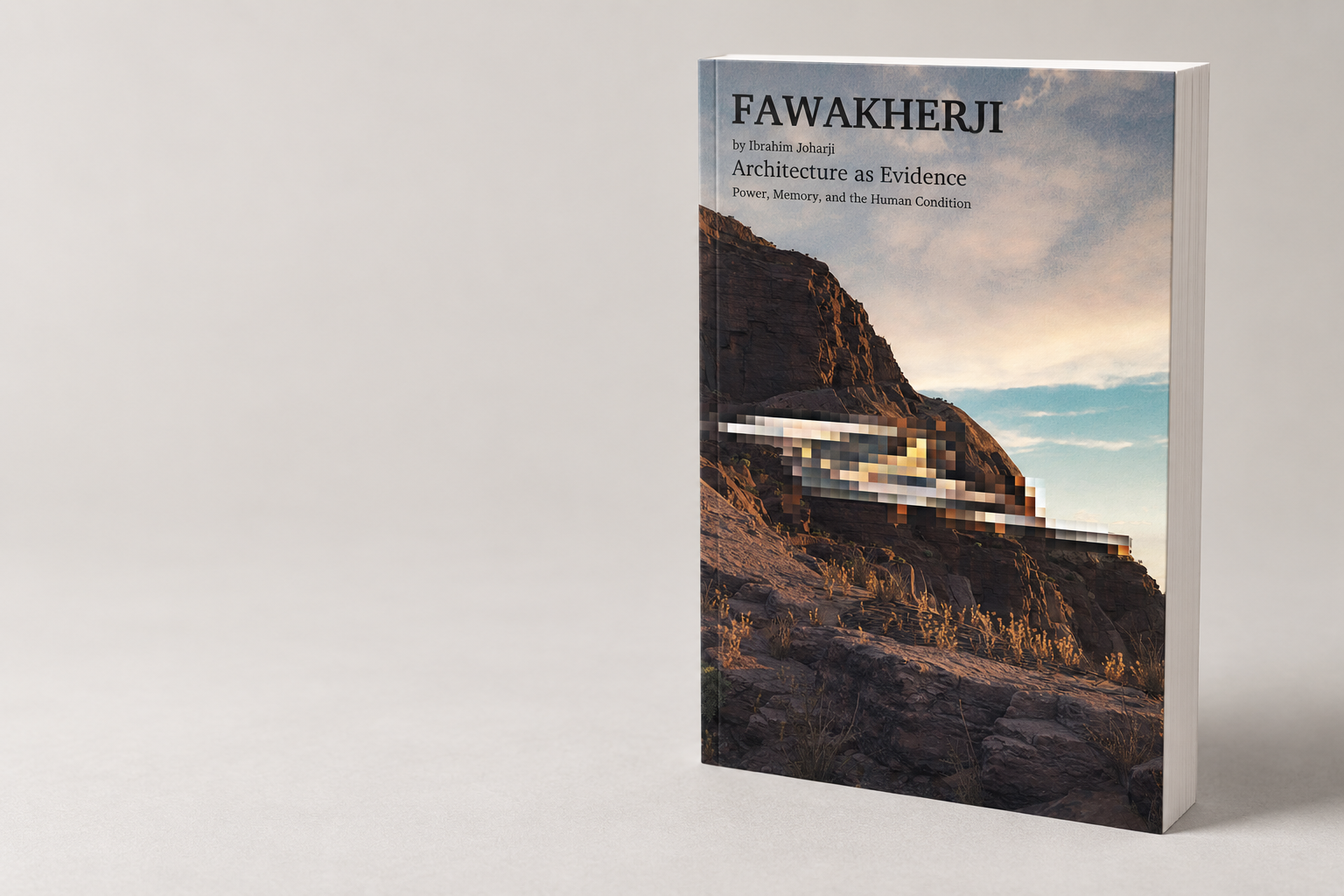
An Early Reading of FAWAKHERJI: Architecture as Evidence by Ibrahim Joharji
Ahead of the publication of FAWAKHERJI: Architecture as Evidence — Power, Memory, and the Human Condition, the INJ Architects editorial team was given access to the complete pre-publication manuscript.
The book is neither a conventional work of architectural theory nor a professional memoir. It is a collection of essays that approaches buildings, cities, and ordinary objects as evidence: physical traces through which questions of power, labor, memory, and human behavior can be examined.
This premise gives the collection a clear degree of coherence despite the range of subjects it addresses. Joharji moves between the house, the workplace, the city, Makkah, the archive, and technology, while repeatedly returning to essentially the same question: What can the built environment tell us about the people and institutions that produced it?
One of the manuscript’s strengths is that it is written from within architectural practice. The author is not observing the profession entirely from outside; his arguments frequently draw upon years of dealing with clients, contractors, construction sites, documents, and details that rarely enter published architectural narratives.
This becomes particularly evident when the book turns toward Makkah, personal memory, and archival material. Here, the architect’s own experience intersects with the transformation of the city, allowing photographs, drawings, and earlier documents to operate not merely as records but as instruments for reading urban change.
The collection is not equally resolved in every essay. Certain arguments could be tighter, and some neighboring subjects overlap more than necessary. These are nevertheless editorial observations rather than structural problems. The manuscript retains a recognizable voice and a central proposition that can be followed throughout.
What makes FAWAKHERJI interesting is therefore less an attempt to establish a new architectural theory than a proposal for how architecture might be read. Buildings are treated not simply as objects to be judged formally or functionally, but as documents carrying the residue of the economic, social, and professional decisions that produced them.
As the book approaches publication, this may be the most useful way to enter it: architecture not as the end of the story, but as the evidence the story leaves behind.
This early review was prepared by the INJ Architects editorial team after reading a pre-publication copy of the complete manuscript. Ibrahim Joharji is the founder and Design Principal of INJ Architects.